Search

Gibco™
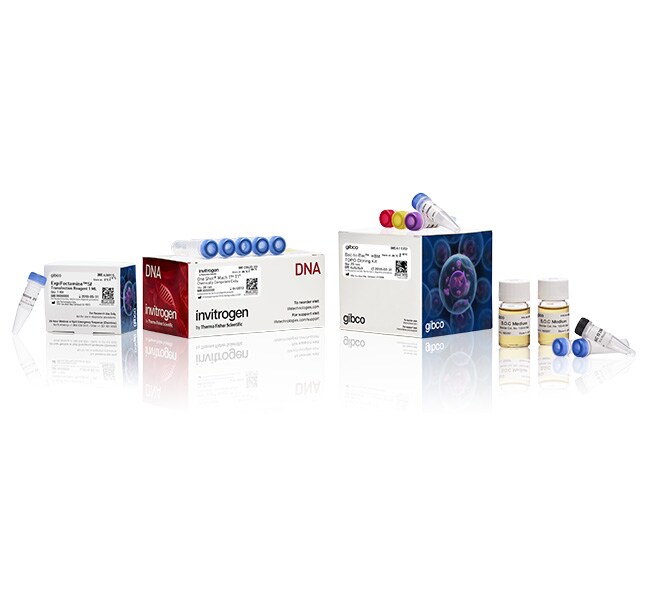
Bac-to-Bac™ HBM TOPO™ Secreted Expression System
Bac-to-Bac baculovirus expression is an efficient method for producing baculovirus for high-level protein expression in insect cells. It relies onRead more
| Catalog Number | Quantity |
|---|---|
| A11339 | 20 Reactions |
Catalog number A11339
Price (CNY)
-
Quantity:
20 Reactions
Bac-to-Bac baculovirus expression is an efficient method for producing baculovirus for high-level protein expression in insect cells. It relies on generation of recombinant virus by site-specific transposition in E. coli rather than homologous recombination in insect cells. The pFastBac HBM TOPO expression system features:
• Expression of secreted proteins—The Bac-to-Bac HBM TOPO vector contains the honeybee melittin (HBM) secretion signal to enable secreted protein expression. Because glycoproteins cannot be glycosylated in the absence of a secretion signal, this vector is recommended for the expression of glycoproteins.
• Flexibility—The Bac-to-Bac HBM TOPO vector contains a C-terminal His-tag with a TEV cleavage site to enable easy purification of His-tagged proteins with nickel-chelating resins (such as the Invitrogen ProBond Purification System) and generation of native proteins with the aid of the Invitrogen AcTEV Protease.
• Fast cloning, easy screening—Blunt TOPO cloning technology enables cloning of blunt-end PCR products into the pFastBac TOPO vector in five minutes. In addition, the pFastBac TOPO expression kit is supplied with Mach1-T1R E. coli that enable the visualization of colonies eight hours after plating on ampicillin-selective plates due to their faster doubling time compared to other standard cloning strains. Find out more about the advantages of TOPO cloning ›
• High transfection efficiency with ExpiFectamine Sf Transfection Reagent—The Bac-to-Bac TOPO expression kits now come with the next-generation ExpiFectamine Sf Transfection Reagent for efficient DNA transfection in insect cells using fast, flexible protocols. Find out more about this reagent ›
• Time-saving expression bacmid—With the Bac-to-Bac system, the expression cassette of the pFastBac vector recombines with the parent bacmid in DH10Bac E. coli Competent Cells to form an expression bacmid. The bacmid is then transfected into insect cells for production of recombinant baculovirus particles.
• Easy colony screening—The parent bacmid in DH10Bac E. coli contains a segment of the lacZa gene. The lacZa gene is disrupted upon transposition of the expression cassette into the bacmid, allowing for blue/white selection of recombinants for easier identification of recombinant colonies.
• High protein expression—The pFastBac vector uses the strong polyhedrin promoter to generate high levels of expression in a variety of insect cell line such as Sf9, Sf21, and High Five cells.
• Expression of secreted proteins—The Bac-to-Bac HBM TOPO vector contains the honeybee melittin (HBM) secretion signal to enable secreted protein expression. Because glycoproteins cannot be glycosylated in the absence of a secretion signal, this vector is recommended for the expression of glycoproteins.
• Flexibility—The Bac-to-Bac HBM TOPO vector contains a C-terminal His-tag with a TEV cleavage site to enable easy purification of His-tagged proteins with nickel-chelating resins (such as the Invitrogen ProBond Purification System) and generation of native proteins with the aid of the Invitrogen AcTEV Protease.
• Fast cloning, easy screening—Blunt TOPO cloning technology enables cloning of blunt-end PCR products into the pFastBac TOPO vector in five minutes. In addition, the pFastBac TOPO expression kit is supplied with Mach1-T1R E. coli that enable the visualization of colonies eight hours after plating on ampicillin-selective plates due to their faster doubling time compared to other standard cloning strains. Find out more about the advantages of TOPO cloning ›
• High transfection efficiency with ExpiFectamine Sf Transfection Reagent—The Bac-to-Bac TOPO expression kits now come with the next-generation ExpiFectamine Sf Transfection Reagent for efficient DNA transfection in insect cells using fast, flexible protocols. Find out more about this reagent ›
• Time-saving expression bacmid—With the Bac-to-Bac system, the expression cassette of the pFastBac vector recombines with the parent bacmid in DH10Bac E. coli Competent Cells to form an expression bacmid. The bacmid is then transfected into insect cells for production of recombinant baculovirus particles.
• Easy colony screening—The parent bacmid in DH10Bac E. coli contains a segment of the lacZa gene. The lacZa gene is disrupted upon transposition of the expression cassette into the bacmid, allowing for blue/white selection of recombinants for easier identification of recombinant colonies.
• High protein expression—The pFastBac vector uses the strong polyhedrin promoter to generate high levels of expression in a variety of insect cell line such as Sf9, Sf21, and High Five cells.
For Research Use Only. Not for use in diagnostic procedures.
Specifications
Cloning MethodBlunt TOPO™
Expression MechanismCell-Based Expression
Product LineBac-to-Bac, TOPO
Protein TagHis Tag (6x)
Quantity20 Reactions
Selection Agent (Eukaryotic)None
Expression SystemBaculovirus
PromoterPolyhedrin
TypePichia Protein Expression System
Unit SizeEach
Contents & Storage
Bac-to-Bac HBM TOPO Secreted Expression System:
• Vector kit for 20 TOPO cloning reactions, store at -20°C
–pFastBac/HBM-TOPO Vector containing C-terminal TEV cleavage site and His-tag
–pFastBac 1-Gus control plasmid (control expression vector)
–Other kit reagents: 10X PCR, dNTP mix, Salt solution, sterile water, control PCR template, polyhedrin forward primer, SV40 pA reverse primer
• One Shot Mach1-T1R Chemically Competent E. coli for 20 reactions (20 x 50 μL), store at -80°C
• MAX Efficiency DH10Bac Competent E. coli for 20 reactions (4 kits with 5 x 0.1 mL each), store at -80°C
• ExpiFectamine Sf Transfection Reagent (1 mL), store at 4°C, do not freeze
• Vector kit for 20 TOPO cloning reactions, store at -20°C
–pFastBac/HBM-TOPO Vector containing C-terminal TEV cleavage site and His-tag
–pFastBac 1-Gus control plasmid (control expression vector)
–Other kit reagents: 10X PCR, dNTP mix, Salt solution, sterile water, control PCR template, polyhedrin forward primer, SV40 pA reverse primer
• One Shot Mach1-T1R Chemically Competent E. coli for 20 reactions (20 x 50 μL), store at -80°C
• MAX Efficiency DH10Bac Competent E. coli for 20 reactions (4 kits with 5 x 0.1 mL each), store at -80°C
• ExpiFectamine Sf Transfection Reagent (1 mL), store at 4°C, do not freeze