Search

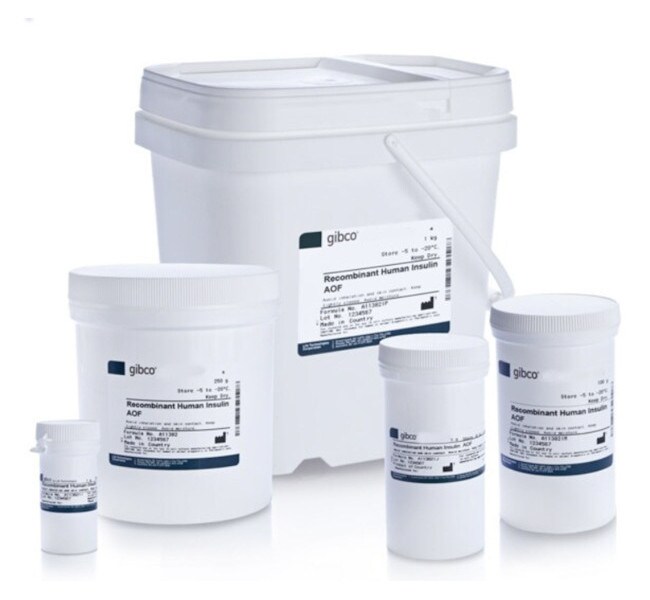
Gibco™
Recombinant Human Insulin AOF
Boost your bioproduction with Gibco Recombinant Human Insulin AOF, a high-purity, animal origin-free insulin designed for CHO, HEK293, and stem cell systems. Achieve consistent performance, regulatory confidence, and scalable productivity from lab to commercial scale.
Have Questions?
Change view

| Catalog Number | Quantity |
|---|---|
| A11382IJ | 5 g |
| A11382II | 1 g |
Catalog number A11382IJ
Price (CNY)
-
Quantity:
5 g
Gibco Recombinant Human (rHu) Insulin AOF is a high-purity, animal origin–free insulin supplement trusted by our scientists and validated through years of internal process development. Designed for advanced cell culture and bioproduction, it enables consistent, USP/EP regulatory-compliant performance in serum-free and chemically defined media.
Manufactured to Gibco quality standards, this insulin supports reliable, high-yield production of monoclonal antibodies, vaccines, viral vectors, recombinant proteins, and stem cell systems, helping ensure optimal performance from development through commercial scale.
Features of Gibco rHu Insulin AOF include:
- Supports cell growth and productivity across CHO, HEK293, Hybridoma, VERO, and stem cell systems
- Manufactured using a fully animal origin–free (AOF), GMP-compliant process to align with USP and EP regulatory expectations and minimize contamination sources
- Designed to promote lot-to-lot consistency, supporting reproducible bioproduction results
- Enables efficient scale-up with globally validated supply assurance and adherence to GMP principles.
- Adaptable to your process needs with customizable volumes and flexible packaging options
Gibco rHu Insulin AOF is produced using advanced recombinant DNA technology, helping ensure exceptional purity, performance stability, and elimination of animal-derived materials. It meets USP and EP grade standards, aligning with global regulatory expectations for therapeutic and vaccine manufacturing.
Validated over years by our media development teams, Gibco rHu Insulin AOF is manufactured under the same stringent Gibco quality and testing standards trusted by scientists globally. Its reliable global supply chain, documented traceability, and scalable production formats make it a low-risk, high-performance option for modern bioproduction without the complexities associated with animal-origin (AO) materials.
Bring Gibco validated performance into your own bioprocess. Contact us to learn how our high-value Gibco rHu Insulin AOF can help enhance your productivity and reduce process risk compared to AO-derived.
As a critical growth factor, insulin regulates glucose uptake and metabolism to promote strong cell viability, growth, and protein expression in serum-free and chemically defined systems. It is ideal for bioreactor-based antibody production (CHO, HEK, NS0, Hybridoma and myeloma cells), viral vector manufacturing (HEK293, VERO), and stem cell expansion, where consistency, purity, and low contamination risk are key.
For Research Use or Further Manufacturing. Not for diagnostic use or direct administration into humans or animals.
Specifications
CAS11061-68-0
Certifications/ComplianceUSP, EP
Endotoxin Level<10 EU/mg, <0.1 EU/mL in a 10 mg/L Solution
Manufacturing QualityGMP
Molecular Weight (g/mol)5807.57
Purity95-105%
Purity or Quality GradeUSP, EP; AOF
Quantity5 g
Reactivity≥27.5 U/mg
Shelf Life3 Years
Solubility>10 g/L at pH 2 to 2.5 and <1 g/L at pH 7
Stem Cell QualifiedYes
Tested ForBioproduction of mABs, viral particles and cell expansion
FormPowder
Product TypeInsulin
SterilityNon-sterile
Unit SizeEach