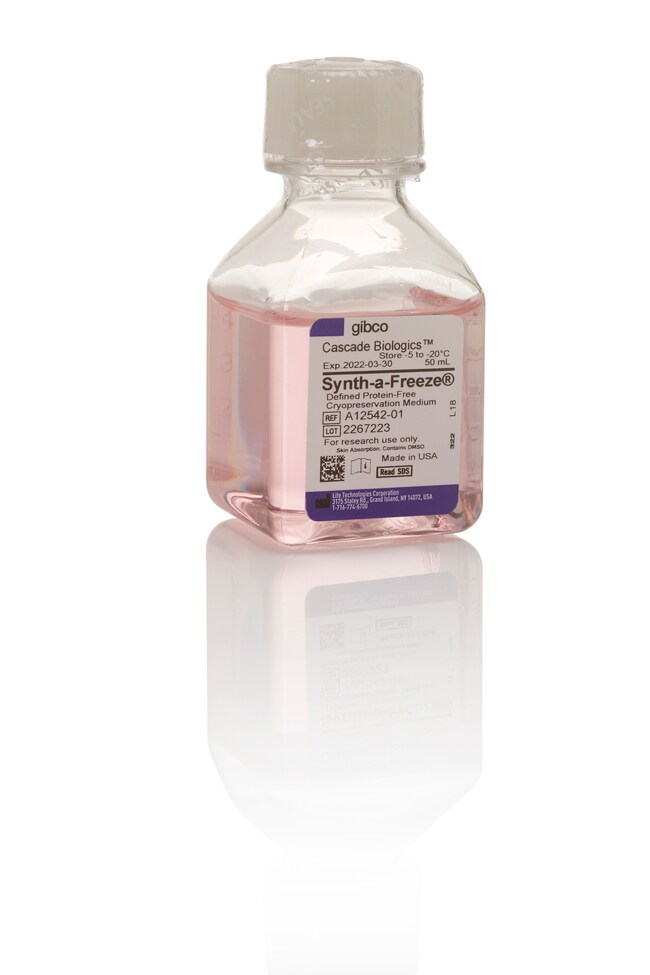
If the Synth-a-Freeze Cryopreservation Medium is not suitable for melanocytes, how should I freeze melanocytes?
We recommend using DMEM plus 10% FBS and 10% DMSO, or the Recovery Cell Culture Freezing Medium. You can try the same general recommendations for freezing cells, just changing the freezing solution.
Find additional tips, troubleshooting help, and resources within our Cell Analysis Support Center.
Is there a Drug Master File for the Synth-a-Freeze Cryopreservation Medium?
There isn't a Drug Master File, but there is a Device Master File on file with the FDA. Please contact our Licensing team at outlicensing@thermofisher.com in order to obtain instructions for referencing this Device Master File.
Find additional tips, troubleshooting help, and resources within our Cell Analysis Support Center.
What can I use Synth-a-Freeze Cryopreservation Medium for?
Synth-a-Freeze Cryopreservation Medium can be used with any standard freezing protocol. It offers performance comparable to that of our standard, serum-containing cryopreservation medium for cyropreserving a variety of cell types including human keratinocytes, embryonic stem cells, neural stem cells, and mesenchymal stem cells.
Find additional tips, troubleshooting help, and resources within our Cell Analysis Support Center.
Was the tissue cryopreserved prior to isolation of primary cells?
No, the tissue was not cryopreserved.
Can I expand your cells and re-freeze them? If so, how?
When either Gibco or Invitrogen cryopreserved or proliferating cultures are purchased from us, they may be expanded and cryopreserved again. However, the cryopreservation process may result in altered growth performance of the cells. The following protocol provides a basic guideline for the cryopreservation of cells using Synth-a-Freeze medium, a defined, protein-free cryopreservation medium available from us.
Please note: Due to differences in cryopreservation equipment and individual techniques, we cannot guarantee that cells cryopreserved using this protocol will be viable upon recovery from cryopreservation, and we do not provide a warranty for cells cryopreserved in an investigator's laboratory.
1. Thaw Synth-a-Freeze medium in a 37 degrees C water bath or overnight at 4 degrees C.
2. If thawed in a water bath, do not exceed 37 degrees C and do not leave the product at 37 degrees C for an extended period of time.
3. Synth-a-Freeze medium should be equilibrated to 4 degrees C prior to use. For optimal results, the use of a controlled-rate freezer is recommended. In the absence of a controlled-rate freezer, a cell cryopreservation container (e.g., Thermo Scientific Mr Frosty container) may be useful.
4. If enzymatic agents are used to remove the cells from a culture surface, resuspend the cells in a solution that will neutralize the effects of the enzyme.
5. Pellet the cells by centrifugation.
6. After removing the supernatant, resuspend the cell pellet in cold Synth-a-Freeze medium at a concentration of 5 x 10E5 to 3 x 10E6 cells/mL.
7. Distribute the cell suspension in an appropriate number of cryopreservation vials.
8. Cool the vials of cells to 4 degrees C as quickly as possible.
9. If using a controlled-rate freezer: freeze the material by reducing the temperature 1degrees C per minute until the temperature reaches -40 degrees C. Then reduce the temperature at a rate of 2 degrees C per minute until the temperature reaches approximately -90 degrees C.
10. If using a cell cryopreservation container: Prepare the container according to the manufacturer's instructions.
For best results we recommend transferring the vials to the vapor phase of a liquid nitrogen storage facility as soon as possible after the cells have reached -80 degrees C.
As a substitute for Synth-a-Freeze medium, the recommended basal medium for the cell type being cryopreserved, supplemented with 10% fetal bovine serum (FBS) and 10% DMSO, may be used. Please note that Synth-a-Freeze medium is NOT recommended for the cryopreservation of human epidermal melanocytes.
Find additional tips, troubleshooting help, and resources within our Cell Culture Support Center.