Search
 Element Search
 Structure Search

Thermo Scientific Chemicals
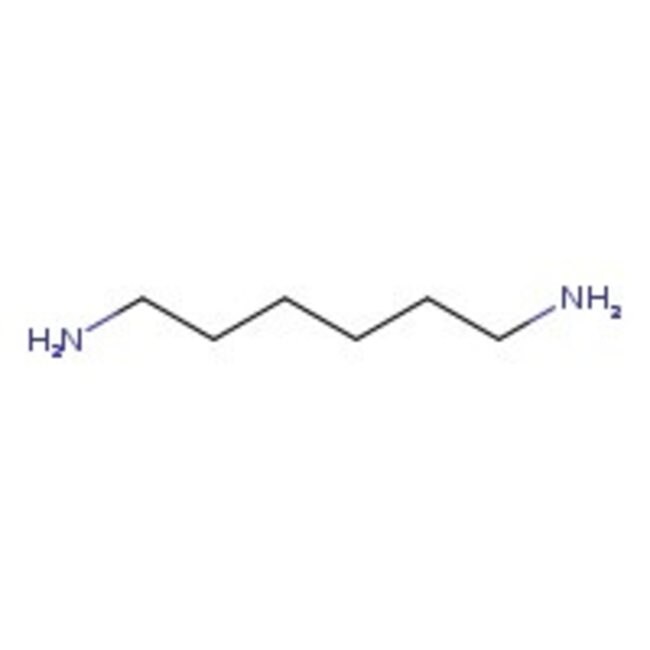
1,6-Diaminohexane, 98+%
CAS: 124-09-4 | C6H16N2 | 116.208 g/mol
| Catalog Number | Quantity |
|---|---|
| A14212.22 also known as A14212-22 | 100 g |



Catalog number A14212.22
also known as A14212-22
Price (CNY)
-
Quantity:
100 g
Chemical Identifiers
CAS124-09-4
IUPAC Namehexane-1,6-diamine
Molecular FormulaC6H16N2
InChI KeyNAQMVNRVTILPCV-UHFFFAOYSA-N
SMILESNCCCCCCN
View more
Specifications Specification Sheet
Specification SheetAppearance (Color)White to cream or pale yellow
FormCrystals or fused solid
Assay (GC)≥98.0%
CommentMay discolor on storage
Identification (FTIR)Conforms
View more
1,6-Diaminohexane is mainly used as a monomer to make nylon 6-6. Its derivative hexamethylene diisocyanate (HDI) is used in the production of polyurethane. It acts as a cross-linking agent in epoxy resins. Other applications include coatings, lubricants and water treatment products.
This Thermo Scientific Chemicals brand product was originally part of the Alfa Aesar product portfolio. Some documentation and label information may refer to the legacy brand. The original Alfa Aesar product / item code or SKU reference has not changed as a part of the brand transition to Thermo Scientific Chemicals.
Applications
1,6-Diaminohexane is mainly used as a monomer to make nylon 6-6. Its derivative hexamethylene diisocyanate (HDI) is used in the production of polyurethane. It acts as a cross-linking agent in epoxy resins. Other applications include coatings, lubricants and water treatment products.
Solubility
Soluble in water. Slightly soluble in ether, alcohol and benzene.
Notes
Air sensitive and hygroscopic. Keep the container tightly closed in a dry and well-ventilated place. Incompatible with acids, strong oxidizing agents, acid chlorides, carbon dioxide and acid anhydrides.
1,6-Diaminohexane is mainly used as a monomer to make nylon 6-6. Its derivative hexamethylene diisocyanate (HDI) is used in the production of polyurethane. It acts as a cross-linking agent in epoxy resins. Other applications include coatings, lubricants and water treatment products.
Solubility
Soluble in water. Slightly soluble in ether, alcohol and benzene.
Notes
Air sensitive and hygroscopic. Keep the container tightly closed in a dry and well-ventilated place. Incompatible with acids, strong oxidizing agents, acid chlorides, carbon dioxide and acid anhydrides.
RUO – Research Use Only
General References:
- Machida, H.; Yamada, H.; Fujioka, Y.; Yamamoto, S. CO2 Solubility Measurements and Modeling for Tertiary Diamines. J. Chem. Eng. Data 2015, 60 (3), 814-820.
- Jong, T.; Bradley, M. Flow-Mediated Synthesis of Boc, Fmoc, and DdivMonoprotected Diamines. Org. Lett. 2015, 17 (3), 422-425.