Search

Gibco™
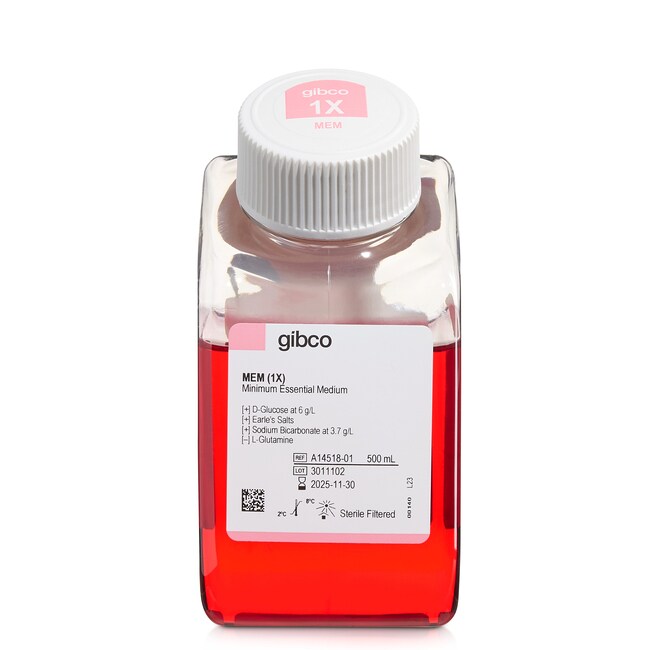
MEM, high glucose, high sodium bicarbonate
Minimum Essential Medium (MEM) is one of the most commonly used of all cell culture media. MEM can be usedRead more
| Catalog Number | Quantity |
|---|---|
| A1451801 | 500 mL |
Catalog number A1451801
Price (CNY)
498.00
Online exclusive
Ends: 31-Dec-2026
623.00Save 125.00 (20%)
Each
Quantity:
500 mL
Price (CNY)
498.00
Online exclusive
Ends: 31-Dec-2026
623.00Save 125.00 (20%)
Each
Minimum Essential Medium (MEM) is one of the most commonly used of all cell culture media. MEM can be used with a variety of suspension and adherent mammalian cells, including HeLa, BHK-21, 293, HEP-2, HT-1080, MCF-7, fibroblasts, and primary rat astrocytes. We offer a variety of Gibco™ MEM modifications for a range of cell culture applications. Find the right formulation using our media selector tool.
This MEM is modified as follows:
| With | Without |
| • Phenol red | • L-glutamine |
| • 6 g/L D-glucose | • HEPES |
| • 3.7 g/L sodium bicarbonate |
Gibco™ MEM, developed by Harry Eagle, was based on his earlier formulation of Basal Medium Eagle (BME). Many other modifications of MEM followed, including Glasgow's MEM, MEM α, DMEM, and Temin's Modification. MEM is available with Earle's salts for use in a CO2 incubator, or with Hanks' salts for use without CO2.
Product Intended Use
For Research Use Only. Not intended for animal or human diagnostic or therapeutic use.
MEM contains no proteins, lipids, or growth factors. Therefore, MEM requires supplementation, commonly with 10% fetal bovine serum (FBS). MEM uses a sodium bicarbonate buffer system (2.2 g/L) and therefore requires a 5–10% CO2 environment to maintain physiological pH.
Specifications
Cell LineHeLa, BHK-21, 293, HEP-2, HT-1080, MCF-7, and fibroblasts
Cell TypePrimary Rat Astrocytes
Concentration1 X
For Use With (Application)Mammalian Cell Culture
Manufacturing QualitycGMP-compliant under the ISO 13485 standard
Product LineGibco
Product TypeMEM (Minimum Essential Medium)
Quantity500 mL
Shelf Life12 Months From Date of Manufacture
Shipping ConditionRoom Temperature
ClassificationAnimal Origin-free
FormLiquid
Regulatory StatusRUO
Serum LevelStandard Serum Supplementation
SterilitySterile-filtered
With AdditivesHigh Glucose, Phenol Red, Sodium Bicarbonate
Without AdditivesNo Glutamine, No HEPES, No Sodium Pyruvate
Unit SizeEach
Contents & Storage
Storage conditions: 2-8 Deg;C. Protect from light
Shipping conditions: Ambient
Shelf life: 12 months from date of manufacture
Shipping conditions: Ambient
Shelf life: 12 months from date of manufacture