Search
 Element Search
 Structure Search

.png-150.jpg)

Thermo Scientific Chemicals
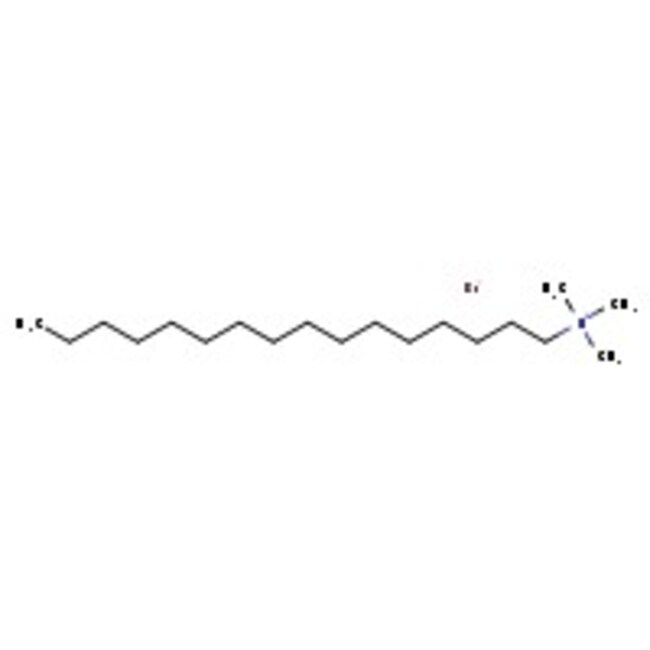
(1-Hexadecyl)trimethylammonium bromide, 98%
CAS: 57-09-0 | C19H42BrN | 364.46 g/mol
| Catalog Number | Quantity |
|---|---|
| A15235.22 also known as A15235-22 | 100 g |





Catalog number A15235.22
also known as A15235-22
Price (CNY)
-
Quantity:
100 g
Chemical Identifiers
CAS57-09-0
IUPAC Namehexadecyltrimethylazanium bromide
Molecular FormulaC19H42BrN
InChI KeyLZZYPRNAOMGNLH-UHFFFAOYSA-M
SMILES[Br-].CCCCCCCCCCCCCCCC[N+](C)(C)C
View more
Specifications Specification Sheet
Specification SheetAppearance (Color)White
Water Content (Karl Fischer Titration)≤1%
FormCrystals or powder or crystalline powder
Assay (Titration ex Bromide)≥97.5 to ≤102.5%
Identification (FTIR)Conforms
(1-Hexadecyl)trimethylammonium bromide is a cationic surfactant in hair conditioning products. It acts as a phase-transfer catalyst for the preparation of polyamide, polycarbonate and polythiocarbonate. It facilitates ligand-free palladium salt-catalyzed Heck and Suzuki cross-coupling reactions in water. It is an active component of the topical antiseptic cetrimide and used in household products such as shampoos and cosmetics. As a buffer solution, it is involved in the extraction of DNA as well as in the synthesis of gold nanoparticles and silican nanoparticles.
This Thermo Scientific Chemicals brand product was originally part of the Alfa Aesar product portfolio. Some documentation and label information may refer to the legacy brand. The original Alfa Aesar product / item code or SKU reference has not changed as a part of the brand transition to Thermo Scientific Chemicals.
Applications
(1-Hexadecyl)trimethylammonium bromide is a cationic surfactant in hair conditioning products. It acts as a phase-transfer catalyst for the preparation of polyamide, polycarbonate and polythiocarbonate. It facilitates ligand-free palladium salt-catalyzed Heck and Suzuki cross-coupling reactions in water. It is an active component of the topical antiseptic cetrimide and used in household products such as shampoos and cosmetics. As a buffer solution, it is involved in the extraction of DNA as well as in the synthesis of gold nanoparticles and silican nanoparticles.
Solubility
Soluble in alcohol, chloroform and water. Slightly soluble in acetone. Insoluble in diethyl ether and benzene.
Notes
Hygroscopic. Store in an airtight container. Incompatible with bases and strong oxidizing agents.
(1-Hexadecyl)trimethylammonium bromide is a cationic surfactant in hair conditioning products. It acts as a phase-transfer catalyst for the preparation of polyamide, polycarbonate and polythiocarbonate. It facilitates ligand-free palladium salt-catalyzed Heck and Suzuki cross-coupling reactions in water. It is an active component of the topical antiseptic cetrimide and used in household products such as shampoos and cosmetics. As a buffer solution, it is involved in the extraction of DNA as well as in the synthesis of gold nanoparticles and silican nanoparticles.
Solubility
Soluble in alcohol, chloroform and water. Slightly soluble in acetone. Insoluble in diethyl ether and benzene.
Notes
Hygroscopic. Store in an airtight container. Incompatible with bases and strong oxidizing agents.
RUO – Research Use Only
General References:
- Surfactant-type catalyst (see Appendix 2) with many applications:
- O-Alkylation of alcohols and phenols; see 2,6-Dimethyl phenol, A11947. Surfactant-assisted permanganate oxidations: Can. J. Chem., 67, 1381 (1989). Reduction of alkyl halides to alkanes using zinc powder in micelles: Synth. Commun., 19, 1649 (1989). Control of ortho-para ratio in the bromination of anilines: Tetrahedron Lett., 30, 6209 (1989). Also facilitates ligand-free palladium salt-catalyzed Heck and Suzuki cross-coupling reactions in water: Tetrahedron Lett., 46, 3357 (2005).
- Chatterjee, S.; Castro, M.; Feller, J. F. Tailoring selectivity of sprayed carbon nanotube sensors (CNT) towards volatile organic compounds (VOC) with surfactants. Sens. Actuators, B 2015, 220, 840-849.
- Andjelković, U.; Milutinović-Nikolić, A.; Jović-Jovičić, N.; Banković, P.; Bajt, T.; Mojović, Z.; Vujčićd, Z.; Jovanović, D. Efficient stabilization of Saccharomyces cerevisiae external invertase by immobilisation on modified beidellite nanoclays. Food Chem. 2015, 168, 262-269.