Search


Citations & References (1)
Invitrogen™
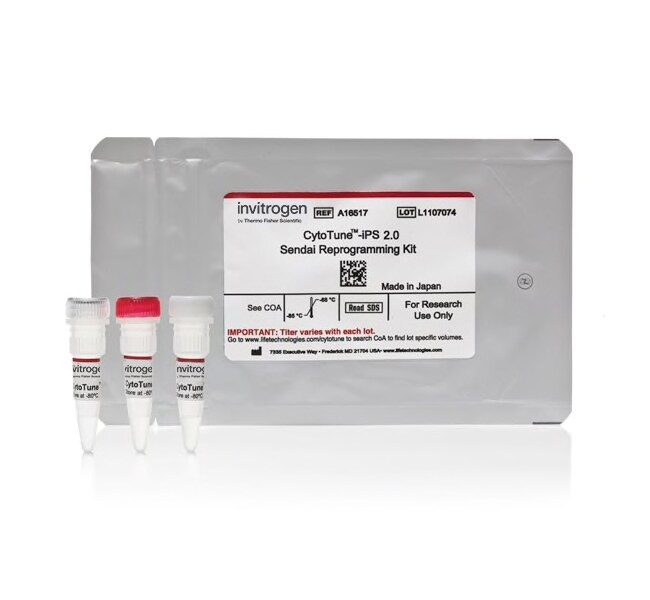
CytoTune™-iPS 2.0 Sendai Reprogramming Kit
The CytoTune-iPS 2.0 Sendai Reprogramming Kit improves upon the well-referenced CytoTune-iPS Sendai Reprogramming Kit.
Have Questions?
Change view

| Catalog Number | Quantity |
|---|---|
| A16517 | 1 Ea. |
| A16518 | 3 Pk. |
Catalog number A16517
Price (CNY)
-
Quantity:
1 Ea.
The CytoTune-iPS 2.0 Sendai Reprogramming Kit improves upon the well-referenced CytoTune-iPS Sendai Reprogramming Kit. This system continues to be easy to use and works with many different somatic cell types, using Sendai particles to deliver Yamanaka factors, which have been shown to be critical for efficient generation of iPSCs. This kit includes three vector preparations: polycistronic Klf4–Oct3/4–Sox2, cMyc, and Klf4.
Features include:
- Ease of use— still requires only one application of the virus to obtain successful reprogramming
- Increased efficiency—usually at least two-fold higher reprogramming efficiencies than the original kit
- Rapid clearance—use the non-integrating Sendai virus that remains in the cytoplasm, reducing the likelihood of integration into the host genome. With the CytoTune-iPS 2.0 Sendai virus, the Sendai backbone and transgenes clear the cytoplasm faster than the original.
For Research Use Only. Not for use in diagnostic procedures.
Specifications
Delivery TypeSendai virus
For Use With (Application)Stem Cell Engineering & Reprogramming
Product LineCytoTune
Product TypeSendai Reprogramming Kit
PromoterProprietary
Quantity1 Ea.
Shipping ConditionDry Ice
Sub Cellular LocalizationCytoplasm
Cell TypeiPSC
FormatKit
Unit SizeEach
Contents & Storage
3 Tubes, store (at -68°C to -85°C.)
Frequently asked questions (FAQs)
What is the shelf life of the CytoTune-iPS 2.0 Sendai Reprogramming Kit (Cat. No. A16517)?
What is the shelf life of the CytoTune-iPS 2.0 Sendai Reprogramming Kit?
What is the optimal passage number for reprogramming patient fibroblasts using the CytoTune-iPS 2.0 Sendai Reprogramming Kit?
Can I scale down my CytoTune-iPS 2.0 Sendai reprogramming experiments?
How many cells do I need to start my reprogramming experiment with the CytoTune-iPS 2.0 Sendai Reprogramming Kit?
Citations & References (1)
Citations & References
Abstract
Whole-genome mutational burden analysis of three pluripotency induction methods.
Journal:Nat Commun
PubMed ID:26892726
'There is concern that the stresses of inducing pluripotency may lead to deleterious DNA mutations in induced pluripotent stem cell (iPSC) lines, which would compromise their use for cell therapies. Here we report comparative genomic analysis of nine isogenic iPSC lines generated using three reprogramming methods: integrating retroviral vectors, non-integrating