Search

Invitrogen™
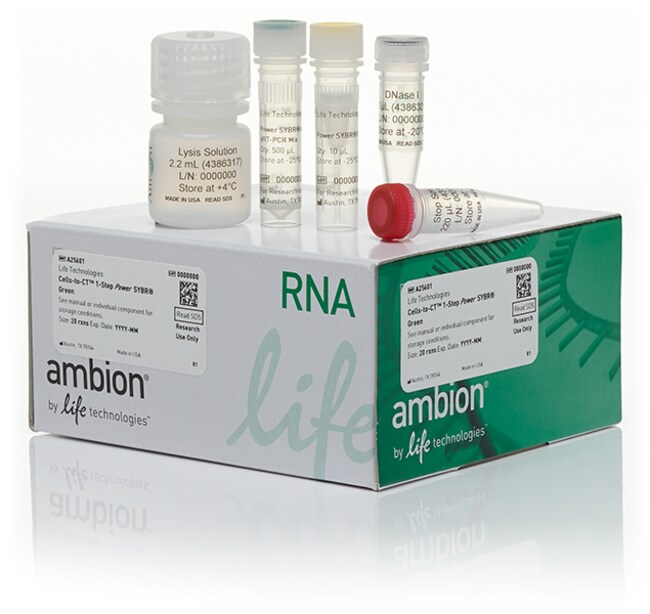
Cells-to-CT™ 1-Step Power SYBR™ Green Kit
Like other members of the Cells-to-CT™ product family, the Cells-to-CT™ 1-Step Power SYBR™ Green Kit makes it possible to performRead more
Have Questions?
Change view

| Catalog Number | Volume | Quantity |
|---|---|---|
| A25601 | 2.2 mL | 20 Preps |
| A25599 | 22 mL | 400 Preps |
| A25600 | 5.5 mL | 100 Preps |
Catalog number A25601
Price (CNY)
3,894.00
Each
Volume:
2.2 mL
Quantity:
20 Preps
Price (CNY)
3,894.00
Each
Like other members of the Cells-to-CT™ product family, the Cells-to-CT™ 1-Step Power SYBR™ Green Kit makes it possible to perform expression analysis directly from cultured cells without RNA purification.
This new addition to the family includes a Power SYBR™ Green 1-Step RT-PCR master mix. The 1-step format of the RT-PCR step streamlines the Cells-to- CT™ 'sample to answer' workflow more than ever without compromising sensitivity and specificity and at an extraordinary value.
The Cells-to-CT 1-Step Power SYBR™ Green Kit is:
- Complete—optimized workflow includes cell lysis reagents with gDNA removal and Power SYBR™ Green 1-Step RT-PCR Master Mix
- Faster—7-minute sample prep, including DNase treatment, versus 30-60 minutes for traditional RNA purification
- Simple—12 steps total (sample prep and real-time RT-PCR combined)
- Robust—perform gene expression analysis on 10–100,000 cells per sample; results equivalent to those from purified RNA
- Affordable—contains sufficient reagents to perform 5 real-time RT-PCRs for each cell sample prepared; study multiple targets per sample at an affordable price
Simple 7-minute Sample Preparation, Then Ready for Real-time RT-PCR
Whether you are using plates or tubes, the Cells-to-CT™ 1-Step Power SYBR™ Green Kit uses a simple 7-minute sample preparation procedure. The lysis technology is designed for 10–100,000 cultured cells/sample. Cells are washed in PBS and lysed in solution for 5 minutes at room temperature with a simultaneous DNase treatment. Lysis is terminated at room temperature by a 2-minute incubation with Stop Solution. The lysate is now ready to analyze on your real-time PCR instrument. Simply add it to a real-time RT-PCR master mix containing the primer sets for your genes of interest. Alternatively, the lysate can be stored at –20°C. Because samples can be processed directly in culture wells (96 or 384 wells), sample handling and the potential for sample loss or transfer error are minimized, facilitating rapid, high-throughput processing. Unlike old-fashioned, multi-step RNA isolation protocols, no heating, washing, or centrifugation steps are required. The kit greatly simplifies a laborious 30–60 minute process and reduces it to 7 minutes.
Completely Validated, Completely Affordable
All components of the Cells-to-CT™ 1-Step Power SYBR™ Green Kit have been optimized for consistent and reliable performance. This removes the guesswork involved in assembling separate sample preparation and real-time 1-step RT-PCR master mixes.
For added quality assurance, the Cells-to-CT™ 1-Step Power SYBR™ Green Kit has been validated with a set of primers for common gene targets and shows performance equivalent to that obtained with purified RNA.
When you add it all up, the Cells-to-CT™ 1-Step Power SYBR™ Green Kit is the best value for your gene expression experiments. With enough reagents to perform 5 real-time RT-PCRs per sample, the savings are substantial compared to buying master mix and an RNA purification kit separately to do the same work.
Accessory Product
The SYBR™ Green Cells-to-CT™ Control Kit was designed for use with SYBR™ Green Cells-to-CT™ products. This kit contains an endogenous control primer set (ACTB) to normalize for sample loading variability and an artificial XenoRNA™ control and corresponding primer set to monitor the effects of PCR inhibition.
For Research Use Only. Not for use in diagnostic procedures.
Specifications
For Use With (Equipment)7500 Fast System, 7500 System, 7900HT Fast System, 7900HT System, QuantStudio™, ViiA™ 7 System, StepOnePlus™ System, StepOne™ System, Real-Time PCR Systems or Thermal Cyclers, 7500 Fast Dx System, QuantStudio 6 and 7 Pro systems, QuantStudio 7 Flex system, QuantStudio 3 and 5 systems, QuantStudio 12k Flex system, QuantStudio 6 Flex system
FormatTube
Product LineCells-to-CT™, Power SYBR™ Green
Product Type1-Step qPCR kit
Quantity20 Preps
Reagent TypeCell Lysis
Sample TypeMammalian Cells
Starting Material10-100,000 Cells
Volume2.2 mL
Detection MethodSYBR
For Use With (Application)Gene Expression
GC-Rich PCR PerformanceHigh
PCR Method1-step RT-qPCR
Reaction Speed7 min.
Unit SizeEach
Contents & Storage
2.2 mL Lysis Solution, store at 2°C to 8°C, 22 μL Dnase I, store at -5° to -30°C, 200 μL Stop Solution, store at -5° to -30°C, 500 μL Power SYBR™ Green 1-step qPCR Mix, store at -5° to -30°C, 10 μL Power SYBR™ Green 1-step RT Mix, store at -5° to -30°C