Search


Citations & References (7)
Invitrogen™
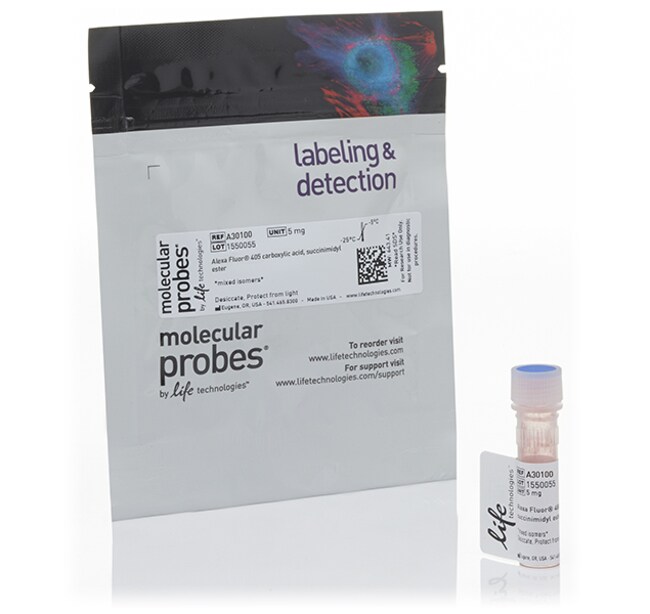
Alexa Fluor™ 405 NHS Ester (Succinimidyl Ester)
Alexa Fluor™ 405 is a blue-fluorescent dye optimal for use with the 405 nm violet laser. Used for stable signalRead more
Have Questions?
Change view

| Catalog Number | Quantity |
|---|---|
| A30100 also known as A-30100 | 5 mg |
| A30000 | 1 mg |
Catalog number A30100
also known as A-30100
Price (CNY)
24,871.00
Each
Quantity:
5 mg
Price (CNY)
24,871.00
Each
Alexa Fluor™ 405 is a blue-fluorescent dye optimal for use with the 405 nm violet laser. Used for stable signal generation in imaging and flow cytometry, Alexa Fluor™ 405 dye is water soluble and pH-insensitive from pH 4 to pH 10. In addition to reactive dye formulations, we offer Alexa Fluor™ 405 dye conjugated to a variety of antibodies, peptides, proteins, tracers, and amplification substrates optimized for cellular labeling and detection (learn more).
The NHS ester (or succinimidyl ester) of Alexa Fluor™ 405 is the most popular tool for conjugating this dye to a protein or antibody. NHS esters can be used to label to the primary amines (R-NH2) of proteins, amine-modified oligonucleotides, and other amine-containing molecules. The resulting Alexa Fluor™ conjugate will exhibit brighter fluorescence and greater photostability than the conjugates of other spectrally similar fluorophores.
Detailed information about this AlexaFluor™ NHS ester:
Fluorophore label: Alexa Fluor™ 405 dye
Reactive group: NHS ester
Reactivity: Primary amines on proteins and ligands, amine-modified oligonucleotides
Ex/Em of the conjugate: 400/424 nm
Extinction coefficient: 35,000 cm-1M-1
Spectrally similar dyes: Pacific Blue
Molecular weight: 1028.3
Typical Conjugation Reaction
You can conjugate amine-reactive reagents with virtually any protein or peptide (the provided protocol is optimized for IgG antibodies). You can scale the reaction for any amount of protein, but the concentration of the protein should be at least 2 mg/mL for optimal results. We recommend trying three different degrees of labeling, using three different molar ratios of the reactive reagent to protein.
The Alexa Fluor™ NHS ester is typically dissolved in high-quality anhydrous dimethylformamide (DMF) or dimethylsulfoxide (DMSO) (D12345), and the reaction is carried out in 0.1–0.2 M sodium bicarbonate buffer, pH 8.3, at room temperature for 1 hour. Because the pKa of the terminal amine is lower than that of the lysine epsilon-amino group, you may achieve more selective labeling of the amine terminus using a buffer closer to neutral pH.
Conjugate Purification
Labeled antibodies are typically separated from free Alexa Fluor™ dye using a gel filtration column, such as Sephadex™ G-25, BioGel™ P-30, or equivalent. For much larger or smaller proteins, select a gel filtration media with an appropriate molecular weight cut-off or purify by dialysis. We offer several purification kits optimized for different quantities of antibody conjugate:
Antibody Conjugate Purification Kit for 0.5-1 mg (A33086)
Antibody Conjugate Purification Kit for 20-50 μg (A33087)
Antibody Conjugate Purification kit for 50-100 μg (A33088)
Learn More About Protein and Antibody Labeling
We offer a wide selection of Molecular Probes™ antibody and protein labeling kits to fit your starting material and your experimental setup. See our Antibody Labeling kits or use our Labeling Chemistry Selection Tool for other choices. To learn more about our labeling kits, read Kits for Labeling Proteins and Nucleic Acids—Section 1.2 in The Molecular Probes™ Handbook.
We’ll Make a Custom Conjugate for You
If you can’t find what you’re looking for in our online catalog, we’ll prepare a custom antibody or protein conjugate for you. Our custom conjugation service is efficient and confidential, and we stand by the quality of our work. We are ISO 13485:2000 certified.
For Research Use Only. Not for use in diagnostic procedures.
Specifications
Chemical ReactivityAmine
Emission424 nm
Excitation400 nm
Label or DyeAlexa Fluor™ 405
Product TypeDye
Quantity5 mg
Reactive MoietyActive Ester, Succinimidyl Ester
Shipping ConditionRoom Temperature
Label TypeAlexa Fluor
Product LineAlexa Fluor
Unit SizeEach
Contents & Storage
Store in freezer (-5 to -30°C) and protect from light.
Frequently asked questions (FAQs)
I am labeling a protein with Alexa Fluor 488 SDP ester. The manual recommends using a sodium bicarbonate buffer at pH 8.3. Can I use a different buffer instead?
I am not going to use all of my Alexa Fluor succinimidyl ester reactive dye. Can I just make it up in DMSO and store aliquots at -20 degrees C?
Is Alexa Fluor 405 dye the best dye for imaging with a 405 nm laser?
Citations & References (7)
Citations & References
Abstract
CD8 T cell competition for dendritic cells in vivo is an early event in activation.
Journal:Proc Natl Acad Sci U S A
PubMed ID:16880405
'T cell responses against an antigen are often focused on a small fraction of potentially immunogenic determinants, a phenomenon known as immunodominance. Immunodominance can be established at several stages of antigen presentation, including antigen processing, binding of peptides to MHC, and competition between T cells for dendritic cells (DCs). The
Color-blind fluorescence detection for four-color DNA sequencing.
Journal:Proc Natl Acad Sci U S A
PubMed ID:15800037
'We present an approach called pulsed multiline excitation (PME) for measurements of multicomponent, fluorescence species and demonstrate its application in capillary electrophoresis for DNA sequencing. To fully demonstrate the advantages of PME, a fluorescent dye set has been developed whose absorption maxima span virtually the entire visible spectrum. Unlike emission
Multicolor super-resolution imaging with photo-switchable fluorescent probes.
Journal:Science
PubMed ID:17702910
Recent advances in far-field optical nanoscopy have enabled fluorescence imaging with a spatial resolution of 20 to 50 nanometers. Multicolor super-resolution imaging, however, remains a challenging task. Here, we introduce a family of photo-switchable fluorescent probes and demonstrate multicolor stochastic optical reconstruction microscopy (STORM). Each probe consists of a photo-switchable
Correlative live-cell and superresolution microscopy reveals cargo transport dynamics at microtubule intersections.
Journal:Proc Natl Acad Sci U S A
PubMed ID:23401534
Intracellular transport plays an essential role in maintaining the organization of polarized cells. Motor proteins tether and move cargos along microtubules during long-range transport to deliver them to their proper location of function. To reach their destination, cargo-bound motors must overcome barriers to their forward motion such as intersection points
Cascade blue as a donor for resonance energy transfer studies of heme-containing proteins.
Journal:Anal Biochem
PubMed ID:11846372
Cascade Blue acetyl azide is an amine reactive compound with spectral properties ideally suited for fluorescence resonance energy transfer (FRET) studies in which heme prosthetic groups serve as acceptors. To demonstrate utility of the Cascade Blue-heme spectroscopic ruler, cytochrome c was employed as a test case to calibrate distance measurements