Search

Applied Biosystems™
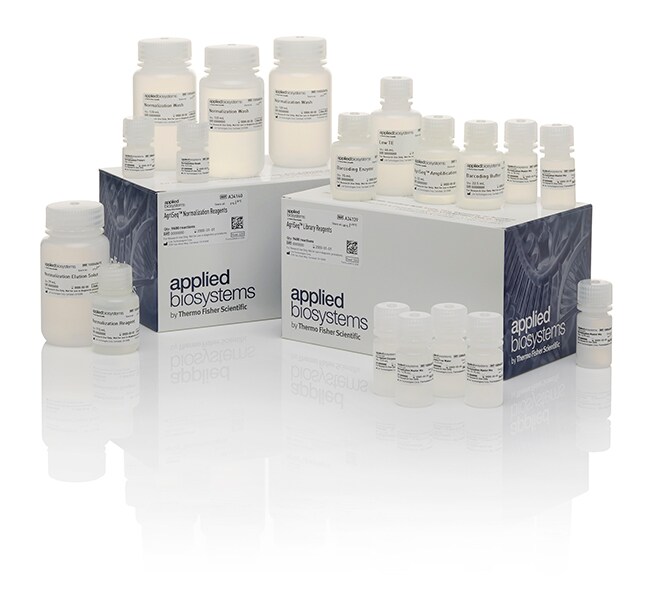
AgriSeq™ HTS Library Kit
The Applied Biosystems AgriSeq HTS Library Kit is specifically designed for high-throughput preparation of amplicon libraries for targeted genotyping-by-sequencing (GBS)Read more
Have Questions?
Change view

| Catalog Number | No. of Reactions |
|---|---|
| A34143 | 9600 Reactions |
| A34144 | 960 Reactions |
Catalog number A34143
Price (CNY)
-
No. of Reactions:
9600 Reactions
The Applied Biosystems AgriSeq HTS Library Kit is specifically designed for high-throughput preparation of amplicon libraries for targeted genotyping-by-sequencing (GBS) applications in agrigenomics.
Key product features include:
• Exceptional uniformity of multiplexed target amplification generates robust, reproducible results
• Simplified workflow enables high-throughput sample processing
• Convenient configuration contains library normalization reagents and volumes sufficient for automated platforms
Excellent data quality
AgriSeq library preparation has been optimized for targeted GBS of panels ranging from 100–5000 amplicons. With a highly efficient and specific multiplex technology, AgriSeq amplification can generate libraries with high uniformity (87.2–99.3%), percent on-target reads (85.7–99.7%), and overall genotype call rates (87.5–99.7%) based on a set of nine recently designed panels ranging in size from 62–3000 amplicons across seven different species. The figure below shows an average of 98.2% uniformity for a 3000-amplicon panel across 192 samples (i.e., 98% of bases are covered by at least 0.2X of the average read depth). Even coverage is significant in that it reduces the amount of sequencing required to achieve consistent genotype calls, thus reducing the sequencing cost per sample. In comparison, weaker multiplexing performance is reported with the competitor technology TruSeq, which provides only 88% average uniformity and a reported 1536 maximum multiplexing capability (see reference).
High throughput sample processing
The AgriSeq Library workflow (see figure below) can be performed in either 96- or 384-well plates for high-throughput sample processing using as little as 10 ng of DNA input per reaction. The workflow has been optimized to minimize sample handling and ancillary reagent usage through the processing of pooled samples. This allows the workflow to be completed with minimal pipetting steps, helping to reduce the potential for error, as well as simplifying automation setup on common third party platforms such as Tecan or Hamilton systems. Standard data analysis processing includes automated quality assessment, alignment, and genotype calling using the included Torrent Suite software and Variant Caller plug-in without the need for a bioinformatician, expensive data storage, or third party programs.
Conveniently packaged containing library normalization reagents & volumes for automation
The AgriSeq HTS Kit is offered in large pack sizes (960 or 9600 reactions) to accommodate high throughput agrigenomics projects while minimizing the cost and waste of unnecessary packaging. The AgriSeq HTS Kit includes not only the reagents for library preparation, but all of the components required for library normalization to help achieve consistent results between samples, and sufficient overage has been provided to accommodate automated workflows. With a low price per sample exclusively available for agricultural customers, AgriSeq targeted GBS is an economical way to generate high-throughput genotyping data to advance your breeding programs.
Key product features include:
• Exceptional uniformity of multiplexed target amplification generates robust, reproducible results
• Simplified workflow enables high-throughput sample processing
• Convenient configuration contains library normalization reagents and volumes sufficient for automated platforms
Excellent data quality
AgriSeq library preparation has been optimized for targeted GBS of panels ranging from 100–5000 amplicons. With a highly efficient and specific multiplex technology, AgriSeq amplification can generate libraries with high uniformity (87.2–99.3%), percent on-target reads (85.7–99.7%), and overall genotype call rates (87.5–99.7%) based on a set of nine recently designed panels ranging in size from 62–3000 amplicons across seven different species. The figure below shows an average of 98.2% uniformity for a 3000-amplicon panel across 192 samples (i.e., 98% of bases are covered by at least 0.2X of the average read depth). Even coverage is significant in that it reduces the amount of sequencing required to achieve consistent genotype calls, thus reducing the sequencing cost per sample. In comparison, weaker multiplexing performance is reported with the competitor technology TruSeq, which provides only 88% average uniformity and a reported 1536 maximum multiplexing capability (see reference).
High throughput sample processing
The AgriSeq Library workflow (see figure below) can be performed in either 96- or 384-well plates for high-throughput sample processing using as little as 10 ng of DNA input per reaction. The workflow has been optimized to minimize sample handling and ancillary reagent usage through the processing of pooled samples. This allows the workflow to be completed with minimal pipetting steps, helping to reduce the potential for error, as well as simplifying automation setup on common third party platforms such as Tecan or Hamilton systems. Standard data analysis processing includes automated quality assessment, alignment, and genotype calling using the included Torrent Suite software and Variant Caller plug-in without the need for a bioinformatician, expensive data storage, or third party programs.
Conveniently packaged containing library normalization reagents & volumes for automation
The AgriSeq HTS Kit is offered in large pack sizes (960 or 9600 reactions) to accommodate high throughput agrigenomics projects while minimizing the cost and waste of unnecessary packaging. The AgriSeq HTS Kit includes not only the reagents for library preparation, but all of the components required for library normalization to help achieve consistent results between samples, and sufficient overage has been provided to accommodate automated workflows. With a low price per sample exclusively available for agricultural customers, AgriSeq targeted GBS is an economical way to generate high-throughput genotyping data to advance your breeding programs.
For Research Use Only. Not for use in diagnostic procedures.
Specifications
For Use With (Application)Sequencing
For Use With (Equipment)Ion GeneStudio S5 System
LibrariesTargeted Sequencing Library
No. of Reactions9600 Reactions
Product LineAgriSeq
Product TypeHTS Library Kit
Quantity9600 reactions
Sample TypeDNA
Shipping ConditionApproved for shipment at Room Temperature or on Wet or Dry Ice
Workflow StepLibrary Generation
FormatKit
Sequencing TypeGenome and DNA Sequencing
Unit SizeEach
Contents & Storage
Store in freezer (-5 to -30°C).