Search


Citations & References (15)
Invitrogen™
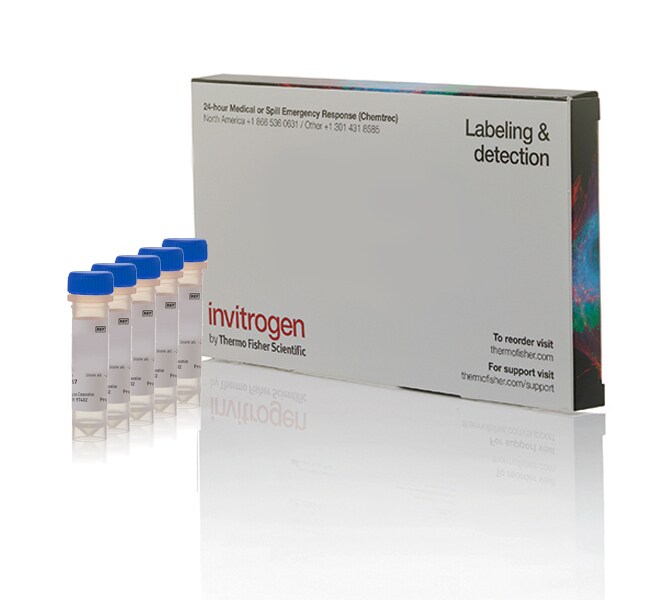
Amplex™ Red and Amplex™ UltraRed Reagents
The Amplex Red and UltraRed reagents are fluorogenic substrates for peroxidase. These highly sensitive and stable probes react with H2O2 in the presence of HRP for solution-based assays and ELISAs. Amplex UltraRed is a brighter version of Amplex Red with an improved pH range and sensitivity.
Have Questions?
Change view

| Catalog Number | Quantity | Dye Type |
|---|---|---|
| A36006 | 5 x 1 mg | Amplex UltraRed |
| A12222 | 5 mg | Amplex Red |
| A22177 | 10 x 10 mg | Amplex Red |
Catalog number A36006
Price (CNY)
4,890.00
Each
Quantity:
5 x 1 mg
Dye Type:
Amplex UltraRed
Price (CNY)
4,890.00
Each
The Amplex Red and Amplex UltraRed reagents are highly sensitive and stable fluorescent probes for the detection of hydrogen peroxide (H2O2) and ideal fluorogenic substrates for peroxidase. These reagents can be used for solution-based assays to detect the activity of H2O2 released from biological samples or with HRP-based ELISA applications. The Amplex UltraRed reagent is an improved version of Amplex Red that is brighter and more sensitive to peroxidase with less pH sensitivity compared to the Amplex Red reagent.
In the presence of horseradish peroxidase (HRP), the Amplex Red and UltraRed reagents react in a 1:1 stoichiometry with H2O2 to produce highly fluorescent, strongly absorbing resorufin (ex/em ∼570/585 nm) or Amplex UltraRed (ex/em ∼568/581 nm), respectively. These oxidized reaction products have a broad red emission with little interference from blue and green autofluorescence found in most biological samples. Because H2O2 is produced in many different enzymatic reactions, the Amplex Red and UltraRed reagents coupled with HRP can be used to detect the activity of many different enzymes. These reagents are also used to detect H2O2 released from biological samples, including cells and isolated mitochondria.
Features of the Amplex Red reagent:
- Sensitive and fast detection of HRP activity or H2O2 for solution-based assays and ELISAs
- Detection of H2O2 produced in many different enzymatic reactions
- Measurement with either fluorescence or absorbance, permitting either fluorogenic or chromogenic detection
The Amplex Red reagent has been used to develop a variety of novel fluorogenic and chromogenic assays for enzymes that produce hydrogen peroxide. When coupled with added horseradish peroxidase, these assays that generate H2O2 permit the ultrasensitive quantitation of a diverse assortment of analytes, including glucose, galactose, cholesterol, glutamic acid, xanthine (or hypoxanthine), uric acid, choline, and acetylcholine.
The Amplex UltraRed reagent offers brighter fluorescence and enhanced sensitivity on a per-mole basis in peroxidase or peroxidase-coupled enzyme assays compared to Amplex Red. The Amplex UltraRed reagent is also less sensitive to acidic pH and exhibits improved stability in the presence of H2O2 or thiols such as dithiothreitol (DTT). For HRP-based ELISA applications, this results in at least two-fold greater sensitivity compared to Amplex Red.
Benefits of the Amplex UltraRed reagent over Amplex Red:
- Brighter signals and enhanced sensitivity for HRP activity and H2O2
- Less sensitive to acidic pH
- Improved stability in the presence of H2O2 or thiols such as DTT
The Amplex Red and Amplex UltraRed reaction products resorufin and Amplex UltroxRed have high extinction coefficients so they can be measured either fluorometrically or spectrophotometrically with absorbance at ∼560 nm, providing flexibility in detection of H2O2, various enzyme assays, and HRP-based ELISAs.
For Research Use Only. Not for use in diagnostic procedures.
Specifications
Detection MethodFluorescence
Dye TypeAmplex UltraRed
FormSolid
Quantity5 x 1 mg
Shipping ConditionRoom Temperature
SubstrateHRP (Horseradish Peroxidase) Substrate
Substrate TypeChemical substrate
Validated ApplicationCell Analysis
Emission Wavelength Range581 nm
Excitation Wavelength Range568 nm
For Use With (Application)Enzyme and Metabolic Activity
For Use With (Equipment)Fluorometer, Microplate Reader
Product LineAmplex
Product TypeRed Hydrogen Peroxide
Unit SizeEach
Contents & Storage
Store in freezer (-5°C to -30°C).
Frequently asked questions (FAQs)
I'm using an Amplex Red kit, the reagent changes color to pink almost immediately in my own Krebs-Ringer buffer but not in HBSS. Why is this?
Citations & References (15)
Citations & References
Abstract
A genetically encoded photosensitizer.
Journal:Nat Biotechnol
PubMed ID:16369538
'Photosensitizers are chromophores that generate reactive oxygen species (ROS) upon light irradiation. They are used for inactivation of specific proteins by chromophore-assisted light inactivation (CALI) and for light-induced cell killing in photodynamic therapy. Here we report a genetically encoded photosensitizer, which we call KillerRed, developed from the hydrozoan chromoprotein anm2CP,
Amplex UltraRed enhances the sensitivity of fluorimetric pyruvate detection.
Journal:Anal Biochem
PubMed ID:20382105
Pyruvate, which is produced in the final step of glycolysis, participates in anabolic metabolism, catabolic metabolism, and signal transduction. We have recently reported a new sensitive and selective fluorimetric assay for pyruvate measurement using Amplex Red as a fluorogenic dye. However, the fluorescence of the reaction product, resorufin, is pH
Ultrahigh-throughput screening in drop-based microfluidics for directed evolution.
Journal:Proc Natl Acad Sci U S A
PubMed ID:20142500
The explosive growth in our knowledge of genomes, proteomes, and metabolomes is driving ever-increasing fundamental understanding of the biochemistry of life, enabling qualitatively new studies of complex biological systems and their evolution. This knowledge also drives modern biotechnologies, such as molecular engineering and synthetic biology, which have enormous potential to
Resveratrol promotes clearance of Alzheimer's disease amyloid-beta peptides.
Journal:J Biol Chem
PubMed ID:16162502
Several epidemiological studies indicate that moderate consumption of wine is associated with a lower incidence of Alzheimer's disease. Wine is enriched in antioxidant compounds with potential neuroprotective activities. However, the exact molecular mechanisms involved in the beneficial effects of wine intake on the neurodegenerative process in Alzheimer's disease brain remain
Facile SNP detection using bifunctional, cross-linking oligonucleotide probes.
Journal:Nucleic Acids Res
PubMed ID:18281702
A facile, sensitive method for detecting specific sequences of oligonucleotides was developed. Detection of DNA sequences with single nucleotide discrimination is achieved by combining the selectivity of hybridization with an efficient cross-linking reaction. Readily synthesized bifunctional oligonucleotide probes containing a modified pyrimidine that is capable of forming interstrand cross-links under