Search


Citations & References (8)
Thermo Scientific™
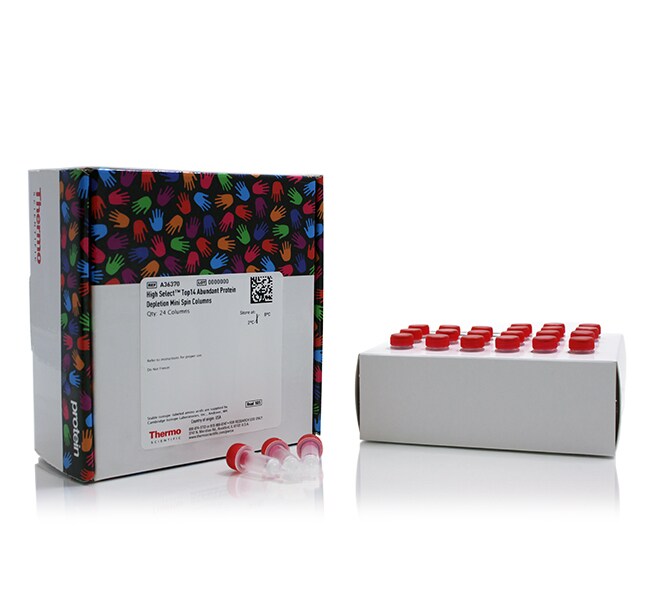
High Select™ Depletion Spin Columns
Decrease albumin, immunoglobulins, and other high-abundance proteins from human serum or plasma in preparation for mass spectrometry analysis, or 1D and 2D gel electrophoresis using High Select depletion spin columns or resin.
Have Questions?
Change view

| Catalog Number | Quantity | Product Type | Purification Target |
|---|---|---|---|
| A36370 | 24 Columns | Mini Spin Column | Top14 Abundant Protein |
| A36365 | 6 Columns | Mini Spin Column | HSA/Immunoglobulin |
| A36366 | 24 Columns | Mini Spin Column | HSA/Immunoglobulin |
| A36367 | 10 Columns | Midi Spin Column | HSA/Immunoglobulin |
| A36368 | 50 mL | Resin | HSA/Immunoglobulin |
| A36371 | 10 Columns | Midi Spin Column | Top14 Abundant Protein |
| A36372 | 50 mL | Resin | Top14 Abundant Protein |
| A36369 | 6 Columns | Mini Spin Column | Top14 Abundant Protein |
Catalog number A36370
Price (CNY)
7,350.00
飞享价
Ends: 31-Dec-2026
9,517.00Save 2,167.00 (23%)
Each
Quantity:
24 Columns
Product Type:
Mini Spin Column
Purification Target:
Top14 Abundant Protein
Price (CNY)
7,350.00
飞享价
Ends: 31-Dec-2026
9,517.00Save 2,167.00 (23%)
Each
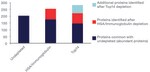
Analysis of human fluids is often complicated by the presence of high concentrations of serum proteins, including albumin and IgG that can make up more than 70% of total serum protein. Removal of albumin, immunoglobulins, and other abundant proteins is essential for the study of low-abundance proteins. Thermo Scientific High Select HSA/Immunoglobulin and Top 14 Abundant Protein depletion spin columns and resins enable depletion of the most abundant proteins in human serum and plasma for improved detection of low-abundance proteins using mass spectrometry analysis or 1D or 2D gel electrophoresis.
• Flexible—resin provided in mini and midi column formats as well as bulk for custom filling options
• Optimized—removes >95% of IgG and >95% of albumin (HSA/Immunoglobulin); removes >95% of IgG and >95% of albumin, plus 12 other abundant proteins (Top 14)
• Fast—process samples in ∼10 minutes
• Economical—cost-effective spin columns are priced for single use
• Reduced carry-over—one-time use prevents protein carryover and experimental variability
High Select HSA/Immunoglobulin Depletion Resin uses highly specific, immobilized anti-HSA and anti-immuoglobulin antibodies (IgG, IgA, IgM, IgD, and IgE) to remove human serum albumin (HSA) and all major subclasses of immunoglobulins from serum and plasma. High Select Top14 Abundant Protein Depletion Resin uses highly specific immobilized antibodies to remove human serum albumin (HSA), albumin, IgG, IgA, IgM, IgD, IgE, kappa and lambda light chains, alpha-1-acidglycoprotein, alpha-1-antitrypsin, alpha-2-macroglobulin, apolipoprotein A1, fibrinogen, haptoglobin, and transferrin from serum, plasma, or spinal fluids. The resins are provided in an economical and convenient spin column format specifically designed for one-step processing and single use or bulk format for custom filling.
• Optimized—removes >95% of IgG and >95% of albumin (HSA/Immunoglobulin); removes >95% of IgG and >95% of albumin, plus 12 other abundant proteins (Top 14)
• Fast—process samples in ∼10 minutes
• Economical—cost-effective spin columns are priced for single use
• Reduced carry-over—one-time use prevents protein carryover and experimental variability
High Select HSA/Immunoglobulin Depletion Resin uses highly specific, immobilized anti-HSA and anti-immuoglobulin antibodies (IgG, IgA, IgM, IgD, and IgE) to remove human serum albumin (HSA) and all major subclasses of immunoglobulins from serum and plasma. High Select Top14 Abundant Protein Depletion Resin uses highly specific immobilized antibodies to remove human serum albumin (HSA), albumin, IgG, IgA, IgM, IgD, IgE, kappa and lambda light chains, alpha-1-acidglycoprotein, alpha-1-antitrypsin, alpha-2-macroglobulin, apolipoprotein A1, fibrinogen, haptoglobin, and transferrin from serum, plasma, or spinal fluids. The resins are provided in an economical and convenient spin column format specifically designed for one-step processing and single use or bulk format for custom filling.
For Research Use Only. Not for use in diagnostic procedures.
Specifications
Final Product TypeProtein
For Use With (Equipment)Mass Spectrometer
Label or DyeUnlabeled
Purification TargetTop14 Abundant Protein
Quantity24 Columns
Shipping ConditionWet Ice
Workflow StepProtein Depletion
FormatMini Spin Column
Product LineHigh Select
Product TypeMini Spin Column
Starting MaterialPlasma, Serum
Unit SizeEach
Contents & Storage
Store at 2–8°C.
Frequently asked questions (FAQs)
Can I use the High Select Top14 Abundant Protein Depletion Midi Spin Columns to deplete proteins from rodent samples?
After depletion of abundant proteins from my sample, I still see albumin and other abundant proteins after LC-MS analysis. Did the depletion work?
How do I proceed to downstream mass spec sample preparation after abundant plasma protein depletion?
What is the maximum loading capacity for the High Select Depletion columns?
What is the percentage of albumin that is removed using abundant protein depletion columns?
Citations & References (8)
Citations & References
Abstract
Integrated proteomics reveals brain-based cerebrospinal fluid biomarkers in asymptomatic and symptomatic Alzheimer's disease.
Journal:Science advances
PubMed ID:33087358
Alzheimer's disease (AD) lacks protein biomarkers reflective of its diverse underlying pathophysiology, hindering diagnostic and therapeutic advancements. Here, we used integrative proteomics to identify cerebrospinal fluid (CSF) biomarkers representing a wide spectrum of AD pathophysiology. Multiplex mass spectrometry identified ~3500 and ~12,000 proteins in AD CSF and brain, respectively. Network
METTL16 inhibits pancreatic cancer proliferation and metastasis by promoting MROH8 RNA stability and inhibiting CAPN2 expression - experimental studies.
Journal:International journal of surgery (London, England)
PubMed ID:39434688
BACKGROUND: N6-methyladenosine (m6A) modification plays a crucial role in the progression of various cancers, including pancreatic cancer, by regulating gene expression. However, the specific mechanisms by which m6A affects pancreatic cancer metastasis remain unclear. This study aims to elucidate the role of METTL16, an m6A writer gene, in regulating core
Proteomic profiling identifies SPP1 associated with rapidly progressive interstitial lung disease in anti-MDA5-positive dermatomyositis.
Journal:Arthritis research & therapy
PubMed ID:38167532
BACKGROUND: Anti-melanoma differentiation-associated gene five antibody positive (MDA5(+)) dermatomyositis (DM) is significantly associated with rapidly progressive interstitial lung disease (RP-ILD). Early detection of RP-ILD remains a major challenge. This study aims to identify and validate prognostic factors for RP-ILD in MDA5(+) DM patients. METHODS: Plasma samples from 20 MDA5(+) DM
Enhancing Proteomics Quality Control: Insights from the Visualization Tool QCeltis.
Journal:Journal of proteome research
PubMed ID:39992359
Large-scale mass-spectrometry-based proteomics experiments are complex and prone to analytical variability, requiring rigorous quality checks across each step in the workflow: sample preparation, chromatography, mass spectrometry, and the bioinformatics stages. This includes quality control (QC) measures that address biological and technical variation. Most QC approaches involve detecting sample outliers and
Tandem mass tag-based quantitative proteomic profiling identifies candidate serum biomarkers of drug-induced liver injury in humans.
Journal:Nature communications
PubMed ID:36869085
Diagnosis of drug-induced liver injury (DILI) and its distinction from other liver diseases are significant challenges in drug development and clinical practice. Here, we identify, confirm, and replicate the biomarker performance characteristics of candidate proteins in patients with DILI at onset (DO; n = 133) and follow-up (n = 120), acute non-DILI at onset