Search


Citations & References (4)
Thermo Scientific™
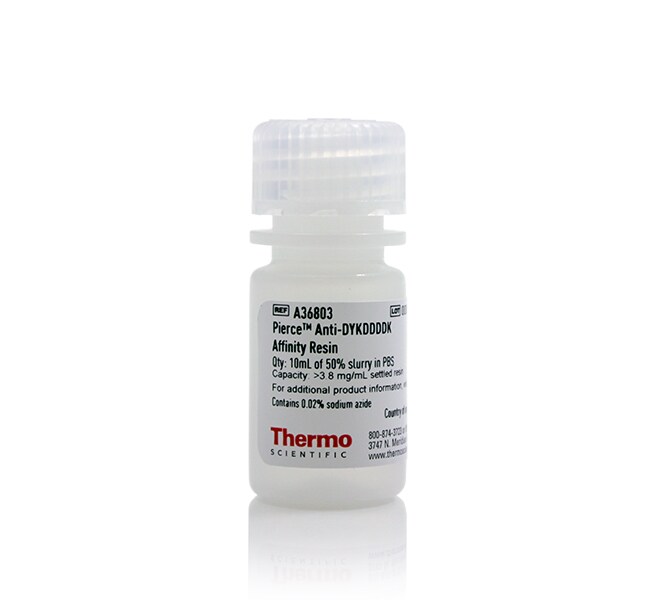
Pierce™ Anti-DYKDDDDK Affinity Resin
Pierce Anti-DYKDDDDK Spin Columns provide a fast, convenient method for purification of DYKDDDDK-tagged proteins expressed in in vitro protein expression systems, bacteria, yeast, and mammalian cells.
Have Questions?
Change view

| Catalog Number | Quantity |
|---|---|
| A36803 | 10 mL |
| A36801 | 2 mL |
| A36804 | 100 mL |
| A40004562 | 5 Columns |
Catalog number A36803
Price (CNY)
16,544.00
Each
Quantity:
10 mL
Price (CNY)
16,544.00
Each
Thermo Scientific Pierce Anti-DYKDDDDK Spin Columns provide a fast, convenient method for purification of DYKDDDDK-tagged proteins expressed in in vitro protein expression systems, bacteria, yeast, and mammalian cells. The amino acid sequence DYKDDDDK, commonly known as 'FLAG', is recognized by a high-affinity rat monoclonal antibody (clone L5) that is covalently attached to UltraLink Biosupport, which is a rigid, hydrophilic, highly crosslinked, copolymeric, and porous resin with high coupling capacity.
For protein purification, resin is added to a sample containing DYKDDDDK-tagged proteins with the tag on either the N- or C-terminus. Following capture of DYKDDDDK-tagged proteins, non-specifically bound proteins can be washed away before dissociating bound target proteins with elution buffer.
Features of Pierce Anti-DYKDDDDK Affinity Resin
- Specific—unique base beads and highly specific antibody minimize off-target binding (low non-specific binding)
- High purity—optimized bind-wash-elute protocol enables high purity
- High yield—special antibody conjugation method enables high yield
- Rapid—entire purification protocol typically takes less than 40 mins
- Economical—purification protocol allows multiple reuses
- Flexible—available in multiple formats including bulk loose resin and spin columns
Characteristics of Pierce Anti-DYKDDDDK Affinity Resin
- Composition: anti-DYKDDDDK antibody covalently attached to UltraLink Biosupport, a highly crosslinked rigid support
- Particle size: 50–80 μm
- pH stability: 1–13
- Operating temperature: 2–30°C; do not freeze
- Particle concentration: 50% slurry in phosphate buffered saline, 0.02% sodium azide, pH 7.5
- Binding capacity: ≥3.0 mg DYKDDDDK-tGFP-His protein (∼32 kDa/mL settled resin)
Available formats
- Resin slurries—2 mL, 10 mL, and 100 mL of 50% slurry in PBS with 0.02% sodium azide, pH 7.5
- Spin columns—10 mL spin columns containing 3 mL of settled resin, supplied at 6 mL 50% slurry
For Research Use Only. Not for use in diagnostic procedures.
Specifications
FormLiquid
FormatLiquid
Formulation50% suspension in PBS containing 0.02% Sodium azide
Product LinePierce
Product TypeAffinity Resin
Quantity10 mL
Shipping ConditionWet Ice
Stationary PhaseAnti-DYKDDDDK monoclonal antibodies
MatrixAffinity Resin
Unit SizeEach
Contents & Storage
5 mL settled resin. 10 mL supplied as a 50% slurry in PBS containing 0.02% sodium azide. Store at 2–8°C.
Frequently asked questions (FAQs)
What is the slurry/suspension percentage for your anti-DYKDDDDK ("FLAG") products?
What is the binding capacity for your Anti-DYKDDDDH Affinity Resin?
Can I use your UltraLink-based Anti-DYKDDDDH ("FLAG") Affinity Resin for FPLC purification?
How do I cleave off the DYKDDDDK ("FLAG") tag after purification?
Citations & References (4)
Citations & References
Abstract
Structural insights into Ubr1-mediated N-degron polyubiquitination.
Journal:Nature
PubMed ID:34789879
The N-degron pathway targets proteins that bear a destabilizing residue at the N terminus for proteasome-dependent degradation(1). In yeast, Ubr1-a single-subunit E3 ligase-is responsible for the Arg/N-degron pathway(2). How Ubr1 mediates the initiation of ubiquitination and the elongation of the ubiquitin chain in a linkage-specific manner through a single E2
FKBP10 promotes clear cell renal cell carcinoma progression and regulates sensitivity to the HIF2α blockade by facilitating LDHA phosphorylation.
Journal:Cell death & disease
PubMed ID:38233415
Renal cell carcinoma (RCC) is one of the three major malignant tumors of the urinary system and originates from proximal tubular epithelial cells. Clear cell renal cell carcinoma (ccRCC) accounts for approximately 80% of RCC cases and is recognized as a metabolic disease driven by genetic mutations and epigenetic alterations.
Increased levels of eIF2A inhibit translation by sequestering 40S ribosomal subunits.
Journal:Nucleic acids research
PubMed ID:37602404
eIF2A was the first eukaryotic initiator tRNA carrier discovered but its exact function has remained enigmatic. Uncharacteristic of translation initiation factors, eIF2A is reported to be non-cytosolic in multiple human cancer cell lines. Attempts to study eIF2A mechanistically have been limited by the inability to achieve high yield of soluble
Brain-enriched RagB isoforms regulate the dynamics of mTORC1 activity through GATOR1 inhibition.
Journal:Nature cell biology
PubMed ID:36097071
Mechanistic target of rapamycin complex 1 (mTORC1) senses nutrient availability to appropriately regulate cellular anabolism and catabolism. During nutrient restriction, different organs in an animal do not respond equally, with vital organs being relatively spared. This raises the possibility that mTORC1 is differentially regulated in different cell types, yet little