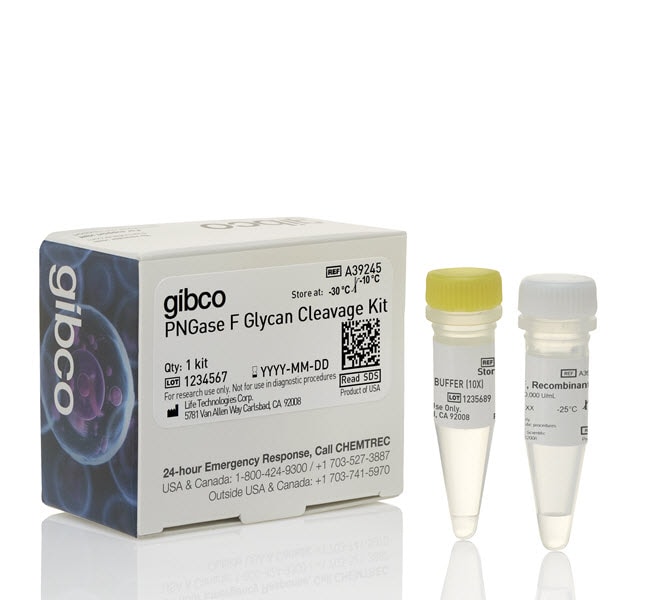
PNGase F Glycan Cleavage Kit
Gibco™

PNGase F Glycan Cleavage Kit

The PNGase F Glycan Cleavage Kit includes all components necessary to perform the enzymatic removal of almost all N-linked oligosaccharidesRead more
Have Questions?
Catalog NumberQuantity
A392451 kit
Catalog number A39245
Price (CNY)
3,600.94
飞享价
Ends: 31-Dec-2025
4,279.00
Save 678.06 (16%)
Each
Add to cart
Quantity:
1 kit
Price (CNY)
3,600.94
飞享价
Ends: 31-Dec-2025
4,279.00
Save 678.06 (16%)
Each
Add to cart
The PNGase F Glycan Cleavage Kit includes all components necessary to perform the enzymatic removal of almost all N-linked oligosaccharides from glycoproteins. The kit includes the PNGase F enzyme, which cleaves N-glycan chains at the innermost GlcNAc and asparagine residues of high mannose, hybrid, and complex oligosaccharides.

The PNGase F Glycan Cleavage Kit features include:
• ≥95% purity
• Recombinant PNGase F enzyme with no endoglycosidase F1, F2, or F3
• Enzyme leaves N-glycan core oligosaccharides intact and suitable for downstream analysis
• Suitable for use under native or denaturing conditions

The components included in the PNGase F Glycan Cleavage Kit are: 30,000 units of PNGase F (500,000 units/mL) and 1 mL PNGase F 10X buffer.

For Research Use Only. Not for use in diagnostic procedures.
Specifications
FormLiquid
Quantity1 kit
Shipping ConditionWet Ice
Product TypePNGase F Glycan Cleavage Kit
Unit SizeEach
Contents & Storage
• 30,000 units PNGase F enzyme, recombinant (500,000 units/mL), store at -20°C
• 1 mL PNGase F 10X Buffer, store at -20°C

Frequently asked questions (FAQs)

In the PNGase Glycan Cleavage Kit, can I use PNGase F under native or denaturing conditions?

Yes, PNGase F enzyme may be used in both native and denaturing conditions

Find additional tips, troubleshooting help, and resources within our Protein Expression Support Center.

In the PNGase Glycan Cleavage Kit, how much PNGase F should I use to remove my carbohydrate under native or DTT denaturing conditions?

When the protein is not denatured with SDS, PNGase F has to work harder to reach the cleavage site of the carbohydrate (due to secondary and tertiary protein structures). In these instances, using more enzyme and/or extended incubation times may help. These conditions will need to be determined empirically for your specific protein.

Find additional tips, troubleshooting help, and resources within our Protein Expression Support Center.

In the PNGase Glycan Cleavage Kit, is PNGase F compatible with downstream analysis such as HPLC and mass spectrometry?

PNGase F enzyme is stored in 50% glycerol. Therefore, HPLC and/or mass spectrometry is not compatible due to the fact that glycerol is not tolerated in instruments used for these applications.

Find additional tips, troubleshooting help, and resources within our Protein Expression Support Center.

In the PNGase Glycan Cleavage Kit, what are the typical reaction conditions for PNGase F, Recombinant?

Typical reaction conditions are as follows:

Optimal incubation times and enzyme concentrations must be determined empirically for a particular substrate.
1. Combine 1-20 µg of glycoprotein, 1 µL of 10X denaturing buffer (5% SDS, 400 mM DTT) and H2O (if necessary) to make a 10 µL total reaction volume.
2. Denature glycoprotein by heating reaction at 100 degrees C for 10 min.
3. Make a total reaction volume of 20 µL by adding 2 µL PNGaseF 10X Buffer, 1-5 µL PNGaseF enzyme, 2 µL 10% NP-40 and H2O.
4. Incubate reaction at 37 degrees C for 1 hr.
Note: Reactions may be scaled-up linearly to accommodate larger reaction volumes.

Find additional tips, troubleshooting help, and resources within our Protein Expression Support Center.

In the PNGase Glycan Cleavage Kit, what happens to the asparagine residue after PNGase F removes the sugar?

As PNGase F is a glycoamidase, the asparagine gets converted into aspartic acid.

Find additional tips, troubleshooting help, and resources within our Protein Expression Support Center.