Search

Thermo Scientific™
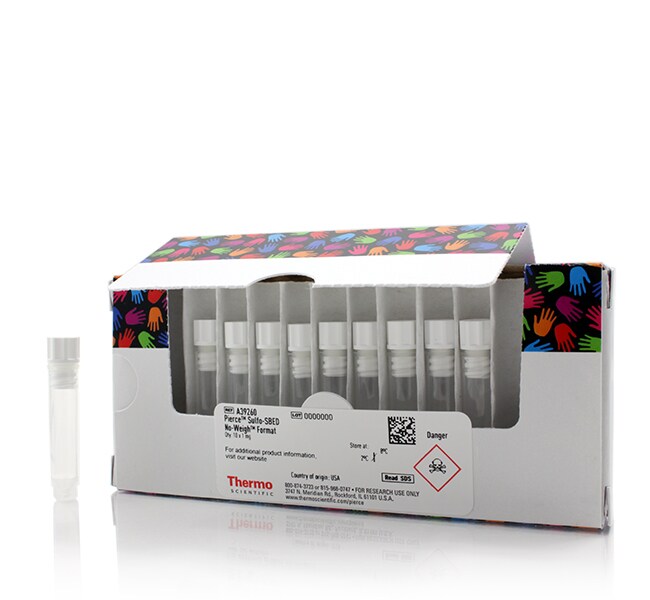
Sulfo-SBED Biotin Label Transfer Reagent, No-Weigh™ Format
The Thermo Scientific Pierce Sulfo-SBED Biotin Label Transfer Reagent is a multifunctional reagent for labeling a purified protein and thenRead more
Have Questions?
Change view

| Catalog Number | Quantity |
|---|---|
| A39260 | 10 x 1 mg |
| 33033 | 10 mg |
Catalog number A39260
Price (CNY)
3,570.00
Online exclusive
Ends: 31-Dec-2026
5,173.00Save 1,603.00 (31%)
Each
Quantity:
10 x 1 mg
Price (CNY)
3,570.00
Online exclusive
Ends: 31-Dec-2026
5,173.00Save 1,603.00 (31%)
Each
The Thermo Scientific Pierce Sulfo-SBED Biotin Label Transfer Reagent is a multifunctional reagent for labeling a purified protein and then covalently transferring the attached biotin tag onto specific interactors of that protein.
Sulfo-SBED is the abbreviation for Sulfo-N-hydroxysuccinimidyl-2-(6-[biotinamido]-2-(p-azido benzamido)-hexanoamido) ethyl-1,3'-dithioproprionate. It is a heterobifunctional chemical crosslinker capable of covalently attaching to primary amines at one end and to nearly any protein functional group at the other end. Unlike typical crosslinkers, Sulfo-SBED also includes a biotin group and a cleavable disulfide spacer arm. Together these features allow one to sequentially crosslink interacting proteins and transfer the biotin affinity tag from one protein (i.e., a purified 'bait' protein) to another (possibly unknown 'prey' protein). Label Transfer is a powerful in vitro method for protein interaction discovery. A growing number of publications feature the use of Sulfo-SBED Biotin Label Transfer Reagent to identify previously unknown protein interaction binding partners and to more fully characterize the specific protein binding domains of other protein interactions.
Sulfo-SBED is the abbreviation for Sulfo-N-hydroxysuccinimidyl-2-(6-[biotinamido]-2-(p-azido benzamido)-hexanoamido) ethyl-1,3'-dithioproprionate. It is a heterobifunctional chemical crosslinker capable of covalently attaching to primary amines at one end and to nearly any protein functional group at the other end. Unlike typical crosslinkers, Sulfo-SBED also includes a biotin group and a cleavable disulfide spacer arm. Together these features allow one to sequentially crosslink interacting proteins and transfer the biotin affinity tag from one protein (i.e., a purified 'bait' protein) to another (possibly unknown 'prey' protein). Label Transfer is a powerful in vitro method for protein interaction discovery. A growing number of publications feature the use of Sulfo-SBED Biotin Label Transfer Reagent to identify previously unknown protein interaction binding partners and to more fully characterize the specific protein binding domains of other protein interactions.
Typical protocol for label transfer experiment:
• Add a few microliters of dissolved Sulfo-SBED Reagent to 0.5-1 mL of purified bait protein in PBS.
• Incubate mixture for 30-120 minutes on ice or at room temperature in the dark.
• Desalt or dialyze (in subdued light) to remove excess non-reacted Sulfo-SBED from the labeled bait protein.
• Add labeled bait protein to cell lysate or other solution containing putative target protein interactors ('prey').
• When interaction complexes have formed, expose the solution to ultraviolet light (365 nm) for several minutes.
• Analyze products by one of several methods:
• Western Blotting: Cleave crosslinks in DTT, separate proteins by SDS-PAGE, and detect biotinylated bands by Western blotting with streptavidin-HRP.
• Purification and Mass Spec or Sequencing: Affinity-purify biotinylated proteins or peptide fragments following trypsin digestion and perform MS or sequencing to characterize the proteins involved.
Related Products
Sulfo-SBED Biotin Label Transfer Kit - Western Blot Application
For Research Use Only. Not for use in diagnostic procedures.
Specifications
Chemical ReactivityAmine-to-Amine
Labeling MethodChemical Labeling, Label Transfer
Label or DyeBiotin
Product TypeSulfo-SBED Biotin Label Transfer Reagent
Quantity10 x 1 mg
Reactive MoietyNHS Ester, Alkyne
Shipping ConditionQualified for Ambient or Wet Ice
SolubilityDMF (Dimethylformamide), DMSO (Dimethylsulfoxide), Methanol, Water
Label TypeBiotin and Other Haptens
Product LinePierce
Unit SizeEach
Contents & Storage
Store at 4°C.