Search

Thermo Scientific™
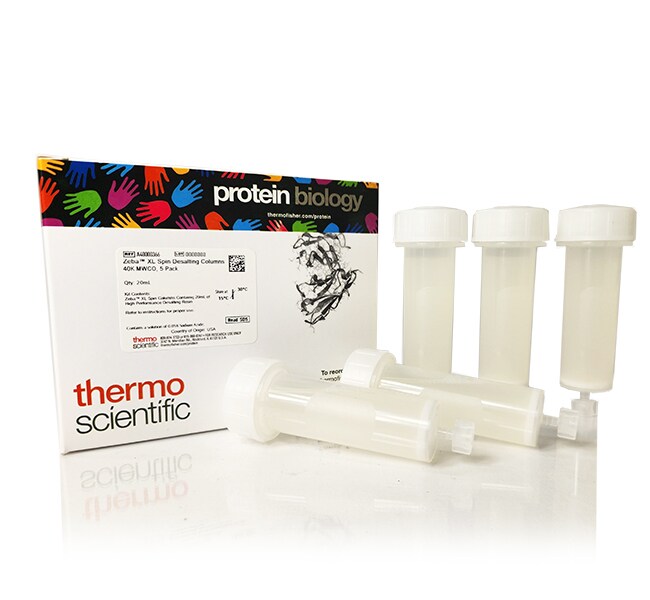
Zeba™ Spin Desalting Columns and Plates, 40K MWCO, 75 μL–10 mL
The new and enhanced Zeba Spin and Micro Spin Desalting columns and plates are designed for efficient desalting and buffer exchanging proteins with a molecular weight >40 kDa and removing small molecules less than 2 kDa. They provide exceptional desalting and protein recovery performance.
Have Questions?
Change view

| Catalog Number | Quantity | Sample Volume (Metric) |
|---|---|---|
| A40002476 | 10 Columns | 4 to 10 mL |
| A40002471 | 5 Columns | 4 to 10 mL |
| A57756 | 25 columns | 5 to 14 μL |
| A57758 | 50 columns | 5 to 14 μL |
| A57759 | 25 columns | 50 to 150 μL |
| A57760 | 50 columns | 50 to 150 μL |
| A57761 | 5 columns | 300 to 800 μL |
| A57762 | 25 columns | 300 to 800 μL |
| A57763 | 5 columns | 500 to 2000 μL |
| A57764 | 25 columns | 500 to 2000 μL |
| A57765 | 5 columns | 1000 to 4000 μL |
| A57766 | 25 columns | 1000 to 4000 μL |
| A57767 | 2 plates | 20 to 100 μL |
| A57768 | 4 plates | 20 to 100 μL |
Catalog number A40002476
Price (CNY)
4,426.00
10 columns
Quantity:
10 Columns
Sample Volume (Metric):
4 to 10 mL
Price (CNY)
4,426.00
10 columns
Thermo Scientific Zeba spin and micro spin desalting columns and plates are designed for efficient desalting and buffer exchange of protein samples. They contain a proprietary size-exclusion chromatography resin with a robust bead structure that withstands centrifugal force and helps produce better flow characteristics and increased efficiency in removing low molecular weight protein contaminants from samples. The Zeba resin performs well even with significantly diluted protein samples and eliminates over 95% of contaminants without causing protein loss.
These Zeba spin and micro spin desalting columns and plates are designed for desalting and buffer exchange of proteins with a molecular weight >40 kDa and removal of small molecules less than 2 kDa. They provide exceptional desalting and protein recovery performance, with expanded capacity to accommodate up to 10 mL of sample volume.
Features of Zeba spin and micro spin desalting columns include:
- High-performing resin—exceptional protein recovery at lower protein concentrations
- Fast and efficient—eliminate sample dilution, fraction collection, and the need for expensive chromatography systems that take time to set up and can only process one sample at a time
- Easy to use—no cumbersome column preparation or equilibration
- Flexible formats—available in spin columns and 96-well spin plates for a range of sample volumes (2 μL to 10 mL)
Zeba Desalting Columns
Convenient, ready-to-use polypropylene columns are the ideal solution for quick and straightforward desalting and buffer exchange of protein samples in a centrifuge format. The pre-dispensed spin columns are offered in various resin fills (75 μL, 0.5 mL, 2 mL, 5 mL, 10 mL, 20mL). These options make it simple to handle sample volumes between 2 μL and 10 mL.
Zeba Spin Desalting Plates
These plates provide trouble-free high-throughput desalting and buffer exchange for sample volumes ranging from 20 to 100 μL. They require no resin dispensing or hydration and provide the same high protein recovery as spin columns with at least 95% removal of salts and other small molecules. One plate can process 96 small sample volumes (20 to 100 μL) in five minutes. Separating macromolecules, such as proteins, from small contaminants is often done through routine methods, including gel filtration chromatography and buffer exchange. These methods are commonly used during protein purification workflows to remove small contaminants like salts, excess labels, and cross-linking reagents from samples before analysis.
Specifications
DisposableSingle-use
For Use With (Application)Small molecule removal and buffer exchange
For Use With (Equipment)Standard Table-top Centrifuge
Formulation20 mL Zeba Desalting Resin Bed
Purification TargetBuffer Exchange, Protein
Quantity10 Columns
Volume (Metric)20 mL
Column TypeSize-exclusion, Proprietary Resin
FormatSpin Column
MWCO40 kDa
Product LineZeba
Sample Volume (Metric)4 to 10 mL
Unit Size10 columns
Contents & Storage
Store at 4°C