Search

Thermo Scientific™
EasyPep™ MS Sample Prep Kits
Generate high quality proteomic samples for MS analysis in less than four hours using optimized EasyPep MS Sample Prep kits.
Have Questions?
Change view

| Catalog Number | Description |
|---|---|
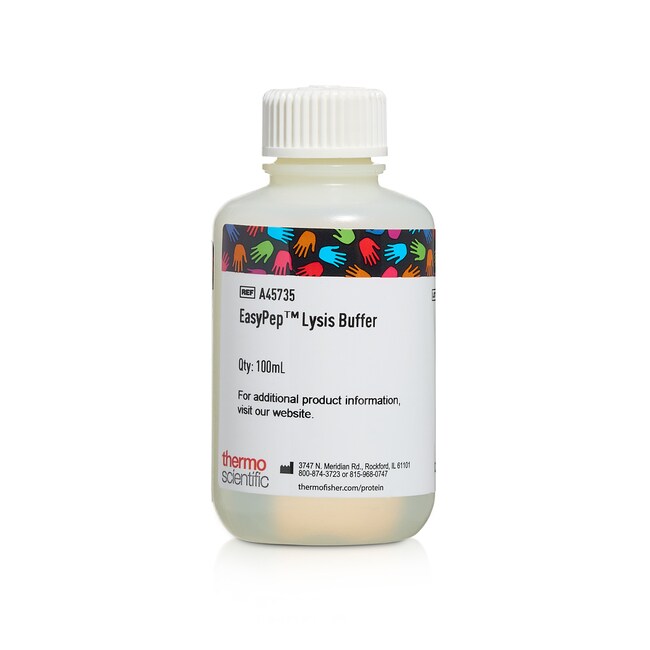
| A45735 | Lysis Buffer |
| A40006 | Mini MS Sample Prep Kit |
| A57864 | Micro MS Sample Prep Kit |
| A45733 | MS Sample Prep Kit |
| A45734 | Maxi Sample Prep Kit |
| A57865 | Peptide Clean-up Plate |
Catalog number A45735
Price (CNY)
1,283.00
飞享价
Ends: 31-Dec-2026
1,583.00Save 300.00 (19%)
Each
Description:
Lysis Buffer
Price (CNY)
1,283.00
飞享价
Ends: 31-Dec-2026
1,583.00Save 300.00 (19%)
Each
EasyPep Mini MS Sample Prep Kits enable efficient and reproducible processing of cultured mammalian cells and tissues for proteomic MS analysis. The kit contains pre-formulated buffers, MS-grade enzyme mix, peptide clean-up columns, and an optimized protocol to generate MS-compatible peptide samples in less than three hours. Kits are optimized to process protein samples from 10–100 μg with a high yield of MS-ready peptides.
• Complete—includes pre-formulated reagents for lysis through digestion, peptide clean-up columns, and an optimized protocol for up to 20 samples
• Optimized—streamlined protocol and reagents minimize the number of steps and time time needed to process samples
• Flexible—reagents and protocol have been verified using cells, plasma, and tissue samples for 10 to 100 μg samples
• Time-saving—sample processing time reduced from more than one day to less than three hours
• Compatible—final preparation is ready for direct MS analysis and other downstream applications, including TMT labeling
The sample preparation of peptides for MS analysis is complex, with numerous steps and varied protocols, resulting in sample variability in both quality and quantity. This kit has been designed to improve reproducibility while saving hands-on and processing time. The number of steps and processing time have been reduced through the addition of Universal Nuclease to reduce viscosity from nucleic acids (replacing sonication), a rapid 'one pot' reduction/alkylation solution for cysteine modification (carbamidomethylation, + 57.02), and a trypsin/Lys-C protease mix for more complete digestion. In addition, the kit includes Peptide Clean-up columns and buffers to prepare detergent-free peptide samples for MS analysis. The optimized reagents and protocol produce high-quality peptides that are compatible with TMT labeling and other downstream applications, or are ready for MS analysis.
• Optimized—streamlined protocol and reagents minimize the number of steps and time time needed to process samples
• Flexible—reagents and protocol have been verified using cells, plasma, and tissue samples for 10 to 100 μg samples
• Time-saving—sample processing time reduced from more than one day to less than three hours
• Compatible—final preparation is ready for direct MS analysis and other downstream applications, including TMT labeling
The sample preparation of peptides for MS analysis is complex, with numerous steps and varied protocols, resulting in sample variability in both quality and quantity. This kit has been designed to improve reproducibility while saving hands-on and processing time. The number of steps and processing time have been reduced through the addition of Universal Nuclease to reduce viscosity from nucleic acids (replacing sonication), a rapid 'one pot' reduction/alkylation solution for cysteine modification (carbamidomethylation, + 57.02), and a trypsin/Lys-C protease mix for more complete digestion. In addition, the kit includes Peptide Clean-up columns and buffers to prepare detergent-free peptide samples for MS analysis. The optimized reagents and protocol produce high-quality peptides that are compatible with TMT labeling and other downstream applications, or are ready for MS analysis.
For Research Use Only. Not for use in diagnostic procedures.
Specifications
DescriptionLysis Buffer
Final Product TypeProtein
For Use With (Equipment)Mass Spectrometer
Label or DyeUnlabeled
Quantity100 mL
Shipping ConditionWet Ice
Workflow StepCell Lysis
Detection MethodMass Spectrometry
FormLiquid
Product LineEasyPep
Product TypeLysis Buffer
Starting MaterialProtein Samples
Unit SizeEach
Contents & Storage
Store at 2°C to 8°C