Search

Applied Biosystems™
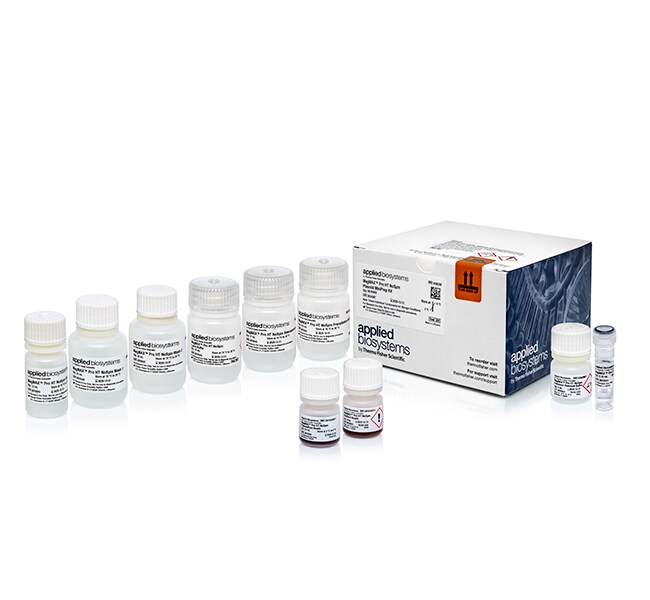
MagMAX™ Pro HT NoSpin Plasmid MiniPrep Kit
The MagMAX Pro HT NoSpin Plasmid Miniprep Kit enables scalable, ultra-rapid purification of high-quality, transfection-grade plasmid DNA (pDNA) from bacterial cultures. Using magnetic-bead technology, it simplifies workflows by eliminating centrifugation and vacuum filtration bottlenecks.
Have Questions?
Change view

| Catalog Number | Product Type | Quantity |
|---|---|---|
| A58309 | Automated, pDNA Extraction Kit | 96 Reactions |
| A58310 | Automated, pDNA Extraction Kit | 384 Reactions |
| A58311 | Automated, pDNA Extraction Kit | 1152 Reactions |
| A58312 | Automated, pDNA Extraction Kit | 2304 Reactions |
| A58310-1 | BactBind Beads | 13.5 mL |
| A58310-2 | PlasmidPure Beads | 19.2 mL |
| A58310-3 | Endotoxin Removal Buffer | 23 mL |
| A58310-4 | RNase A | 1.45 mL |
| A58310-5 | Resuspension Buffer | 68 mL |
| A58310-6 | Lysis Buffer | 72 mL |
| A58310-7 | Precipitation | 72 mL |
| A58310-8 | Wash 1 Buffer | 88 mL |
| A58310-9 | Wash 2 Buffer | 88 mL |
| A58310-10 | Elution Buffer | 41 mL |
Catalog number A58309
Price (CNY)
2,729.00
Each
Product Type:
Automated, pDNA Extraction Kit
Quantity:
96 Reactions
Price (CNY)
2,729.00
Each
The Applied Biosystems MagMAX Pro HT NoSpin Plasmid Miniprep Kit provides a scalable and ultra-rapid approach for purifying high quality, transfection-grade plasmid DNA (pDNA) directly from bacterial culture. Utilizing advanced magnetic-bead technology, the MagMAX Pro HT NoSpin kit drastically simplifies and streamlines plasmid purification workflows by eliminating centrifugation and vacuum filtration bottlenecks.
MagMAX Pro HT NoSpin Plasmid Miniprep Kit features include:
- Bead-based—utilizes dual para-magnetic beads for plasmid isolation without time-intensive processing steps (centrifugation, vacuum filtration)
- Automation enabled—turn-key, automation-friendly protocols and scripts, allowing 96 samples to be processed in under 35 minutes on KingFisher Apex and KingFisher Flex systems
- Fast plasmid DNA isolation—35 minutes from start to completion and ready for downstream applications
- Wide range of compatibility—typical E. coli cultures, common medias, and range of plasmids all acceptable
- High-quality pDNA yields of up to 20 μg, ready for downstream applications
- Ready for transfection—isolated pDNA with very low endotoxin levels < 1 EU/μg
Specifically designed for high-throughput plasmid isolation, the MagMAX Pro HT NoSpin technology is automation friendly and suited for use with KingFisher Apex, KingFisher Flex, and KingFisher Presto purification systems, as well as integrated liquid handling robots.
The MagMAX Pro HT purification chemistry is both effective and ecofriendly. Kits include a novel endotoxin reduction buffer to remove pyrogenic contaminates, and buffers are free of ethanol and chaotropic salts.
pDNA purified with the MagMAX Pro HT NoSpin kit is suitable for a wide array of downstream applications, such as transfection, cloning, enzymatic restriction, in vitro transcription, and sequencing.
Specifications
Elution Volume100 μL
For Use With (Application)Cloning, Transfection, Protein Expression, Protein Production, mRNA production via In Vitro Transcription, Gene Editing, Sequencing, PCR, Nucleic acid labeling, PCR
For Use With (Equipment)KingFisher Apex, Flex and Presto Processors with 96 Deep Well Heads, Liquid Handling Robotic Systems
Nucleic Acid TypePlasmid DNA (pDNA)
Plate CompatibilityKingFisher 96 Deep Well Plates with or without barcodes
Product TypeAutomated, pDNA Extraction Kit
PurityTransfection Grade
Quantity96 Reactions
Sample TypeBacteria, E. coli
Sample VolumeBacterial Culture, 1 mL per well
ScaleMini
Size Distribution5-12kb
Test Time 32 min. for 96 samples, 1 KingFisher 96 DWP
YieldUp to 20 μg pDNA using high copy plasmid
Format96 Deep-well Plate
Isolation TechnologyMagnetic Bead
Unit SizeEach
Contents & Storage
2°C to 8°C BactBind Beads, PlasmidPure Beads, Endotoxin Reduction Buffer
15°C to 25°C RNAse A, Resuspension Buffer, Lysis Buffer, Precipitation Buffer, Wash 1 Buffer, Wash 2 Buffer, Elution Buffer
15°C to 25°C RNAse A, Resuspension Buffer, Lysis Buffer, Precipitation Buffer, Wash 1 Buffer, Wash 2 Buffer, Elution Buffer