Search


Citations & References (37)
Invitrogen™
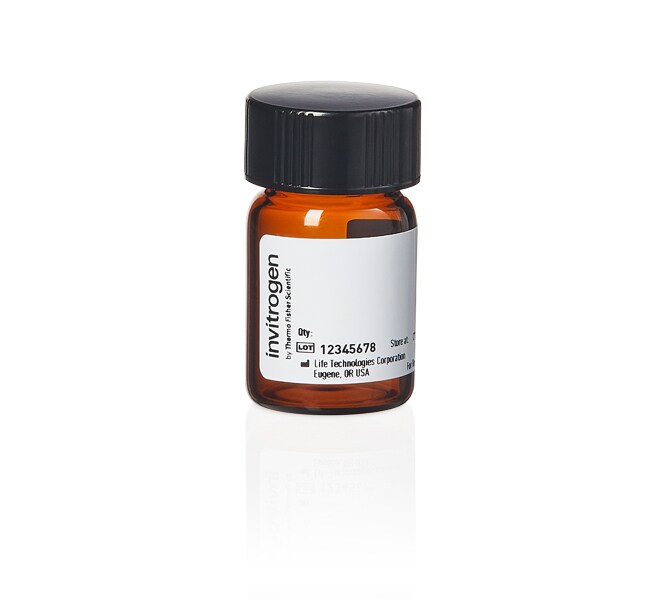
APTS (8-Aminopyrene-1,3,6-Trisulfonic Acid, Trisodium Salt)
The aromatic amine of APTS (8-aminopyrene-1,3,6-trisulfonic acid, trisodium salt) can be reversibly coupled to aldehydes and ketones to form a Schiff base - which can be reduced to a stable amine derivative by sodium borohydride (NaBH4) or sodium cyanoborohydride (NaCNH3) to form new biotinylated probes.
| Catalog Number | Quantity |
|---|---|
| A6257 also known as A-6257 | 10 mg |
Catalog number A6257
also known as A-6257
Price (CNY)
4,790.00
Each
Quantity:
10 mg
Price (CNY)
4,790.00
Each
The aromatic amine of APTS (8-aminopyrene-1,3,6-trisulfonic acid, trisodium salt) can be reversibly coupled to aldehydes and ketones to form a Schiff base - which can be reduced to a stable amine derivative by sodium borohydride (NaBH4) or sodium cyanoborohydride (NaCNH3) to form new biotinylated probes.
For Research Use Only. Not for use in diagnostic procedures.
Specifications
Chemical ReactivityKetone, Aldehyde
Label or DyePyrene
Product TypeAPTS
Quantity10 mg
Reactive MoietyAmine, Primary Amine
Shipping ConditionRoom Temperature
Label TypeClassic Dyes
Unit SizeEach
Contents & Storage
Store at room temperature and protect from light.
Citations & References (37)
Citations & References
Abstract
Leishmania tropica: intraspecific polymorphisms in lipophosphoglycan correlate with transmission by different Phlebotomus species.
Journal:Exp Parasitol
PubMed ID:15208044
'Lipophosphoglycan (LPG) is a dominant surface molecule of Leishmania promastigotes which has been shown to be critical for parasite-sand fly vector interactions. To provide additional evidence for its importance in transmission, the LPGs from three Leishmania tropica strains that differ in their capability to infect sand flies, were biochemically characterized.
Receptor for anionic pyrene derivatives provides the basis for new biomembrane assays.
Journal:J Am Chem Soc
PubMed ID:16231924
'This study describes a new receptor cyclen 1 capable of strong selective binding of pyrene-based anionic dyes under near-physiological conditions. This receptor comprises four naphthylthiourea groups tethered to a cyclen core via an ester linkage. The complexation behavior of cyclen 1 receptor is characterized by a series of (1)H NMR,
Profiling glycoprotein n-linked oligosaccharide by capillary electrophoresis.
Journal:Electrophoresis
PubMed ID:9848672
'A method for analysis of N-linked oligosaccharides derived from glycoproteins including sialic acid-containing species is presented. It is based on the combination of specific chemical and enzymatic conversions coupled with capillary electrophoretic (CE) separation and laser-induced fluorescence (LIF) detection. Glycoproteins were heat-denatured in the presence of a reducing agent and
Analysis of neutral N-linked oligosaccharides from antibodies using free-solution capillary electrophoresis in bare fused-silica capillaries.
Journal:Methods Mol Biol
PubMed ID:15163856
'Conditions for the enzymatic release, chemical derivatization, and analysis of oligosaccharides from the consensus glycosylation sites on antibodies are described. Release of the oligosaccharides is from the native protein. The APTS derivatives of the released oligosaccharides are then analyzed by capillary electrophoresis (CE) using a free solution separation in a
Analysis of chitin oligosaccharides by capillary electrophoresis with laser-induced fluorescence.
Journal:J Chromatogr A
PubMed ID:12498275
'A method, using capillary electrophoresis (CE) with laser-induced fluorescence (LIF) detection for analyzing chitin oligosaccharides is described. Chitin oligosaccharides were derivatized with 9-aminopyrene-1,4,6-trisulfonate (APTS) via reductive amination at 37 degrees C for 16 h (optimized conditions). The APTS-chitin oligosaccharides were analyzed using either an acidic citric acid-phosphate buffer or an