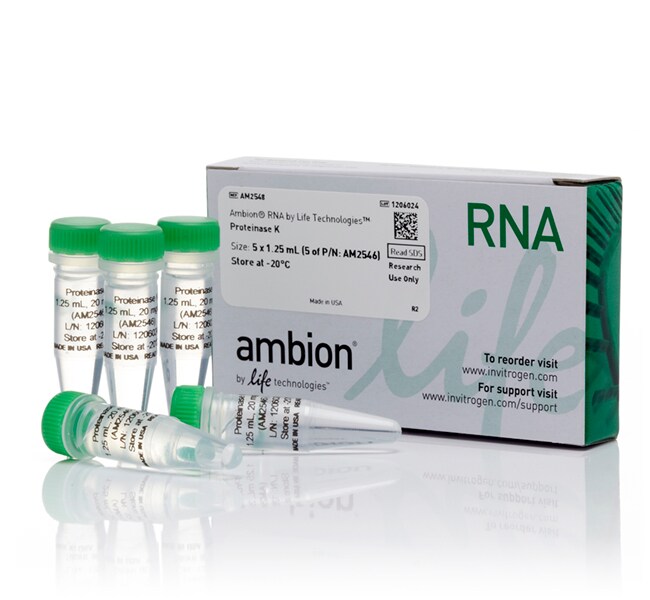
Recombinant Proteinase K Solution (20 mg/mL)
Invitrogen17万+抗体限时买二赠一,靶点广,灵活用!
Recombinant Proteinase K Solution (20 mg/mL)
Invitrogen™

Recombinant Proteinase K Solution (20 mg/mL)

Recombinant Proteinase K is a nonspecific serine protease that is useful for general digestion of proteins.
Have Questions?
Change viewbuttonViewtableView
Catalog NumberQuantity
AM25485 x 1.25 mL
AM25461.25 mL
Catalog number AM2548
Price (CNY)
2,848.00
飞享价
Ends: 31-Dec-2025
3,487.00
Save 639.00 (18%)
Each
Add to cart
Quantity:
5 x 1.25 mL
Price (CNY)
2,848.00
飞享价
Ends: 31-Dec-2025
3,487.00
Save 639.00 (18%)
Each
Add to cart

Recombinant Proteinase K is a nonspecific serine protease that is useful for general digestion of proteins.

Proteinase K remains active:

  • Over a wide pH range (optimal activity between 6.5 and 9.5)
  • Under denaturing conditions (e.g., in the presence of SDS or urea)
  • In the presence of metal chelating agents (e.g., EDTA)
  • At comparatively high temperatures (optimum digestion temperature is 65°C)

Applications

Removal of endogenous nucleases during the preparation of DNA and RNA; preparation of tissue sections for in situ hybridization.

Performance and quality testing

Endodeoxyribonuclease and exodeoxyribonuclease assays; liquid form tested for absence of RNase activity.

Unit definition

One mAnson unit is described as that amount of enzyme that liberates 1 μmole of Folin-positive amino acid within one minute at 37°C using hemoglobin as a substrate.

For Research Use Only. Not for use in diagnostic procedures.
Specifications
Host SpeciesT. album
Product TypeProteinase K
Quantity5 x 1.25 mL
Shipping ConditionDry Ice
Concentration20 mg/mL
FormLiquid
Product LineAmbion™
Unit SizeEach
Contents & Storage
Store at -20°C.

Frequently asked questions (FAQs)

How do I isolate DNA from single bacterial colonies before PCR?

Scrape a single colony from the surface of an agar plate and transfer to 12 µL of SCL solution [10 mM Tris-HCl (pH 7.5), 1 mM EDTA, 50 µg/mL proteinase K] and incubate for 15 min at 55 degrees C. Inactivate proteinase K for 15 min at 80 degrees C and add 20 µL of deionized water. Centrifuge at 12,000 x g for 3 min. Transfer the supernatant to a new tube.

What are the recommended conditions for proteinase K treatment when isolating RNA or DNA samples?

Concentration: Generally proteinase K is used in the concentration range of 50 to 500 µg/mL at 65 degrees C in the presence of SDS (0.5-1%).

Temperature optimum: 65 degrees C; 12X more active at 65 degrees C than at 25 degrees C.

pH: Proteinase K is stable over a wide pH range (4.0 to 12.5), with optimal activity at pH 6.5 to 9.5. It is most stable at pH 8.
Inactivation: Heat inactivate Proteinase K at 80 degrees C for 15 min. Phenol extraction is the recommended method to ensure complete inactivation.

Inhibited by: PMSF (0.1 to 1.0 mM of PMSF is usually sufficient for inhibition of Proteinase K)

Not inhibited by: Proteinase K is not inactivated by metal ions, chelating agents (e.g., EDTA), sulfhydryl reagents or by trypsin or chymotrypsin inhibitors. Activity can be stimulated by addition of denaturing agents (SDS and urea).

I received Recombinant Proteinase K Solution (Cat. No. AM2546, AM2548) on Friday and it sat over the weekend and thawed. Is it still usable?

No, we do not recommend using it.

Do you offer the Proteinase K from the MagMAX mirVana Total RNA Isolation Kit (Cat. No. A27828) separately from the kit?

We do not sell the Proteinase K from the MagMAX mirVana Total RNA Isolation Kit as a standalone item. A different Proteinase K product (Cat. No. AM2548) can be purchased as a standalone item and can be used at 2.5X in the MagMAX mirVana protocol if you would like to add more Proteinase K to the procedure.