Search


Citations & References (2)
Invitrogen™
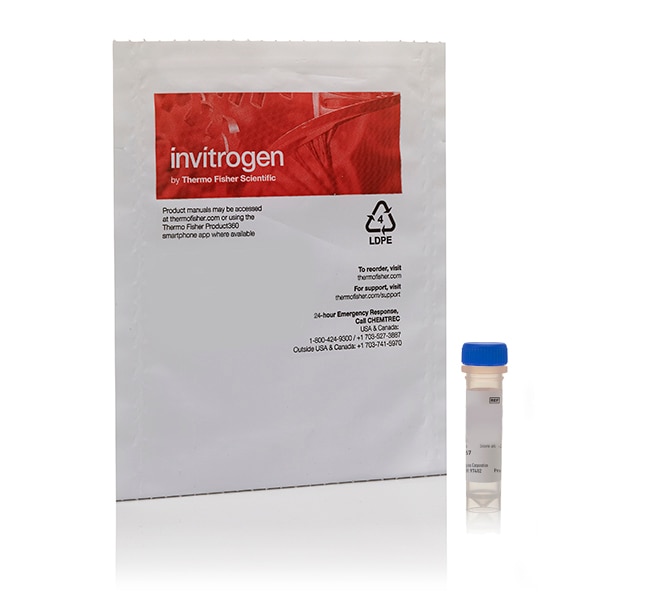
BODIPY™ FL L-Cystine
BODIPY™ FL L-cystine
| Catalog Number | Quantity |
|---|---|
| B20340 | 1 mg |
Catalog number B20340
Price (CNY)
2,463.00
Each
Quantity:
1 mg
Price (CNY)
2,463.00
Each
We have attached two BODIPY FL fluorophores to the amino groups of the disulfide-containing amino acid cystine to create this reagent for reversible thiol-specific labeling of thiolated oligonucleotides, proteins and cells. BODIPY FL L-cystine is virtually nonfluorescent due to interactions between the two fluorophores; however, thiol-specific exchange with thiolated biomolecules occurs to form mixed disulfides, resulting in green fluorescence.
For Research Use Only. Not for use in diagnostic procedures.
Specifications
Chemical ReactivityThiol
Label or DyeBODIPY™ FL
Product TypeFL L-Cystine
Quantity1 mg
Reactive MoietyThiol
Shipping ConditionRoom Temperature
Label TypeBODIPY Dyes
Product LineBODIPY
Unit SizeEach
Contents & Storage
Store in freezer (-5 to -30°C) and protect from light.
Citations & References (2)
Citations & References
Abstract
Innate immune recognition triggers secretion of lysosomal enzymes by macrophages.
Journal:Traffic
PubMed ID:17555533
'Gamma interferon-induced lysosomal thiolreductase (GILT) is expressed constitutively in antigen-presenting cells, where it reduces disulfide bonds to facilitate antigen presentation. GILT is synthesized as an enzymatically active precursor protein and is processed in early endosomes to yield the mature enzyme. The exposure of the promonocytic cell line THP-1 to Escherichia
The radioprotective agent, amifostine, suppresses the reactivity of intralysosomal iron.
Journal:Redox Rep
PubMed ID:14980067
Amifostine (2-[(3-aminopropyl)amino]ethane-thiol dihydrogen phosphate ester; WR-2721) is a radioprotective agent used clinically to minimize damage from radiation therapy to adjacent normal tissues. This inorganic thiophosphate requires dephosphorylation to produce the active, cell-permeant thiol metabolite, WR-1065. The activation step is presumably catalyzed by membrane-bound alkaline phosphatase, activity of which is substantially