Search
 Element Search
 Structure Search

Thermo Scientific Chemicals
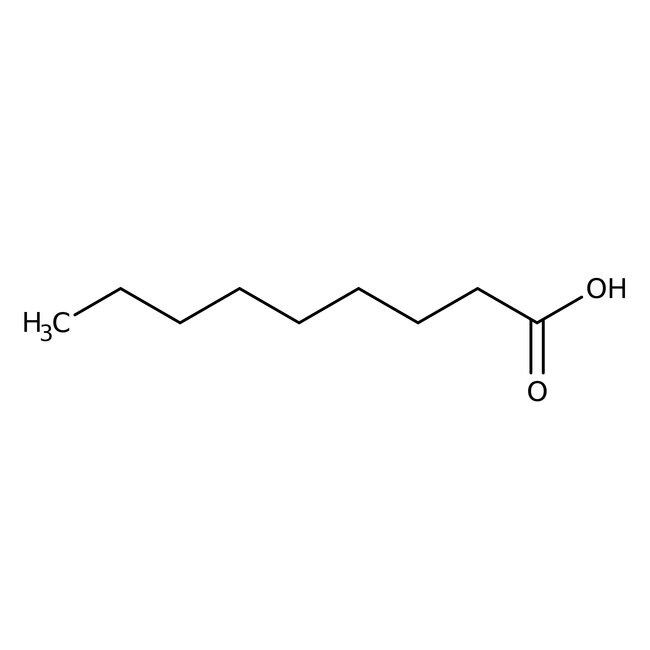
Nonanoic acid, 97%
CAS: 112-05-0 | C9H18O2 | 158.241 g/mol
| Catalog Number | Quantity |
|---|---|
| B21568.AK also known as B21568-AK | 250 mL |


Catalog number B21568.AK
also known as B21568-AK
Price (CNY)
-
Quantity:
250 mL
Chemical Identifiers
CAS112-05-0
IUPAC Namenonanoic acid
Molecular FormulaC9H18O2
InChI KeyFBUKVWPVBMHYJY-UHFFFAOYSA-N
SMILESCCCCCCCCC(O)=O
View more
Specifications Specification Sheet
Specification SheetAppearance (Color)Clear colorless to pale yellow
FormLiquid
Assay (Aqueous acid-base Titration)≥96.0 to ≤104.0%
Assay (Silylated GC)≥96.0%
Identification (FTIR)Conforms
View more
Nonanoic acid is used in the preparation of plasticizers and lacquers. It is commonly used in conjunction with glyphosate, for a quick burn-down effect in the control of weeds in turfgrass.
This Thermo Scientific Chemicals brand product was originally part of the Alfa Aesar product portfolio. Some documentation and label information may refer to the legacy brand. The original Alfa Aesar product / item code or SKU reference has not changed as a part of the brand transition to Thermo Scientific Chemicals.
Applications
Nonanoic acid is used in the preparation of plasticizers and lacquers. It is commonly used in conjunction with glyphosate, for a quick burn-down effect in the control of weeds in turfgrass.
Solubility
Soluble in water at 20°C,0.26g/L. Soluble in alcohol and dipropylene glycol.
Notes
Store away from oxidizing agents and bases. Keep the container tightly closed and place it in a cool, dry and well ventilated condition.
Nonanoic acid is used in the preparation of plasticizers and lacquers. It is commonly used in conjunction with glyphosate, for a quick burn-down effect in the control of weeds in turfgrass.
Solubility
Soluble in water at 20°C,0.26g/L. Soluble in alcohol and dipropylene glycol.
Notes
Store away from oxidizing agents and bases. Keep the container tightly closed and place it in a cool, dry and well ventilated condition.
RUO – Research Use Only
General References:
- Zhiyong Sun, et al. Carbon-limited fed-batch production of medium-chain-length polyhydroxyalkanoates from nonanoic acid by Pseudomonas putida KT2440.Appl. Microbiol. Biotechnol.,200774(1), 69-77.
- Madhu Aneja, et al. Trichoderma harzianum produces nonanoic acid, an inhibitor of spore germination and mycelial growth of two cacao pathogens.Physiological and Molecular Plant Pathology.,200567(6), 304-307.