Search


Citations & References (10)
Invitrogen™
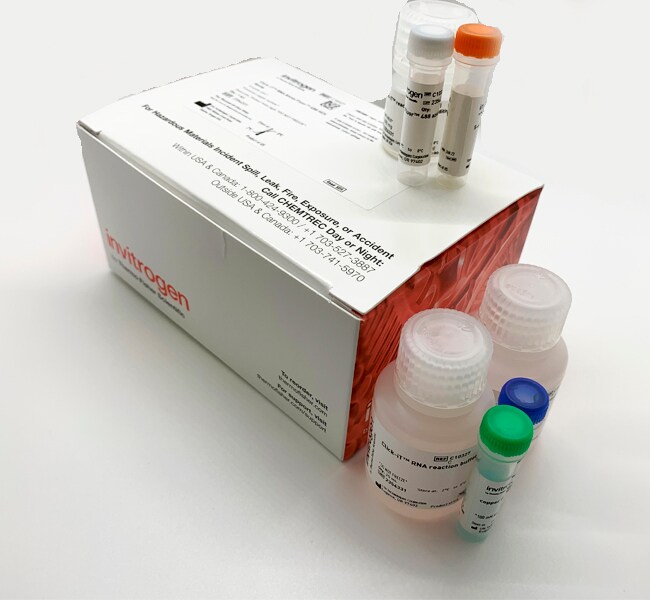
Click-iT™ RNA Alexa Fluor™ 488 Imaging Kit
The Click-iT™ RNA Alexa Fluor™ 488 Imaging Kit enables detection of global RNA transcription temporally and spatially in cells andRead more
| Catalog Number | Quantity |
|---|---|
| C10329 | 1 kit |
Catalog number C10329
Price (CNY)
7,933.00
飞享价
Ends: 31-Dec-2026
11,018.00Save 3,085.00 (28%)
Each
Quantity:
1 kit
Price (CNY)
7,933.00
飞享价
Ends: 31-Dec-2026
11,018.00Save 3,085.00 (28%)
Each
The Click-iT™ RNA Alexa Fluor™ 488 Imaging Kit enables detection of global RNA transcription temporally and spatially in cells and tissues (PNAS (2008) 105:15779-84).
The ability to detect newly synthesized RNA or changes in RNA levels resulting from disease, environmental damage or drug treatments is an important aspect of toxicological profiling. Utilizing an alkyne-modified nucleoside, 5-ethynyl uridine (EU), and powerful click chemistry, newly synthesized RNA can be detected without the use of radioactivity or antibodies with a simple, two-step procedure. In step one, the alkyne-containing nucleoside is fed to cells or animals and actively incorporated into nascent RNA. The small size of the tag enables efficient incorporation of the modified nucleoside into RNA, but not into DNA. Detection utilizes the chemoselective ligation or “click” reaction between and azide and an alkyne where the modified RNA is detected with a corresponding azide-containing dye. With its dimunitive “footprint”, the Click-iT™ detection molecule can easily penetrate complex samples and leaves open the possibility of multiplex analyses with other probes, including antibodies for the detection of RNA-interactive proteins for deeper biological insights.
The ability to detect newly synthesized RNA or changes in RNA levels resulting from disease, environmental damage or drug treatments is an important aspect of toxicological profiling. Utilizing an alkyne-modified nucleoside, 5-ethynyl uridine (EU), and powerful click chemistry, newly synthesized RNA can be detected without the use of radioactivity or antibodies with a simple, two-step procedure. In step one, the alkyne-containing nucleoside is fed to cells or animals and actively incorporated into nascent RNA. The small size of the tag enables efficient incorporation of the modified nucleoside into RNA, but not into DNA. Detection utilizes the chemoselective ligation or “click” reaction between and azide and an alkyne where the modified RNA is detected with a corresponding azide-containing dye. With its dimunitive “footprint”, the Click-iT™ detection molecule can easily penetrate complex samples and leaves open the possibility of multiplex analyses with other probes, including antibodies for the detection of RNA-interactive proteins for deeper biological insights.
For Research Use Only. Not for use in diagnostic procedures.
Specifications
ColorGreen
Excitation/Emission495/519
For Use With (Equipment)Confocal Microscope, Fluorescence Microscope
Product LineAlexa Fluor, Click-iT, Molecular Probes
Product TypeNew RNA Synthesis Assay
Quantity1 kit
Shipping ConditionRoom Temperature
Detection MethodFluorescence
FormatSlide
Label or DyeAlexa Fluor 488
Unit SizeEach
Contents & Storage
The kit contains sufficient material for 25, 18 X 18 coverslips. Store at 2-6°C, dessicate and protect from light.
Frequently asked questions (FAQs)
Do you offer the Alexa Fluor 488 azide (Component B) from the Click-iT RNA Alexa Fluor 488 Imaging Kit (Cat. No. C10329) as a standalone product?
Can the components of the Click-iT Plus EdU Alexa Fluor Imaging Kits be used for labeling samples for flow cytometry?
Can any type of cell incorporate EU?
Citations & References (10)
Citations & References
Abstract
RNA m6A methylation regulates the ultraviolet-induced DNA damage response.
Journal:Nature
PubMed ID:28297716
Cohesin Removal Reprograms Gene Expression upon Mitotic Entry.
Journal:Mol Cell
PubMed ID:32035037
HMGB2 Loss upon Senescence Entry Disrupts Genomic Organization and Induces CTCF Clustering across Cell Types.
Journal:Mol Cell
PubMed ID:29706538
Wiskott-Aldrich syndrome protein forms nuclear condensates and regulates alternative splicing.
Journal:Nat Commun
PubMed ID:35752626
Topoisomerase 1 activity during mitotic transcription favors the transition from mitosis to G1.
Journal:Mol Cell
PubMed ID:34767771