Search

Invitrogen™
CyQUANT™ LDH Cytotoxicity Assays
CyQUANT cytotoxicity assays measure cellular toxicity based on the release of cytosolic enzymes (LDH or G6PD) from damaged cells. These cytotoxicity assays utilize either colorimetric or fluorescence detection and allow continuous monitoring of cell death using microplate readers.
Have Questions?
Change view

| Catalog Number | Quantity | Detection Method |
|---|---|---|
| C20303 | 1000 Assays | Fluorescence |
| C20300 | 200 Assays | Absorbance |
| C20302 | 200 Assays | Fluorescence |
| C20301 | 1000 Assays | Absorbance |
Catalog number C20303
Price (CNY)
7,769.00
Each
Quantity:
1000 Assays
Detection Method:
Fluorescence
Price (CNY)
7,769.00
Each
CyQUANT cytotoxicity assays provide a simple and reliable method to assess chemical or cell-mediated cellular toxicity. The CyQUANT LDH Cytotoxicity Assays and the CyQUANT Cytotoxicity Assay (G6PD Release Assay) use colorimetric- or fluorescence-based detection to measure the release of cytosolic enzymes (LDH or G6PD) from damaged cells. These cytotoxicity assays are optimized for use on microplate readers and can be used for continuous monitoring of cell health over time since cell lysis is not required, making them versatile tools for high-throughput screening and drug discovery applications.
CyQUANT LDH Cytotoxicity Assays are used to measure cytotoxicity through the release of lactate dehydrogenase (LDH), a proven indicator of cellular toxicity. LDH is a cytosolic enzyme found in many cells that is released into the surrounding cell culture medium when the plasma membrane is damaged due to cellular injury, tissue damage, or disease. CyQUANT LDH Assays enable accurate and quantitative measurement of this extracellular LDH release using either colorimetric or fluorescence detection on microplate readers. These LDH assay kits can be used with different cell types, including 3D cell models. Since LDH released into the medium is the indicator of cytotoxicity, these assays can monitor cellular toxicity from the same sample over time.
In the colorimetric CyQUANT LDH Assay (Cat. Nos. C20300 and C20301), extracellular LDH release is quantified by a coupled enzymatic reaction in which LDH catalyzes the conversion of lactate to pyruvate via NAD+ reduction to NADH. Diaphorase then uses NADH to reduce a tetrazolium salt (INT) to a red formazan product that can be measured at 490 nm.
In the fluorescence CyQUANT LDH Assay (Cat. Nos. C20302 and C20303), extracellular LDH release is quantified by a coupled enzymatic reaction in which LDH catalyzes the conversion of lactate to pyruvate via NAD+ reduction to NADH. Diaphorase then uses NADH to reduce resazurin to resorufin that can be detected using an ex/em of 560/590 nm using a fluorescence microplate reader.
Features of the CyQUANT LDH Cytotoxicity Assay
- Convenient—add-mix-read format for adherent and suspension cells, including 3D cell models
- Accurate—provides a quantitative measurement of LDH release
- Flexible—ideal for high-throughput screening, monitor cytotoxicity from the same sample over time
- Robust—uses stable LDH enzyme activity as a cytotoxic marker
For Research Use Only. Not for use in diagnostic procedures.
Specifications
Cell PermeabilityCell-impermeant
DescriptionCyQUANT™ LDH Cytotoxicity Assay, fluorescence
Detection MethodFluorescence
Dye TypeOther Label(s) or Dye(s), Resorufin
Format96-well plate
Quantity1000 Assays
Shipping ConditionDry Ice
ColorRed
Emission590 nm
Excitation Wavelength Range560 nm
For Use With (Application)LDH Cytotoxicity Assay
For Use With (Equipment)Microplate Reader
Product LineCyQUANT
Product TypeLDH Cytotoxicity Assay
Unit SizeEach
Contents & Storage
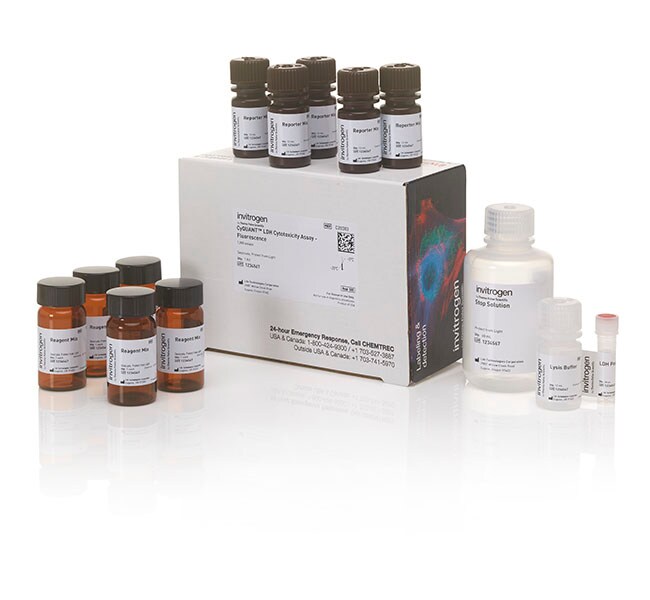
• 5 vials Reagent Mix
• 5 x 12 mL Reporter Mix
• 1 x 12 mL Lysis Buffer
• 1 x 60 mL Stop Solution
• 1 x 30 μL LDH Positive Control
Store at -20°C, protect from light.
• 5 x 12 mL Reporter Mix
• 1 x 12 mL Lysis Buffer
• 1 x 60 mL Stop Solution
• 1 x 30 μL LDH Positive Control
Store at -20°C, protect from light.