Search


Citations & References (18)
Invitrogen™
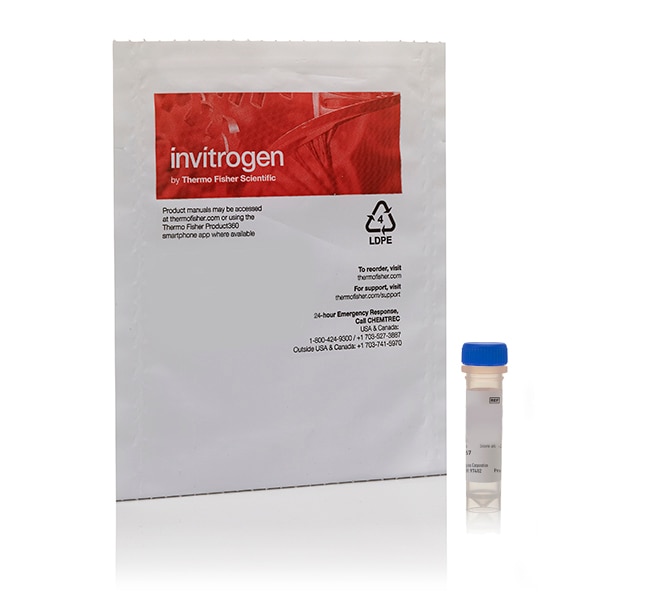
CellTrace™ BODIPY™ TR Methyl Ester (Lipophilic Counterstain For GFP)
The red-fluorescent CellTrace™ BODIPY® TR methyl ester is an excellent counterstain for cells and tissues that are expressing GFP. CellTrace™Read more
| Catalog Number | Quantity |
|---|---|
| C34556 | 1 mL |
Catalog number C34556
Price (CNY)
6,607.00
Each
Quantity:
1 mL
Price (CNY)
6,607.00
Each
The red-fluorescent CellTrace™ BODIPY® TR methyl ester is an excellent counterstain for cells and tissues that are expressing GFP. CellTrace™ BODIPY® TR methyl ester readily permeates cell membranes and selectively stains mitochondria and endomembranous organelles such as endoplasmic reticulum and the Golgi apparatus, but does not appear to localize in the plasma membrane. CellTrace™ BODIPY® TR methyl ester staining is retained after paraformaldehyde fixation.
For Research Use Only. Not for use in diagnostic procedures.
Specifications
Dye TypeBODIPY Dyes
Product LineBODIPY, CellTrace
Quantity1 mL
Reagent TypeCell Tracker Compounds, Cell Labeling Reagents
Shipping ConditionRoom Temperature
Label TypeOther Labels or Dyes
Product TypeLipophilic Tracer
Unit SizeEach
Contents & Storage
Store in freezer -5°C to -30°C and protect from light.
Frequently asked questions (FAQs)
I am storing the DMSO stock solutions of the CellTrace cell proliferation reagents and am not obtaining a good signal with my cells compared to freshly dissolved dye stock. Why does the product not work after storage?
I am using the CellTrace Cell Proliferation reagents and am not obtaining good separation of my cell generation peaks. How can I improve the peak separation?
Can I store the stock solutions of the CellTrace reagents and how do you recommend storing them?
How do the CellTrace Cell Proliferation reagents work?
I am trying to assay cell proliferation with a CellTrace stain, and I am not seeing separate peaks for each cell division. How can I optimize this assay?
Citations & References (18)
Citations & References
Abstract
Live-cell imaging of rhabdovirus-induced morphological changes in plant nuclear membranes.
Journal:Mol Plant Microbe Interact
PubMed ID:16042016
'Potato yellow dwarf virus (PYDV) and Sonchus yellow net virus (SYNV) belong to the genus Nucleorhabdovirus. These viruses replicate in nuclei of infected cells and mature virions accumulate in the perinuclear space after budding through the inner nuclear membrane. Infection of transgenic Nicotiana benthamiana 16c plants (which constitutively express green
Fragile X mental retardation protein FMRP binds mRNAs in the nucleus.
Journal:Mol Cell Biol
PubMed ID:18936162
The fragile X mental retardation protein FMRP is an RNA binding protein that associates with a large collection of mRNAs. Since FMRP was previously shown to be a nucleocytoplasmic shuttling protein, we examined the hypothesis that FMRP binds its cargo mRNAs in the nucleus. The enhanced green fluorescent protein-tagged FMRP
Transcriptional repression mediated by repositioning of genes to the nuclear lamina.
Journal:Nature
PubMed ID:18272965
Nuclear compartmentalization seems to have an important role in regulating metazoan genes. Although studies on immunoglobulin and other loci have shown a correlation between positioning at the nuclear lamina and gene repression, the functional consequences of this compartmentalization remain untested. We devised an approach for inducible tethering of genes to
Conditional lethality, division defects, membrane involution, and endocytosis in mre and mrd shape mutants of Escherichia coli.
Journal:J Bacteriol
PubMed ID:17993535
Maintenance of rod shape in Escherichia coli requires the shape proteins MreB, MreC, MreD, MrdA (PBP2), and MrdB (RodA). How loss of the Mre proteins affects E. coli viability has been unclear. We generated Mre and Mrd depletion strains under conditions that minimize selective pressure for undefined suppressors and found
POLKADOTS are foci of functional interactions in T-Cell receptor-mediated signaling to NF-kappaB.
Journal:Mol Biol Cell
PubMed ID:16495340
Stimulation of the T-cell receptor (TCR) results in the activation of several transcription factors, including NF-kappaB, that are crucial for T-cell proliferation and gain of effector functions. On TCR engagement, several proteins within the TCR-directed NF-kappaB signaling pathway undergo dynamic spatial redistribution, but the significance of these redistribution events is