Search


Citations & References (7)
Invitrogen™
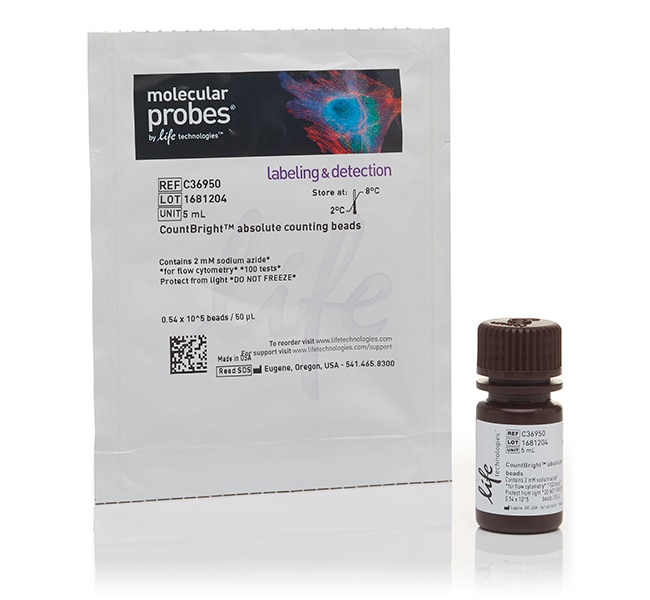
CountBright™ Absolute Counting Beads, for flow cytometry
CountBright™ absolute counting beads are a calibrated suspension of microspheres that are brightly fluorescent across a wide range of excitationRead more
| Catalog Number | Quantity |
|---|---|
| C36950 | 5 mL |
Catalog number C36950
Price (CNY)
3,883.00
飞享价
Ends: 31-Dec-2026
5,108.00Save 1,225.00 (24%)
Each
Quantity:
5 mL
Price (CNY)
3,883.00
飞享价
Ends: 31-Dec-2026
5,108.00Save 1,225.00 (24%)
Each
CountBright™ absolute counting beads are a calibrated suspension of microspheres that are brightly fluorescent across a wide range of excitation and emission wavelengths (UV to 635 nm excitation and 385-800 nm emission). CountBright™ absolute counting beads are mixed with the cell sample and assayed via flow cytometry. By comparing the ratio of bead events to cell events, absolute numbers of cells in the sample can be calculated. Because CountBright™ beads are mixed in the test sample, absolute cell counts using this single-platform method are more accurate and less complicated than cell concentration determined using multiple-platform testing. CountBright™ absolute counting beads can be used with any sample type, including no-wash/lysed whole blood.
View information about all flow cytometry cell counting beads.
View information about all flow cytometry cell counting beads.
For Research Use Only. Not for use in diagnostic procedures.
Specifications
Detection MethodFluorescence
Diameter (Metric)7 μm
EmissionAny Lasers (UV to 633/635)
Excitation Wavelength RangeUV to 635/385 to 800 nm
For Use With (Equipment)Flow Cytometer
FormatSolution
No. of Tests100
Quantity5 mL
Shipping ConditionRoom Temperature
Product LineCountBright
Product TypeCell Counting Bead
Unit SizeEach
Contents & Storage
Contains 1 bottle of CountBright™ absolute counting beads (5 mL). Store in refrigerator (2°C to 8°C) and protect from light.
Frequently asked questions (FAQs)
With the CountBright Plus Absolute Counting Beads/CountBright Absolute Counting Beads, instead of a tight cluster of beads on the scatter plot, I am seeing the beads cover a broad area. What is causing this?
Which buffers can I use with the CountBright Plus Absolute Counting Beads and CountBright Absolute Counting Beads?
How are CountBright Plus Absolute Counting Beads different from CountBright Absolute Counting Beads?
When using the Live/Dead BacLight Bacterial Viability and Counting Kit, for flow cytometry, some cells seem to have both red and green signal. Are these cells dead or alive or dying?
How can I count my bacteria by flow cytometry?
Citations & References (7)
Citations & References
Abstract
An impaired transendothelial migration potential of chronic lymphocytic leukemia (CLL) cells can be linked to ephrin-A4 expression.
Journal:Blood
PubMed ID:19828693
'Chronic lymphocytic leukemia (CLL) cell migration into lymphoid tissues is an important aspect of the pathobiology of this disease. Here, we investigated the role of ephrin-A4 (EFNA4) in the transendothelial migration (TEM) capacity of CLL and normal B cells through interacting with endothelial EphA2 (erythropoietin-producing hepatocellular carcinoma). CLL cells showed
Analysis of microRNA and protein transfer by exosomes during an immune synapse.
Journal:
PubMed ID:23719941
'Immune cells release microRNA-containing exosomes that can be taken up by recipient cells. Exosomes can thus act as mediators of cell-cell communication through direct exchange of genetic material between cells. Exosome-mediated transfer of miRNAs between T cells and antigen-presenting cells (APCs) can take place over long distances. Our work has
Inhibition of NF-?B-mediated signaling by the cyclin-dependent kinase inhibitor CR8 overcomes prosurvival stimuli to induce apoptosis in chronic lymphocytic leukemia cells.
Journal:Clin Cancer Res
PubMed ID:23532892
Chronic lymphocytic leukemia (CLL) is currently incurable with standard chemotherapeutic agents, highlighting the need for novel therapies. Overcoming proliferative and cytoprotective signals generated within the microenvironment of lymphoid organs is essential for limiting CLL progression and ultimately developing a cure. We assessed the potency of cyclin-dependent kinase (CDK) inhibitor CR8,
PKCa negatively regulates in vitro proplatelet formation and in vivo platelet production in mice.
Journal:Platelets
PubMed ID:23402219
Proplatelet formation is a part of the intricate process by which platelets are generated by their precursor cell, the megakaryocyte. The processes that drive megakaryocyte maturation and platelet production are however still not well understood. The protein kinase C (PKC) family of serine/threonine kinases has been demonstrated as an important
CD26 inhibition enhances perfusion recovery in ApoE-/-mice.
Journal:Curr Vasc Pharmacol
PubMed ID:23391419
The adaptive growth of blood vessels is important to prevent tissue loss following arterial occlusion. Extravasation of monocytes is essential for this process. The peptidase CD26 targets SDF-1 alpha, a chemokine regulating monocyte trafficking. We hypothesized that blocking SDF-1 alpha inactivation, using a commercially available CD26 inhibitor, accelerates perfusion recovery