Search


Citations & References (9)
Invitrogen™
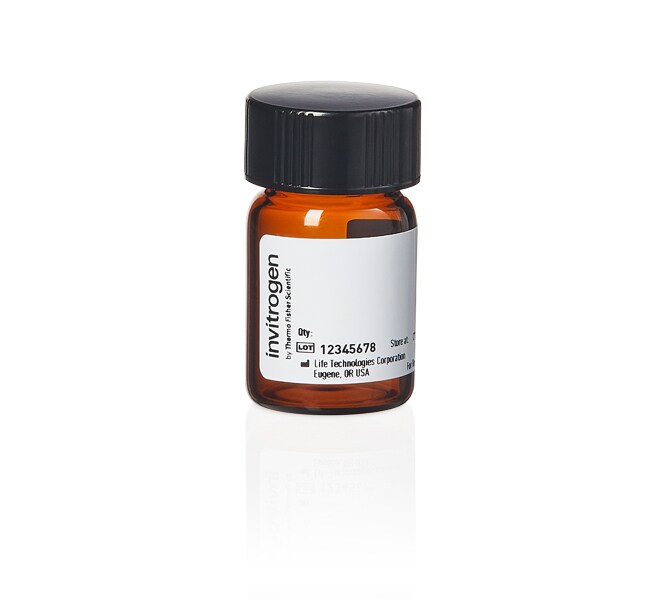
BODIPY™ 558/568 NHS Ester (Succinimidyl Ester)
BODIPY™ 558/568 dye is bright, red fluorescent dye. It has a high extinction coefficient and fluorescence quantum yield and isRead more
| Catalog Number | Quantity |
|---|---|
| D2219 | 5 mg |
Catalog number D2219
Price (CNY)
6,831.00
Each
Quantity:
5 mg
Price (CNY)
6,831.00
Each
BODIPY™ 558/568 dye is bright, red fluorescent dye. It has a high extinction coefficient and fluorescence quantum yield and is relatively insensitive to solvent polarity and pH change. In contrast to the highly water soluble fluorophores Alexa Fluor™ 488 dye and fluorescein (FITC), BODIPY™ dyes have unique hydrophobic properties ideal for staining lipids, membranes, and other lipophilic compounds. BODIPY™ 558/568 dye has a relatively long excited-state lifetime (typically 5 nanoseconds or longer), which is useful for fluorescence polarization-based assays and a large two-photon cross-section for multiphoton excitation. In addition to reactive dye formulations, we offer BODIPY™ 558/568 dye conjugated to a variety of antibodies, peptides, proteins, tracers, and amplification substrates optimized for cellular labeling and detection.
The NHS ester (or succinimidyl ester) of BODIPY™ 558/568 is the most popular tool for conjugating the dye to a protein or antibody. NHS esters can be used to label the primary amines (R-NH2) of proteins, amine-modified oligonucleotides, and other amine-containing molecules. The resulting BODIPY™ 558/568 conjugates exhibit bright fluorescence, narrow emission bandwidths, and relatively long excited-state lifetimes, which can be useful for fluorescence polarization assays and two-photon excitation (TPE) microscopy.
This reactive dye contains a C3 alkyl spacer between the fluorophore and the NHS ester group. This spacer helps to separate the fluorophore from its point of attachment, potentially reducing the interaction of the fluorophore with the biomolecule to which it is conjugated.
Detailed information about this BODIPY™ 558/568 NHS ester:
Fluorophore label: BODIPY™ 558/568 dye
Reactive group: NHS ester (succinimidyl ester)
Reactivity: Primary amines on proteins and ligands, amine-modified oligonucleotides
Ex/Em of the conjugate: 559/568 nm
Extinction coefficient: 97,000 cm-1M-1
Molecular weight: 443.23
Typical Conjugation Reaction
Amine-reactive reagents can be conjugated with virtually any protein or peptide; the provided protocol is optimized for IgG antibodies. The reaction can be scaled for any amount of protein, but the concentration of the protein should be at least 2 mg/mL for optimal results. We recommend trying three different degrees of labeling, using three different molar ratios of the reactive reagent to protein.
The BODIPY™ NHS ester is typically dissolved in high-quality anhydrous dimethylformamide (DMF) or dimethylsulfoxide (DMSO), and the reaction is carried out in 0.1-0.2 M sodium bicarbonate buffer, pH 8.3, at room temperature for 1 hour. Because the pKa of the terminal amine is lower than that of the lysine epsilon-amino group, you may achieve more selective labeling of the amine terminus using a buffer closer to neutral pH.
Conjugate Purification
Labeled antibodies are typically separated from free BODIPY™ dye using a gel filtration column, such as Sephadex™ G-25, BioGel™ P-30, or equivalent. For much larger or smaller proteins, select a gel filtration medium with an appropriate molecular weight cut-off or purify by dialysis. We offer several purification kits optimized for different quantities of antibody conjugate:
Antibody Conjugate Purification Kit for 0.5-1 mg (A33086)
Antibody Conjugate Purification Kit for 20-50 μg (A33087)
Antibody Conjugate Purification kit for 50-100 μg (A33088)
Learn More About Protein and Antibody Labeling
We offer a wide selection of Molecular Probes™ antibody and protein labeling kits to fit your starting material and your experimental setup. See our Antibody Labeling kits or use our Labeling Chemistry Selection Tool for other choices. To learn more about our labeling kits, read Kits for Labeling Proteins and Nucleic Acids—Section 1.2 in The Molecular Probes™ Handbook.
We’ll Make a Custom Conjugate for You
If you can’t find what you’re looking for in our online catalog, we’ll prepare a custom antibody or protein conjugate for you. Our custom conjugation service is efficient and confidential, and we stand by the quality of our work. We are ISO 13485:2000 certified.
The NHS ester (or succinimidyl ester) of BODIPY™ 558/568 is the most popular tool for conjugating the dye to a protein or antibody. NHS esters can be used to label the primary amines (R-NH2) of proteins, amine-modified oligonucleotides, and other amine-containing molecules. The resulting BODIPY™ 558/568 conjugates exhibit bright fluorescence, narrow emission bandwidths, and relatively long excited-state lifetimes, which can be useful for fluorescence polarization assays and two-photon excitation (TPE) microscopy.
This reactive dye contains a C3 alkyl spacer between the fluorophore and the NHS ester group. This spacer helps to separate the fluorophore from its point of attachment, potentially reducing the interaction of the fluorophore with the biomolecule to which it is conjugated.
Detailed information about this BODIPY™ 558/568 NHS ester:
Fluorophore label: BODIPY™ 558/568 dye
Reactive group: NHS ester (succinimidyl ester)
Reactivity: Primary amines on proteins and ligands, amine-modified oligonucleotides
Ex/Em of the conjugate: 559/568 nm
Extinction coefficient: 97,000 cm-1M-1
Molecular weight: 443.23
Typical Conjugation Reaction
Amine-reactive reagents can be conjugated with virtually any protein or peptide; the provided protocol is optimized for IgG antibodies. The reaction can be scaled for any amount of protein, but the concentration of the protein should be at least 2 mg/mL for optimal results. We recommend trying three different degrees of labeling, using three different molar ratios of the reactive reagent to protein.
The BODIPY™ NHS ester is typically dissolved in high-quality anhydrous dimethylformamide (DMF) or dimethylsulfoxide (DMSO), and the reaction is carried out in 0.1-0.2 M sodium bicarbonate buffer, pH 8.3, at room temperature for 1 hour. Because the pKa of the terminal amine is lower than that of the lysine epsilon-amino group, you may achieve more selective labeling of the amine terminus using a buffer closer to neutral pH.
Conjugate Purification
Labeled antibodies are typically separated from free BODIPY™ dye using a gel filtration column, such as Sephadex™ G-25, BioGel™ P-30, or equivalent. For much larger or smaller proteins, select a gel filtration medium with an appropriate molecular weight cut-off or purify by dialysis. We offer several purification kits optimized for different quantities of antibody conjugate:
Antibody Conjugate Purification Kit for 0.5-1 mg (A33086)
Antibody Conjugate Purification Kit for 20-50 μg (A33087)
Antibody Conjugate Purification kit for 50-100 μg (A33088)
Learn More About Protein and Antibody Labeling
We offer a wide selection of Molecular Probes™ antibody and protein labeling kits to fit your starting material and your experimental setup. See our Antibody Labeling kits or use our Labeling Chemistry Selection Tool for other choices. To learn more about our labeling kits, read Kits for Labeling Proteins and Nucleic Acids—Section 1.2 in The Molecular Probes™ Handbook.
We’ll Make a Custom Conjugate for You
If you can’t find what you’re looking for in our online catalog, we’ll prepare a custom antibody or protein conjugate for you. Our custom conjugation service is efficient and confidential, and we stand by the quality of our work. We are ISO 13485:2000 certified.
For Research Use Only. Not for use in diagnostic procedures.
Specifications
Chemical ReactivityAmine
Emission568 nm
Excitation559 nm
Label or DyeBODIPY™ 558⁄568
Product TypeDye
Quantity5 mg
Reactive MoietyActive Ester, Succinimidyl Ester
Shipping ConditionRoom Temperature
Label TypeBODIPY Dyes
Product LineBODIPY
Unit SizeEach
Contents & Storage
Store in freezer (-5 to -30°C) and protect from light.
Citations & References (9)
Citations & References
Abstract
E2A activity is induced during B-cell activation to promote immunoglobulin class switch recombination.
Journal:EMBO J
PubMed ID:10562543
'The basic helix-loop-helix protein, E2A, is required for proper early B lymphopoiesis. Specifically, in E2A-deficient mice, B-cell development is blocked at the progenitor stage prior to the onset of immunoglobulin (Ig) V(D)J recombination. Here, we demonstrate that E2A plays an additional role during peripheral B lymphopoiesis. Upon activation of primary
FRET analysis of protein conformational change through position-specific incorporation of fluorescent amino acids.
Journal:Nat Methods
PubMed ID:17060916
'We designed and synthesized new, fluorescent, non-natural amino acids that emit fluorescence of wavelengths longer than 500 nm and are accepted by an Escherichia coli cell-free translation system. We synthesized p-aminophenylalanine derivatives linked with BODIPY fluorophores at the p-amino group and introduced them into streptavidin using the four-base codon CGGG
Flow cytometry-based biosensor for detection of multivalent proteins.
Journal:Anal Biochem
PubMed ID:10933853
'Microsphere-based flow cytometric detection of cholera toxin (CT) through distance-dependent fluorescence resonant energy transfer (FRET) has been developed. Simultaneous double-fluorescence changes induced by multivalent interactions between CT and fluorophore (both fluorescence donor and acceptor)-labeled ganglioside GM1 on a biomimetic membrane surface (supported bilayers of phospholipids) can be measured by a
ER-Tracker dye and BODIPY-brefeldin A differentiate the endoplasmic reticulum and golgi bodies from the tubular-vacuole system in living hyphae of Pisolithus tinctorius.
Journal:J Microsc
PubMed ID:10692127
Two fluorochromes, ER-TrackerTM Blue-White DPX dye and the fluorescent brefeldin A (BFA) derivative, BODIPY-BFA, label the endoplasmic reticulum (ER) in hyphal tips of Pisolithus tinctorius and allow its differentiation from the tubular-vacuole system at the light microscope level in living cells. The ER-Tracker dye labels a reticulate network similar in
Ultrasensitive hybridization analysis using fluorescence correlation spectroscopy.
Journal:Nucleic Acids Res
PubMed ID:7784185
The hybridization of fluorescently tagged 18mer deoxyribonucleotides with complementary DNA templates was analysed by fluorescence correlation spectroscopy (FCS) in a droplet under an epi-illuminated fluorescence microscope at the level of single molecules. The interaction can be monitored by the change in the translational diffusion time of the smaller (18mer) primer