Search


Citations & References (11)
Invitrogen™
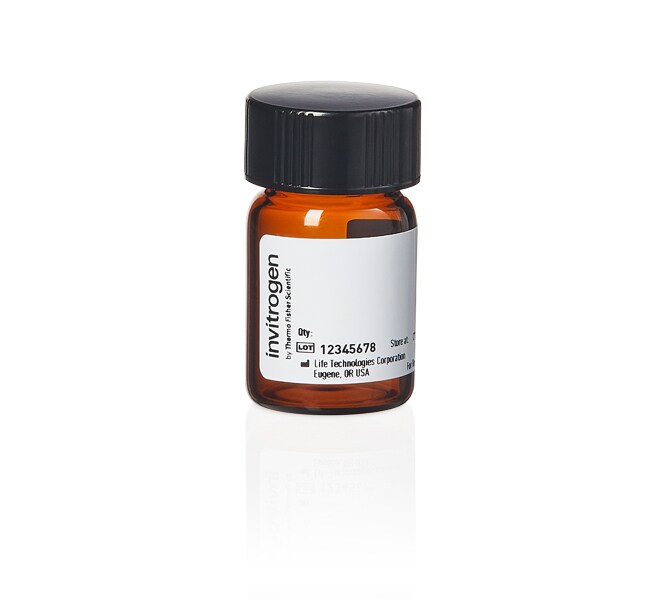
BODIPY™ TR-X NHS Ester (Succinimidyl Ester)
BODIPY™ TR-X dye is bright, red fluorescent dye with similar excitation and emission to Texas Red™ or Alexa Fluor™ 594Read more
| Catalog Number | Quantity |
|---|---|
| D6116 | 5 mg |
Catalog number D6116
Price (CNY)
6,913.00
Each
Quantity:
5 mg
Price (CNY)
6,913.00
Each
BODIPY™ TR-X dye is bright, red fluorescent dye with similar excitation and emission to Texas Red™ or Alexa Fluor™ 594 dye. It has a high extinction coefficient and fluorescence quantum yield and is relatively insensitive to solvent polarity and pH change. In contrast to the highly water soluble fluorophores Alexa Fluor™ 488 dye and fluorescein (FITC), BODIPY™ dyes have unique hydrophobic properties ideal for staining lipids, membranes, and other lipophilic compounds. BODIPY™ TR-X dye has a relatively long excited-state lifetime (typically 5 nanoseconds or longer), which is useful for fluorescence polarization-based assays and a large two-photon cross-section for multiphoton excitation. In addition to reactive dye formulations, we offer BODIPY™ TR-X dye conjugated to a variety of antibodies, peptides, proteins, tracers, and amplification substrates optimized for cellular labeling and detection.
The NHS ester (or succinimidyl ester) of BODIPY™ TR-X is the most popular tool for conjugating the dye to a protein or antibody. NHS esters can be used to label the primary amines (R-NH2) of proteins, amine-modified oligonucleotides, and other amine-containing molecules. The resulting BODIPY™ TR-X conjugates exhibit bright fluorescence, narrow emission bandwidths, and relatively long excited-state lifetimes, which can be useful for fluorescence polarization assays and two-photon excitation (TPE) microscopy.
This reactive dye contains a seven-atom aminohexanoyl ('X') spacer between the fluorophore and the NHS ester group. This spacer helps to separate the fluorophore from its point of attachment, potentially reducing the interaction of the fluorophore with the biomolecule to which it is conjugated.
Detailed information about this BODIPY™ TR-X NHS ester:
Fluorophore label: BODIPY™ TR-X dye
Reactive group: NHS ester (succinimidyl ester)
Reactivity: Primary amines on proteins and ligands, amine-modified oligonucleotides
Ex/Em of the conjugate: 588/616 nm
Extinction coefficient: 68,000 cm-1M-1
Molecular weight: 634.46
Typical Conjugation Reaction
Amine-reactive reagents can be conjugated with virtually any protein or peptide; the provided protocol is optimized for IgG antibodies. The reaction can be scaled for any amount of protein, but the concentration of the protein should be at least 2 mg/mL for optimal results. We recommend trying three different degrees of labeling, using three different molar ratios of the reactive reagent to protein.
The BODIPY™ NHS ester is typically dissolved in high-quality anhydrous dimethylformamide (DMF) or dimethylsulfoxide (DMSO), and the reaction is carried out in 0.1-0.2 M sodium bicarbonate buffer, pH 8.3, at room temperature for 1 hour. Because the pKa of the terminal amine is lower than that of the lysine epsilon-amino group, you may achieve more selective labeling of the amine terminus using a buffer closer to neutral pH.
Conjugate Purification
Labeled antibodies are typically separated from free BODIPY™ dye using a gel filtration column, such as Sephadex™ G-25, BioGel™ P-30, or equivalent. For much larger or smaller proteins, select a gel filtration medium with an appropriate molecular weight cut-off or purify by dialysis. We offer several purification kits optimized for different quantities of antibody conjugate:
Antibody Conjugate Purification Kit for 0.5-1 mg (A33086)
Antibody Conjugate Purification Kit for 20-50 μg (A33087)
Antibody Conjugate Purification kit for 50-100 μg (A33088)
Learn More About Protein and Antibody Labeling
We offer a wide selection of Molecular Probes™ antibody and protein labeling kits to fit your starting material and your experimental setup. See our Antibody Labeling kits or use our Labeling Chemistry Selection Tool for other choices. To learn more about our labeling kits, read Kits for Labeling Proteins and Nucleic Acids—Section 1.2 in The Molecular Probes™ Handbook.
We’ll Make a Custom Conjugate for You
If you can’t find what you’re looking for in our online catalog, we’ll prepare a custom antibody or protein conjugate for you. Our custom conjugation service is efficient and confidential, and we stand by the quality of our work. We are ISO 13485:2000 certified.
The NHS ester (or succinimidyl ester) of BODIPY™ TR-X is the most popular tool for conjugating the dye to a protein or antibody. NHS esters can be used to label the primary amines (R-NH2) of proteins, amine-modified oligonucleotides, and other amine-containing molecules. The resulting BODIPY™ TR-X conjugates exhibit bright fluorescence, narrow emission bandwidths, and relatively long excited-state lifetimes, which can be useful for fluorescence polarization assays and two-photon excitation (TPE) microscopy.
This reactive dye contains a seven-atom aminohexanoyl ('X') spacer between the fluorophore and the NHS ester group. This spacer helps to separate the fluorophore from its point of attachment, potentially reducing the interaction of the fluorophore with the biomolecule to which it is conjugated.
Detailed information about this BODIPY™ TR-X NHS ester:
Fluorophore label: BODIPY™ TR-X dye
Reactive group: NHS ester (succinimidyl ester)
Reactivity: Primary amines on proteins and ligands, amine-modified oligonucleotides
Ex/Em of the conjugate: 588/616 nm
Extinction coefficient: 68,000 cm-1M-1
Molecular weight: 634.46
Typical Conjugation Reaction
Amine-reactive reagents can be conjugated with virtually any protein or peptide; the provided protocol is optimized for IgG antibodies. The reaction can be scaled for any amount of protein, but the concentration of the protein should be at least 2 mg/mL for optimal results. We recommend trying three different degrees of labeling, using three different molar ratios of the reactive reagent to protein.
The BODIPY™ NHS ester is typically dissolved in high-quality anhydrous dimethylformamide (DMF) or dimethylsulfoxide (DMSO), and the reaction is carried out in 0.1-0.2 M sodium bicarbonate buffer, pH 8.3, at room temperature for 1 hour. Because the pKa of the terminal amine is lower than that of the lysine epsilon-amino group, you may achieve more selective labeling of the amine terminus using a buffer closer to neutral pH.
Conjugate Purification
Labeled antibodies are typically separated from free BODIPY™ dye using a gel filtration column, such as Sephadex™ G-25, BioGel™ P-30, or equivalent. For much larger or smaller proteins, select a gel filtration medium with an appropriate molecular weight cut-off or purify by dialysis. We offer several purification kits optimized for different quantities of antibody conjugate:
Antibody Conjugate Purification Kit for 0.5-1 mg (A33086)
Antibody Conjugate Purification Kit for 20-50 μg (A33087)
Antibody Conjugate Purification kit for 50-100 μg (A33088)
Learn More About Protein and Antibody Labeling
We offer a wide selection of Molecular Probes™ antibody and protein labeling kits to fit your starting material and your experimental setup. See our Antibody Labeling kits or use our Labeling Chemistry Selection Tool for other choices. To learn more about our labeling kits, read Kits for Labeling Proteins and Nucleic Acids—Section 1.2 in The Molecular Probes™ Handbook.
We’ll Make a Custom Conjugate for You
If you can’t find what you’re looking for in our online catalog, we’ll prepare a custom antibody or protein conjugate for you. Our custom conjugation service is efficient and confidential, and we stand by the quality of our work. We are ISO 13485:2000 certified.
For Research Use Only. Not for use in diagnostic procedures.
Specifications
Chemical ReactivityAmine
Emission616 nm
Excitation588 nm
Label or DyeBODIPY™ TR
Product TypeDye
Quantity5 mg
Reactive MoietyActive Ester, Succinimidyl Ester
Shipping ConditionRoom Temperature
Label TypeBODIPY Dyes
Product LineBODIPY
Unit SizeEach
Contents & Storage
Store in freezer (-5 to -30°C) and protect from light.
Citations & References (11)
Citations & References
Abstract
Simultaneous red/green dual fluorescence detection on electroblots using BODIPY TR-X succinimidyl ester and ELF 39 phosphate.
Journal:Proteomics
PubMed ID:11987124
'A two-color fluorescence detection method is described based upon covalently coupling the succinimidyl ester of BODIPY TR-X dye to proteins immobilized on polyvinylidene difluoride membranes, followed by detection of target proteins using the fluorogenic, precipitating substrate ELF 39-phosphate in combination with alkaline phosphatase conjugated reporter molecules. This results in all
Multiphoton confocal microscopy using a femtosecond Cr:forsterite laser.
Journal:Scanning
PubMed ID:11534811
'With its output wavelength covering the infrared penetrating window of most biological tissues at 1,200-1,250 nm, the femtosecond Cr:forsterite laser shows high potential to serve as an excellent excitation source for the multiphoton fluorescence microscope. Its high output power, short optical pulse width, high stability, and low dispersion in fibers
Single-molecule detection of specific nucleic acid sequences in unamplified genomic DNA.
Journal:Anal Chem
PubMed ID:9322430
'A new technique is described for the rapid detection of specific nucleic acid sequences in unamplified DNA samples. The method consists of using two nucleic acid probes complementary to different sites on a target DNA sequence. The two probes are each labeled with different fluorescent dyes. When mixed with a
Protein-free parallel triple-stranded DNA complex formation.
Journal:Nucleic Acids Res
PubMed ID:11160932
'A 14 nt DNA sequence 5''-AGAATGTGGCAAAG-3'' from the zinc finger repeat of the human KRAB zinc finger protein gene ZNF91 bearing the intercalator 2-methoxy,6-chloro,9-amino acridine (Acr) attached to the sugar-phosphate backbone in various positions has been shown to form a specific triple helix (triplex) with a 16 bp hairpin (intramolecular)
Rapid determination of single base mismatch mutations in DNA hybrids by direct electric field control.
Journal:Proc Natl Acad Sci U S A
PubMed ID:9037016
'We have demonstrated that controlled electric fields can be used to regulate transport, concentration, hybridization, and denaturation of single- and double-stranded oligonucleotides. Discrimination among oligonucleotide hybrids with widely varying binding strengths may be attained by simple adjustment of the electric field strength. When this approach is used, electric field denaturation