Search


Citations & References (5)
Invitrogen™
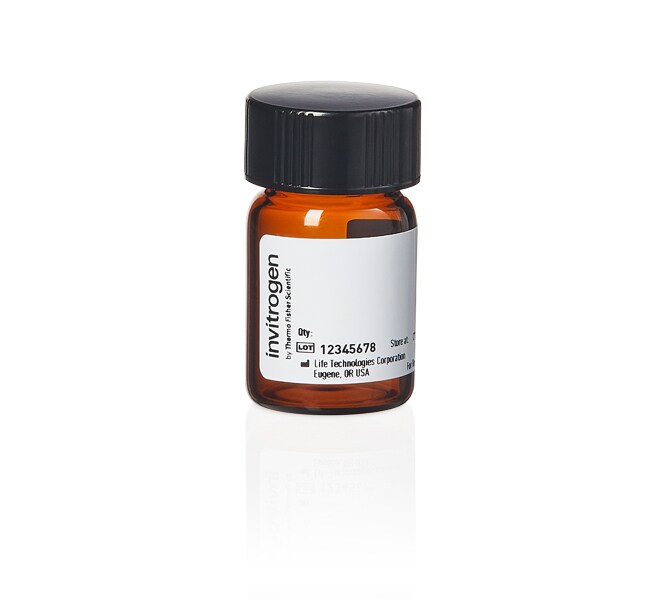
BODIPY™ FL-C5 NHS Ester (Succinimidyl Ester)
BODIPY™ FL-C5 dye is bright, green fluorescent dye with similar excitation and emission to fluorescein (FITC) or Alexa Fluor™ 488Read more
| Catalog Number | Quantity |
|---|---|
| D6184 also known as D-6184 | 5 mg |
Catalog number D6184
also known as D-6184
Price (CNY)
6,780.00
Each
Quantity:
5 mg
Price (CNY)
6,780.00
Each
BODIPY™ FL-C5 dye is bright, green fluorescent dye with similar excitation and emission to fluorescein (FITC) or Alexa Fluor™ 488 dye. It has a high extinction coefficient and fluorescence quantum yield and is relatively insensitive to solvent polarity and pH change. In contrast to the highly water soluble fluorophores Alexa Fluor™ 488 dye and fluorescein (FITC), BODIPY™ dyes have unique hydrophobic properties ideal for staining lipids, membranes, and other lipophilic compounds. BODIPY™ FL-C5 dye has a relatively long excited-state lifetime (typically 5 nanoseconds or longer), which is useful for fluorescence polarization-based assays and a large two-photon cross-section for multiphoton excitation. In addition to reactive dye formulations, we offer BODIPY™ FL-C5 dye conjugated to a variety of antibodies, peptides, proteins, tracers, and amplification substrates optimized for cellular labeling and detection (learn more).
The NHS ester (or succinimidyl ester) of BODIPY™ FL-C5 is the most popular tool for conjugating the dye to a protein or antibody. NHS esters can be used to label the primary amines (R-NH2) of proteins, amine-modified oligonucleotides, and other amine-containing molecules. The resulting BODIPY™ FL-C5 conjugates exhibit bright fluorescence, narrow emission bandwidths, and relatively long excited-state lifetimes, which can be useful for fluorescence polarization assays and two-photon excitation (TPE) microscopy.
This reactive dye contains a C5 alkyl spacer between the fluorophore and the NHS ester group. This spacer helps to separate the fluorophore from its point of attachment, potentially reducing the interaction of the fluorophore with the biomolecule to which it is conjugated.
Detailed information about this BODIPY™ FL-C5 NHS ester:
Fluorophore label: BODIPY™ FL-C5 dye
Reactive group: NHS ester (succinimidyl ester)
Reactivity: Primary amines on proteins and ligands, amine-modified oligonucleotides
Ex/Em of the conjugate: 504/511 nm
Extinction coefficient: 87,000 cm-1M-2
Molecular weight: 417.22
Typical Conjugation Reaction
Amine-reactive reagents can be conjugated with virtually any protein or peptide; the provided protocol is optimized for IgG antibodies. The reaction can be scaled for any amount of protein, but the concentration of the protein should be at least 2 mg/mL for optimal results. We recommend trying three different degrees of labeling, using three different molar ratios of the reactive reagent to protein.
The BODIPY™ NHS ester is typically dissolved in high-quality anhydrous dimethylformamide (DMF) or dimethylsulfoxide (DMSO), and the reaction is carried out in 0.1-0.2 M sodium bicarbonate buffer, pH 8.3, at room temperature for 1 hour. Because the pKa of the terminal amine is lower than that of the lysine epsilon-amino group, you may achieve more selective labeling of the amine terminus using a buffer closer to neutral pH.
Conjugate Purification
Labeled antibodies are typically separated from free BODIPY™ dye using a gel filtration column, such as Sephadex™ G-25, BioGel™ P-30, or equivalent. For much larger or smaller proteins, select a gel filtration medium with an appropriate molecular weight cut-off or purify by dialysis. We offer several purification kits optimized for different quantities of antibody conjugate:
Antibody Conjugate Purification Kit for 0.5-1 mg (A33086)
Antibody Conjugate Purification Kit for 20-50 μg (A33087)
Antibody Conjugate Purification kit for 50-100 μg (A33088)
Learn More About Protein and Antibody Labeling
We offer a wide selection of Molecular Probes™ antibody and protein labeling kits to fit your starting material and your experimental setup. See our Antibody Labeling kits or use our Labeling Chemistry Selection Tool for other choices. To learn more about our labeling kits, read Kits for Labeling Proteins and Nucleic Acids—Section 1.2 in The Molecular Probes™ Handbook.
We’ll Make a Custom Conjugate for You
If you can’t find what you’re looking for in our online catalog, we’ll prepare a custom antibody or protein conjugate for you. Our custom conjugation service is efficient and confidential, and we stand by the quality of our work. We are ISO 13485:2000 certified.
The NHS ester (or succinimidyl ester) of BODIPY™ FL-C5 is the most popular tool for conjugating the dye to a protein or antibody. NHS esters can be used to label the primary amines (R-NH2) of proteins, amine-modified oligonucleotides, and other amine-containing molecules. The resulting BODIPY™ FL-C5 conjugates exhibit bright fluorescence, narrow emission bandwidths, and relatively long excited-state lifetimes, which can be useful for fluorescence polarization assays and two-photon excitation (TPE) microscopy.
This reactive dye contains a C5 alkyl spacer between the fluorophore and the NHS ester group. This spacer helps to separate the fluorophore from its point of attachment, potentially reducing the interaction of the fluorophore with the biomolecule to which it is conjugated.
Detailed information about this BODIPY™ FL-C5 NHS ester:
Fluorophore label: BODIPY™ FL-C5 dye
Reactive group: NHS ester (succinimidyl ester)
Reactivity: Primary amines on proteins and ligands, amine-modified oligonucleotides
Ex/Em of the conjugate: 504/511 nm
Extinction coefficient: 87,000 cm-1M-2
Molecular weight: 417.22
Typical Conjugation Reaction
Amine-reactive reagents can be conjugated with virtually any protein or peptide; the provided protocol is optimized for IgG antibodies. The reaction can be scaled for any amount of protein, but the concentration of the protein should be at least 2 mg/mL for optimal results. We recommend trying three different degrees of labeling, using three different molar ratios of the reactive reagent to protein.
The BODIPY™ NHS ester is typically dissolved in high-quality anhydrous dimethylformamide (DMF) or dimethylsulfoxide (DMSO), and the reaction is carried out in 0.1-0.2 M sodium bicarbonate buffer, pH 8.3, at room temperature for 1 hour. Because the pKa of the terminal amine is lower than that of the lysine epsilon-amino group, you may achieve more selective labeling of the amine terminus using a buffer closer to neutral pH.
Conjugate Purification
Labeled antibodies are typically separated from free BODIPY™ dye using a gel filtration column, such as Sephadex™ G-25, BioGel™ P-30, or equivalent. For much larger or smaller proteins, select a gel filtration medium with an appropriate molecular weight cut-off or purify by dialysis. We offer several purification kits optimized for different quantities of antibody conjugate:
Antibody Conjugate Purification Kit for 0.5-1 mg (A33086)
Antibody Conjugate Purification Kit for 20-50 μg (A33087)
Antibody Conjugate Purification kit for 50-100 μg (A33088)
Learn More About Protein and Antibody Labeling
We offer a wide selection of Molecular Probes™ antibody and protein labeling kits to fit your starting material and your experimental setup. See our Antibody Labeling kits or use our Labeling Chemistry Selection Tool for other choices. To learn more about our labeling kits, read Kits for Labeling Proteins and Nucleic Acids—Section 1.2 in The Molecular Probes™ Handbook.
We’ll Make a Custom Conjugate for You
If you can’t find what you’re looking for in our online catalog, we’ll prepare a custom antibody or protein conjugate for you. Our custom conjugation service is efficient and confidential, and we stand by the quality of our work. We are ISO 13485:2000 certified.
For Research Use Only. Not for use in diagnostic procedures.
Specifications
Chemical ReactivityAmine
Emission511 nm
Excitation504 nm
Label or DyeBODIPY™ FL
Product TypeDye
Quantity5 mg
Reactive MoietyActive Ester, Succinimidyl Ester
Shipping ConditionRoom Temperature
Label TypeBODIPY Dyes
Product LineBODIPY
Unit SizeEach
Contents & Storage
Store in freezer (-5 to -30°C) and protect from light.
Citations & References (5)
Citations & References
Abstract
The dynamin-dependent, arrestin-independent internalization of 5-hydroxytryptamine 2A (5-HT2A) serotonin receptors reveals differential sorting of arrestins and 5-HT2A receptors during endocytosis.
Journal:J Biol Chem
PubMed ID:11069907
'5-Hydroxytryptamine 2A (5-HT2A) receptors, a major site of action of clozapine and other atypical antipsychotic medications, are, paradoxically, internalized in vitro and in vivo by antagonists and agonists. The mechanisms responsible for this paradoxical regulation of 5-HT2A receptors are unknown. In this study, the arrestin and dynamin dependences of agonist-
Real experiences of uHTS: a prototypic 1536-well fluorescence anisotropy-based uHTS screen and application of well-level quality control procedures.
Journal:J Biomol Screen
PubMed ID:11689128
This paper describes, for the first time, a true ultra-high throughput screen (uHTS) based upon fluorescence anisotropy and performed entirely in 1536-well assay plates. The assay is based upon binding and displacement of a BODIPY-FL-labeled antibiotic to a specific binding site on 70S ribosomes from Escherichia coli (Kd approximately 15
Donor-donor energy migration (DDEM) as a tool for studying aggregation in lipid phases.
Journal:Spectrochim Acta A Mol Biomol Spectrosc
PubMed ID:11506035
A BODIPY-labelled sulfatide (N-(BODIPY-FL-pentanoyl)-galactosylcerebroside-sulfate, hereafter abbreviated as BD-Sulfatide) was solubilised at different concentrations in lipid vesicles of 1,2-dioleoyl-sn-glycero-3-phosphocholine (DOPC). Time-correlated single photon counting experiments show that the fluorescence relaxation is mono-exponential (with a lifetime of 6.5 ns) at molar ratios of BD-Sulfatide: DOPC that are less than 1:100. The fluorescence
Different sphingolipids show differential partitioning into sphingolipid/cholesterol-rich domains in lipid bilayers.
Journal:Biophys J
PubMed ID:10969009
Two fluorescence-based approaches have been applied to examine the differential partitioning of fluorescent phospho- and sphingolipid molecules into sphingolipid-enriched domains modeling membrane "lipid rafts." Fluorescence-quenching measurements reveal that N-(diphenylhexatrienyl)propionyl- (DPH3:0-)-labeled gluco- and galactocerebroside partition into sphingolipid-enriched domains in sphingolipid/phosphatidylcholine/cholesterol bilayers with substantially higher affinity than do analogous sphingomyelin, ceramide, or
Functional characterization of coding polymorphisms in the human MDR1 gene using a vaccinia virus expression system.
Journal:Mol Pharmacol
PubMed ID:12065748
The human MDR1-encoded transporter is a 170-kDa plasma membrane glycoprotein [P-glycoprotein (P-gp)] capable of binding and energy-dependent extrusion of structurally diverse organic compounds and drugs. P-gp seems to play a significant role in uptake, distribution, and excretion of many different drugs. To determine whether common polymorphic forms of P-gp are