Search


Citations & References (4)
Invitrogen™
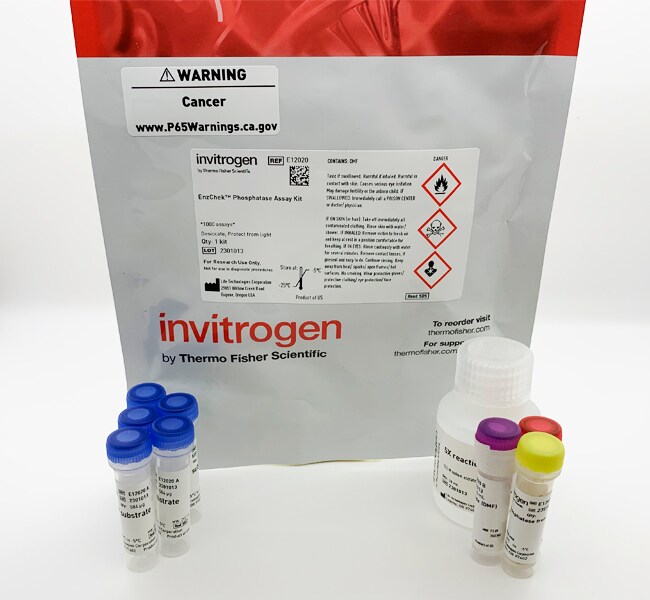
EnzChek™ Phosphatase Assay Kit
Continuous assay of prostatic acid phosphatase and protein phosphatase 1
| Catalog Number | Quantity |
|---|---|
| E12020 | 1000 Assays |
Catalog number E12020
Price (CNY)
4,585.00
Each
Quantity:
1000 Assays
Price (CNY)
4,585.00
Each
Using the EnzChek Phosphatase Assay Kit continuous monitoring of phosphatase activity, even at neutral or acidic pH, can be achieved. The kit contains Molecular Probes' patented 6,8-difluoro-4-methylumbelliferyl phosphate (DiFMUP) substrate (D6567). DiFMUP is about 100 times more sensitive than 4-methylumbelliferyl phosphate (MUP) for the detection of prostatic acid phosphatase at pH 5.5. The kit is perfect for the continuous assay of prostatic acid phosphatase, protein phosphatase 1 or almost any other phosphatase that can be assayed with nonprotein-based substrates such as MUP or 4-nitrophenyl phosphate (PNPP). Each kit contains a sufficient amount of substrate for ∼1000 assays, using a reaction volume of 100 μL per assay. Fluorescence (excitation/emission maxima ∼358/455 nm) can be measured in a fluorescence microplate reader or a standard fluorometer.
For Research Use Only. Not for use in diagnostic procedures.
Specifications
Detection MethodFluorescence
Dye TypeDiFMU
Emission Wavelength455 nm
Excitation Wavelength358 nm
Quantity1000 Assays
Shipping ConditionRoom Temperature
SubstrateDiFMUP
Substrate PropertiesChemical Substrate
Substrate TypePhosphatase Substrate
Target EnzymePhosphatases
ColorBlue
For Use With (Application)Enzyme and Metabolic Activity
For Use With (Equipment)Microplate Reader
Product LineEnzChek
Product TypeEnzChek Assay Kit
Unit SizeEach
Contents & Storage
Store in freezer -5°C to -30°C and protect from light.
Frequently asked questions (FAQs)
What is the reaction product excitation/emission maxima when using the EnzChek Phosphatase Assay kit?
Citations & References (4)
Citations & References
Abstract
Plectin scaffolds recruit energy-controlling AMP-activated protein kinase (AMPK) in differentiated myofibres.
Journal:J Cell Sci
PubMed ID:16608880
'Plectin, a cytolinker protein greater than 500 kDa in size, has an important role as a mechanical stabiliser of cells. It interlinks the various cytoskeletal filament systems and anchors intermediate filaments to peripheral junctional complexes. In addition, there is increasing evidence that plectin acts as a scaffolding platform that controls
The Down syndrome critical region protein RCAN1 regulates long-term potentiation and memory via inhibition of phosphatase signaling.
Journal:J Neurosci
PubMed ID:18045910
'Regulator of calcineurin 1 (RCAN1/MCIP1/DSCR1) regulates the calmodulin-dependent phosphatase calcineurin. Because it is located on human chromosome 21, RCAN1 has been postulated to contribute to mental retardation in Down syndrome and has been reported to be associated with neuronal degeneration in Alzheimer''s disease. The studies herein are the first to
Adenovirus-facilitated nuclear translocation of adeno-associated virus type 2.
Journal:J Virol
PubMed ID:12388712
'We examined cytoplasmic trafficking and nuclear translocation of adeno-associated virus type 2 (AAV) by using Alexa Fluor 488-conjugated wild-type AAV, A20 monoclonal antibody immunocytochemistry, and subcellular fractionation techniques followed by DNA hybridization. Our results indicated that in the absence of adenovirus (Ad), AAV enters the cell rapidly and escapes from
Redox modulation of global phosphatase activity and protein phosphorylation in intact skeletal muscle.
Journal:J Physiol
PubMed ID:19841000
Skeletal muscles produce transient reactive oxygen species (ROS) in response to intense stimulation, disuse atrophy, heat stress, hypoxia, osmotic stress, stretch and cell receptor activation. The physiological significance is not well understood. Protein phosphatases (PPases) are known to be highly sensitive to oxidants and could contribute to many different signalling