Search


Citations & References (4)
Invitrogen™
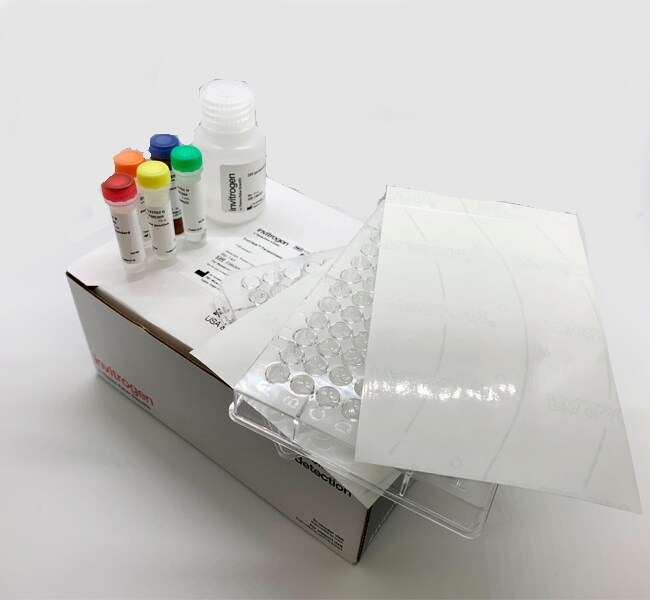
EnzChek™ Paraoxonase Assay Kit
The EnzChek™ Paraoxonase Assay Kit is a highly sensitive, homogenous fluorometric assay for the organophosphatase acitivty of paraoxonase. Based onRead more
| Catalog Number | Quantity |
|---|---|
| E33702 | 1 Kit |
Catalog number E33702
Price (CNY)
9,622.00
Each
Quantity:
1 Kit
Price (CNY)
9,622.00
Each
The EnzChek™ Paraoxonase Assay Kit is a highly sensitive, homogenous fluorometric assay for the organophosphatase acitivty of paraoxonase. Based on the hydrolysis of a fluorogenic analog, this assay is >10-fold more sensitive than the colorimetric assay, and unlike the colorimetric assay, can distinguish samples of very similar paraoxonase activity. Under standard conditions, the assay requires only 5 μl of serum, yields a signal in as little as 15 minutes, and is linear for up to 50 minutes. The assay requires only a single reaction that can be either continuously monitored or terminated using the stop reagent included in the kit.
For Research Use Only. Not for use in diagnostic procedures.
Specifications
Detection MethodFluorescence
Quantity1 Kit
Shipping ConditionRoom Temperature
Substrate TypeParaoxonase Substrate
Target EnzymeParaoxonases
For Use With (Application)Paraoxonase Assay
Product LineEnzChek
Product TypeEnzChek Assay Kit
Unit SizeEach
Contents & Storage
Store in freezer -5°C to -30°C.
Citations & References (4)
Citations & References
Abstract
Increased serum advanced glycation end products are associated with impairment in HDL antioxidative capacity in diabetic nephropathy.
Journal:Nephrol Dial Transplant
PubMed ID:18065800
'Advanced glycation end products (AGEs) play an important role in the pathogenesis of diabetic complications. Recent data suggest that AGEs may also interfere with the function of HDL and the reverse cholesterol transport pathway. We have investigated whether serum AGE level is associated with impairment in the antioxidative capacity of
An apolipoprotein A-I mimetic dose-dependently increases the formation of prebeta1 HDL in human plasma.
Journal:J Lipid Res
PubMed ID:18056684
'Prebeta1 HDL is the initial plasma acceptor of cell-derived cholesterol in reverse cholesterol transport. Recently, small amphipathic peptides composed of D-amino acids have been shown to mimic apolipoprotein A-I (apoA-I) as a precursor for HDL formation. ApoA-I mimetic peptides have been proposed to stimulate the formation of prebeta1 HDL and
Exercise and diet induced weight loss improves measures of oxidative stress and insulin sensitivity in adults with characteristics of the metabolic syndrome.
Journal:Am J Physiol Endocrinol Metab
PubMed ID:17473052
'Obesity and insulin resistance (IR) increase the risk for coronary heart disease; however, much of this risk is not attributable to traditional risk factors. We sought to determine whether weight loss associated with supervised aerobic exercise beneficially alters biomarkers of oxidative stress and whether these alterations are associated with improvements
The antiatherogenic function of HDL is impaired in hyperhomocysteinemic subjects.
Journal:J Nutr
PubMed ID:18936200
High plasma homocysteine concentrations have been associated with increased risk of cardiovascular disease, whereas plasma HDL concentration is inversely correlated to such disorders. We hypothesized that hyperhomocysteinemic subjects may have dysfunctional HDL. We therefore investigated the ability of serum from hyperhomocysteinemic male and female subjects (n = 10) and control