Search

Thermo Scientific™
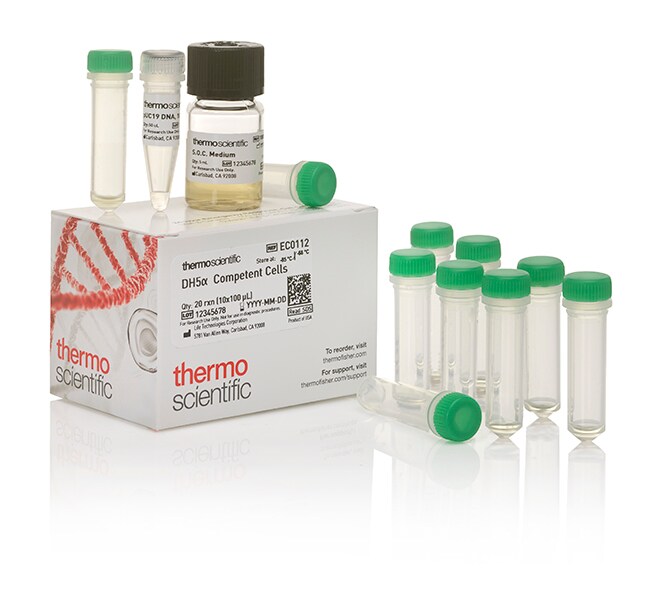
DH5α Competent Cells
Thermo Scientific DH5α Competent Cells are high efficiency, chemically competent E. coli cells ideal for construction of gene banks orRead more
| Catalog Number | Quantity |
|---|---|
| EC0112 | 10 x 100 μL |
Catalog number EC0112
Price (CNY)
964.00
Online exclusive
Ends: 31-Dec-2026
1,285.00Save 321.00 (25%)
Each
Quantity:
10 x 100 μL
Price (CNY)
964.00
Online exclusive
Ends: 31-Dec-2026
1,285.00Save 321.00 (25%)
Each
Thermo Scientific DH5α Competent Cells are high efficiency, chemically competent E. coli cells ideal for construction of gene banks or generation of cDNA libraries using plasmid-derived vectors. The φ80dlacZΔM15 marker provides α-complementation of the β-galactosidase gene from pUC or similar vectors to allow blue/white colony screening on bacterial agar plates containing Bluo-Gal or X-Gal. RecA1 and endA1 mutations in DH5α cells improve insert stability and quality of the extracted plasmid DNA.
• High transformation efficiency: >1x10⁹ cfu/μg pUC19 DNA
• Suitable for routine and high-throughput cloning applications
• Genetic markers that allow for blue/white colony screening
• Convenient two reactions per vial packaging
• S.O.C. Outgrowth medium included
Applications
DH5α Competent Cells are suitable for variety of applications requiring high transformation efficiency:
• Efficient DNA cloning derived from PCR, cDNA-generation reactions
• recA1 marker facilitates working with difficult to transform DNA
• Ideal for generation of cDNA libraries using plasmid-derived vectors
• Site-directed mutagenesis
Genotype
F– φ80lacZΔ M15 Δ (lacZYA-argF) U169 recA1 endA1 hsdR17 (rK– mK+) phoA supE44 λ- thi–1 gyrA96 relA1
• High transformation efficiency: >1x10⁹ cfu/μg pUC19 DNA
• Suitable for routine and high-throughput cloning applications
• Genetic markers that allow for blue/white colony screening
• Convenient two reactions per vial packaging
• S.O.C. Outgrowth medium included
Applications
DH5α Competent Cells are suitable for variety of applications requiring high transformation efficiency:
• Efficient DNA cloning derived from PCR, cDNA-generation reactions
• recA1 marker facilitates working with difficult to transform DNA
• Ideal for generation of cDNA libraries using plasmid-derived vectors
• Site-directed mutagenesis
Genotype
F– φ80lacZΔ M15 Δ (lacZYA-argF) U169 recA1 endA1 hsdR17 (rK– mK+) phoA supE44 λ- thi–1 gyrA96 relA1
For Research Use Only. Not for use in diagnostic procedures.
Specifications
Bacterial or Yeast StrainDH5α
Blue/White ScreeningYes
Cell TypeChemically Competent
Cloning Methylated DNANo
Contains F' EpisomeLacks F' Episome
EfficiencyHigh Efficiency (>1x10^9 cfu/μg pUC19 DNA)
For Use With (Application)Cloning
High-throughput CompatibilityNot High-throughput Compatible
LibrariescDNA
Product LineThermo Scientific
Product TypeCompetent Cell
Propagating ccdB VectorsNot for ccdB vector propagation
Quantity10 x 100 μL
Shipping ConditionDry Ice
FormatTube
SpeciesE. coli
Unit SizeEach
Contents & Storage
• 10 x DH5α Competent Cells (100 μL)
• pUC19 DNA (50 μL) (10 pg/μL)
• S.O.C. Medium (5 mL)
Store at -80°C.
• pUC19 DNA (50 μL) (10 pg/μL)
• S.O.C. Medium (5 mL)
Store at -80°C.