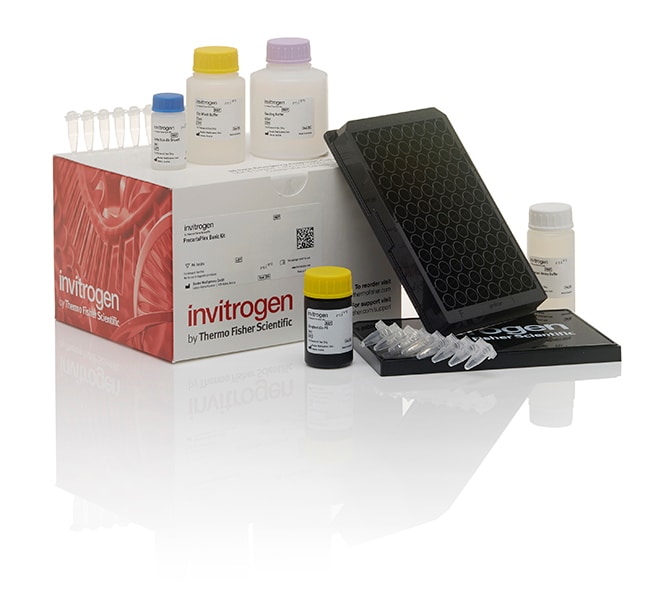
ProcartaPlex Human Basic Kit
Invitrogen™

ProcartaPlex Human Basic Kit

Ideal solution for assessing multiple protein biomarkers in a single sample. This kit includes all non-target specific reagents - assay diluent, wash buffers, SA-PE and plates. Explore our broad portfolio of pre-configures panels and combinable single analytes.
Have Questions?
Catalog NumberQuantity
EPX010-10420-90196 Tests
Catalog number EPX010-10420-901
Price (CNY)
-
Quantity:
96 Tests

ProcartaPlex™ immunoassays are our ideal solution for assessing multiple protein biomarkers in a single sample.

Our ProcartaPlex assays use Luminex ™ xMAP technology for the multi-analyte detection of secreted proteins including cytokines, chemokines, growth factors and other proteins.

ProcartaPlex™ assays are subject to the same stringent and robust development and manufacturing as are our extensively validated Platinum and Instant ELISA kits. Quantitate multiple targets in cell/tissue culture supernatants, serum, and plasma. Explore our broad portfolio of pre-configures panels and combinable single analytes. For combination of only Simplex Kits an additional Basic Kit is required. This kit includes all non-target specific reagents - assay diluent, wash buffers, SA-PE and plates.

This kit does not contain a Multiscreen Filter Plate.

Suitable Sample Types

Cell culture supernatant, serum, plasma

Sample Volume

Serum, Plasma: 25 μL; CCS: 50 μL

Reported Application:

Multiplex Immunoassay

For Research Use Only. Not for use in diagnostic procedures.
Specifications
Assay SensitivitySee Certificate of Analysis
For Use With (Equipment)Luminex™ Instruments
Product LineProcartaPlex
CombinabilityCombinable
Product TypeBasic and Setup Kits
Quantity96 Tests
SpeciesHuman
Unit SizeEach

Frequently asked questions (FAQs)

What is the size of the Luminex beads you currently use?

The beads used in our Luminex instrument-compatible ProcartaPlex and QuantiGene Plex assays are 6.5 micron superparamagnetic beads.

Find additional tips, troubleshooting help, and resources within our Protein Assays and Analysis Support Center.

I am interested in performing Luminex assays using BioSource kits, and I have a Luminex xMAP system. Besides the kits and system, what other reagents and equipment will I need?

The following is a list of general lab supplies that are required for running BioSource immunoassays on the Luminex xMAP system:
1) Sonicating water bath
2) Orbital shaker
3) Vortexer
4) Repeating and/or multi-channel pipetter (not required, but recommended)
5) Calibrated adjustable precision pipettes, with disposable plastic tips
6) Glass/plastic tubes and racks for preparing reagents
7) Graduated cylinder and container for preparing wash solution
8) Aluminum foil
9) Deionized or distilled water.

Find additional tips, troubleshooting help, and resources within our Protein Assays and Analysis Support Center.

Do the Luminex beads require special care in handling?

The Luminex beads should be protected from light because they are susceptible to photobleaching. We recommend protecting the beads by keeping containers covered with aluminum foil during all incubation steps, and exercising care during handling. The beads should not be frozen, subjected to excessive heat, or exposed to organic solvents.

Find additional tips, troubleshooting help, and resources within our Protein Assays and Analysis Support Center.

Why would the Luminex acquisition software display "Sample Empty" messages during analysis?

(1) The user did not properly aliquot the diluted beads, such that no beads were actually added to the wells (make sure that the bead concentrates are sonicated and vortexed well, then check the pipet tip to ensure that air bubbles were not drawn up)
(2) The user missed loading diluted beads to some wells, which is likely since the small volume is clear and difficult to visualize in the clear plastic plate (we have now addressed this customer difficulty by coloring each of the Buffer Reagent Kit components)
(3) The user applied too much vacuum pressure at some point during the wash steps, or allowed the pressure to spike even once, such that the filter membrane tore in a few wells releasing the beads (make sure that the vacuum manifold pressure is kept below 5mm/in Hg, depending on their system -- a good rule of thumb is that it should take a full 3-second count to GENTLY empty the wells of 200uL)
(4) The user did not properly sonicate and vortex the beads prior to dilution, such that the percent of bead aggregation was high and the instrument was unable to find enough single beads to meet the events/bead value designated by the customer (make sure that the Bead Concentrate tube is put into the waterbath all the way to the cap, since the tube is hollow until the top third)
(5) The user lost beads by shaking the plate too aggressively or handling it improperly (make sure that the orbital shaker is set to a speed that allows for maximum vortex in the wells without spillage)
(6) The user exposed the beads to an excess of light during storage or running of the assay, such that some but not all of the beads were photobleached and therefore falling outside the acceptable range for each bead region (make sure that the plate is covered on the top/sides with foil throughout the assay, away from Windows and spotlights, and that the bead component of the kits is stored in the dark)*
(7) There was a clog in the sample needle, such that the instrument was unable to take up enough sample to meet the number of events requested per bead region (suggest that the user follow the manual instructions for dislodging a clog, which include several Back Flush steps and may require removal of the needle for sonication with probe alignment).

* Some of the older Antibody Bead Kits still have clear plastic tops instead of black ones. In cases where customers store kits in lit refrigerators, or keep them open on the lab bench, even a few hours of light exposure is enough to photobleach beads. It is important to note, in general, that higher number bead regions are more susceptible to photobleaching. In order to draw conclusions about the source of the difficulty, we would ask to see the data, specifically the Masterplex QT file, which would enable us to examine the pattern of "Sample Empty" occurrences in addition to the bead counts per well.

Find additional tips, troubleshooting help, and resources within our Protein Assays and Analysis Support Center.

What are the Luminex beads made of?

The beads are made of polystyrene.

Find additional tips, troubleshooting help, and resources within our Protein Assays and Analysis Support Center.

Citations & References (4)

Citations & References
Abstract
Failure recovery of circulating NKG2D
Authors:Gao J, Duan Z, Zhang L, Huang X, Long L, Tu J, Liang H, Zhang Y, Shen T, Lu F
Journal:
PubMed ID:26942056
Dysfunction of natural killer (NK) cells has been implicated in the failure of antitumor immune responses in hepatocellular carcinoma (HCC) patients. However, the changes of NK profile in peripheral blood after surgery and tumor tissues of HCC patients, as well as the underlying reason and the significance are vague. Here, ... More
Characterization of clinical and immunological features in patients coinfected with dengue virus and HIV.
Authors:Torrentes-Carvalho A, Hottz ED, Marinho CF, da Silva JB, Pinto LM, Fialho LG, Bozza FA, Cunha RV, Damasco PV, Kubelka CF, de Azeredo EL
Journal:Clin Immunol
PubMed ID:26826597
'The pathogenesis of dengue in subjects coinfected with HIV remains largely unknown. We investigate clinical and immunological parameters in coinfected DENV/HIV patients. According to the new dengue classification, most coinfected DENV/HIV patients presented mild clinical manifestations of dengue infection. Herein, we show that DENV/HIV coinfected patients had higher CD8 T ... More
A xenograft model of macrophage activation syndrome amenable to anti-CD33 and anti-IL-6R treatment.
Authors:Wunderlich M, Stockman C, Devarajan M, Ravishankar N, Sexton C, Kumar AR, Mizukawa B, Mulloy JC
Journal:JCI Insight
PubMed ID:27699249
Transgenic expression of key myelosupportive human cytokines in immune-deficient mice corrects for the lack of cross-species activities of stem cell factor (SCF), IL-3, and GM-CSF. When engrafted with human umbilical cord blood (UCB), these triple-transgenic mice produce BM and spleen grafts with much higher myeloid composition, relative to nontransgenic controls. ... More
No effect of anti-TNF-a agents on the surgical stress response in patients with inflammatory bowel disease undergoing bowel resections: a prospective multi-center pilot study.
Authors:El-Hussuna A, Qvist N, Zangenberg MS, Langkilde A, Siersma V, Hjort S, Gögenur I
Journal:BMC Surg
PubMed ID:30390672
TNF-a plays a role in angiogenesis and collagen synthesis, both essential in the wound healing process. There are concerns that pre-operative anti-TNF-a treatment may influence the surgical stress response and increase the risk of surgical complications. The aim of this study was to describe the surgical stress response in patients ... More