Search


Citations & References (13)
Invitrogen™
FluxOR™ Potassium Ion Channel Assay
FluxOR™ Potassium Ion Channel Assay
Have Questions?
Change view

| Catalog Number | Quantity |
|---|---|
| F10016 | 10 Microplates |
| F10017 | 100 Microplates |
Catalog number F10016
Price (CNY)
12,973.00
Each
Quantity:
10 Microplates
Price (CNY)
12,973.00
Each
- K+ channel specific – measure ion flux in both voltage- and ligand-gated potassium channels
- Fast – perform screens in high-throughput mode with reproducible results and excellent S/N without quenching dye
- Pharmacologically relevant – known blockers show dose-dependent inhibition in a large signal window
- K+ channel specific—measure ion flux in both voltage- and ligand-gated potassium channels
- Fast—perform screens in high-throughput mode with reproducible results and excellent S/N without quenching dye
- Pharmacologically relevant—known blockers show dose-dependent inhibition in a large signal window
The FluxOR™ Potassium Ion Channel Assay is an optically based, homogenous assay for high throughput screening (HTS) measurements of potassium ion channel and transporter activities. The homogenous assay is based on the permeability of potassium channels to thallium I. When potassium channels are opened by a stimulus, thallium influx from the external medium is detected with a highly sensitive indicator dye. The fluorogenic signal quantitatively reflects the activity of ion channels and transporters that are permeant to thallium, including hERG, Kir2.1, and other pharmacologically important potassium channels. Fluorescence reported in the FluxOR™ system thus becomes a surrogate indicator of activity for any ion channel or transporter that is permeable to thallium.
The FluxOR™ Potassium Ion Channel Assay enables rapid and robust high-throughput screening (HTS) of potassium channel targets in a novel equilibrium measurement, reproducibly giving IC50 values that are predictive of block or modulation in lower-throughput platforms. The FluxOR™ dye is sensitive enough that low mM levels of extracellular thallium give large signals in high-throughput mode. For most applications, FluxOR™ dye is dissolved in physiological HBSS buffer for loading into cells, assisted by our proprietary Powerload™ formulation (Catalog number P10020).
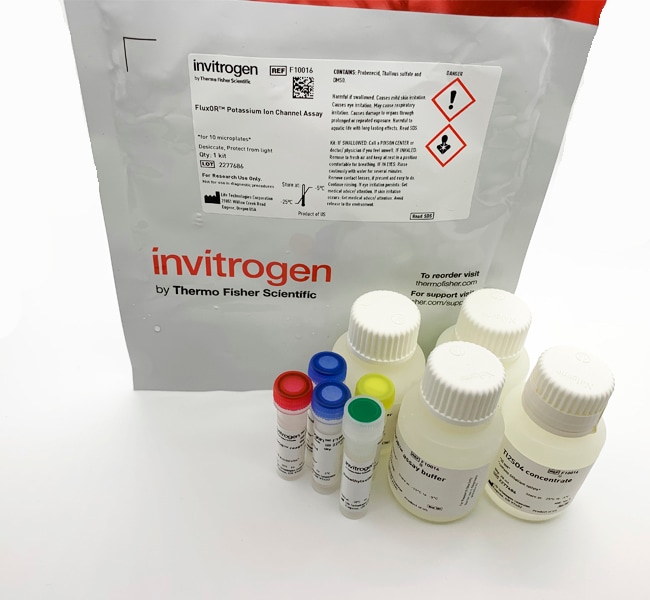
The FluxOR™ Potassium Ion Channel Assay provides a concentrated thallium solution and all necessary buffers, allowing maximum target flexibility and ease of operation in a homogenous format that has been demonstrated for use with cells stably expressing hERG, as well as our BacMam-hERG delivery and expression reagent (Catalog number B10019 and B10033). Optional for use with this kit is the hERG potassium channel cDNA engineered into Invitrogen's BacMam delivery and expression system. The combination of a bright proprietary fluorescent potassium sensor dye and the hERG potassium channel gene delivered by BacMam affords excellent assay design flexibility and superior sensitivity in detecting potassium channel activity in biologically relevant systems at physiological conditions without the need for quenchers.
For Research Use Only. Not for use in diagnostic procedures.
Specifications
Detection MethodFluorescence
Dye TypeFluxOR
Quantity10 Microplates
Shipping ConditionWet Ice
Emission Wavelength Range525 nm
Excitation Wavelength Range490 nm
For Use With (Application)Potassium Ion Channel
For Use With (Equipment)Fluorescence Microscope, Microplate Reader
Product LineFluxOR
Product TypePotassium Indicator
Unit SizeEach
Contents & Storage
Store in freezer -5°C to -30°C and protect from light.
Citations & References (13)
Citations & References
Abstract
Analysis of plasma membrane integrity by fluorescent detection of Tl(+) uptake.
Journal:J Membr Biol
PubMed ID:20623351
'The exclusion of polar dyes by healthy cells is widely employed as a simple and reliable test for cell membrane integrity. However, commonly used dyes (propidium, Yo-Pro-1, trypan blue) cannot detect membrane defects which are smaller than the dye molecule itself, such as nanopores that form by exposure to ultrashort
The Ste20 kinases Ste20-related proline-alanine-rich kinase and oxidative-stress response 1 regulate NKCC1 function in sensory neurons.
Journal:J Biol Chem
PubMed ID:19307180
'NKCC1 is highly expressed in dorsal root ganglion neurons, where it is involved in gating sensory information. In a recent study, it was shown that peripheral nerve injury results in increased NKCC1 activity, not due to an increase in cotransporter expression, but to increased phosphorylation of the cotransporter (Pieraut, S.,
Discovery of novel allosteric modulators of metabotropic glutamate receptor subtype 5 reveals chemical and functional diversity and in vivo activity in rat behavioral models of anxiolytic and antipsychotic activity.
Journal:Mol Pharmacol
PubMed ID:20923853
'Modulators of metabotropic glutamate receptor subtype 5 (mGluR5) may provide novel treatments for multiple central nervous system (CNS) disorders, including anxiety and schizophrenia. Although compounds have been developed to better understand the physiological roles of mGluR5 and potential usefulness for the treatment of these disorders, there are limitations in the
Development of a selective small-molecule inhibitor of Kir1.1, the renal outer medullary potassium channel.
Journal:Mol Pharmacol
PubMed ID:20926757
'The renal outer medullary potassium (K+) channel, ROMK (Kir1.1), is a putative drug target for a novel class of loop diuretic that would lower blood volume and pressure without causing hypokalemia. However, the lack of selective ROMK inhibitors has hindered efforts to assess its therapeutic potential. In a high-throughput screen
Lipid nanopores can form a stable, ion channel-like conduction pathway in cell membrane.
Journal:Biochem Biophys Res Commun
PubMed ID:19450553
Cell permeabilization by electric pulses (EPs), or electroporation, has been well established as a tool to indiscriminately increase membrane flows of water solutes down the concentration and voltage gradients. However, we found that EPs of nanosecond duration (nsEPs) trigger formation of voltage-sensitive and inward-rectifying membrane pores. NsEP-treated cells remain mostly