Search


Citations & References (29)
Invitrogen™
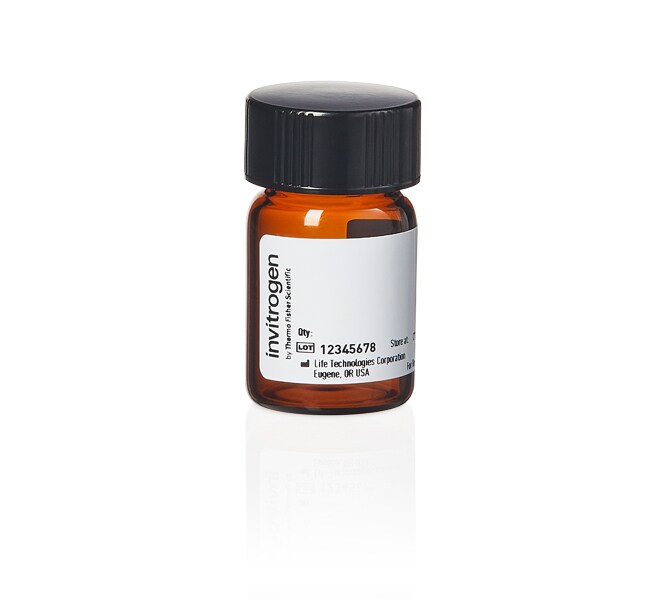
5(6)-SFX (6-(Fluorescein-5-(and-6)-Carboxamido) Hexanoic Acid, Succinimidyl Ester), mixed isomers
Fluorescein is a common green-fluorescent derivatization reagent, while succinimidyl esters are frequently used for the labeling of the primary aminesRead more
| Catalog Number | Quantity |
|---|---|
| F2181 also known as F-2181 | 10 mg |
Catalog number F2181
also known as F-2181
Price (CNY)
3,200.00
Each
Quantity:
10 mg
Price (CNY)
3,200.00
Each
Fluorescein is a common green-fluorescent derivatization reagent, while succinimidyl esters are frequently used for the labeling of the primary amines (R-NH2) of proteins, amine-modified oligonucleotides, and other amine-containing molecules. This 'SFX' succinimidyl ester contains a seven-atom amino-hexanoyl spacer between the fluorophore and the reactive group. This spacer separates the fluorophore from the biomolecule to which it is conjugated, potentially reducing the quenching that typically occurs upon conjugation. The resulting fluorescein conjugates can be detected with standard FITC or GFP filter sets. Fluorescein-based dyes and their conjugates have a relatively high rate of photobleaching and a pH-sensitive fluorescence. Alexa Fluor™ 488 and Oregon Green™ 488 are alternative dyes whose spectra mimic those of fluorescein and are much more photostable with little to no pH sensitivity in the physicological pH range.
Specifications:
• Fluorophore label : fluorescein
• Reactive group: succinimidyl ester
• Reactivity: primary amines on proteins and ligands, amine-modified oligonucleotides
• Molecular weight: 586
• Extinction coefficient: 74,000 cm-1M-1
• Ex/Em of the conjugate: 494/520 nm
• Spectrally similar dyes: Alexa Fluor™ 488, GFP
Typical Conjugation Reaction
Amine-reactive reagents can be conjugated with virtually any protein or peptide; the provided protocol is optimized for IgG antibodies. You may scale the reaction for any amount of protein, but the concentration of the protein should be at least 2 mg/mL for optimal results. We recommend trying three different degrees of labeling, using three different molar ratios of the reactive reagent to protein.
The fluorescein succinimidyl ester is typically dissolved in high-quality, anhydrous dimethylformamide (DMF) or dimethylsulfoxide (DMSO) and the reaction carried out in 0.1–0.2 M sodium bicarbonate buffer, pH 8.3, at room temperature for 1 hour. Because the pKa of the terminal amine is lower than that of the lysine epsilon-amino group, you may achieve more selective labeling of the amine terminus using a buffer closer to neutral pH.
Conjugate Purification
Labeled antibodies are typically separated from free dye using a gel filtration column, such as Sephadex™ G-25, BioGel™ P-30, or equivalent. For much larger or smaller proteins, select a gel filtration media with an appropriate molecular weight cut-off or purify by dialysis.
Alternative Packagings
Mixed-isomer amine-reactive succinimidyl esters of fluorescein are also available in a 10 x 1 mg unit size (F6129), a single isomer (F6106), and with a spacer that is more hydrophilic than the SFX spacer (F6130), as well as in numerous kits for labeling proteins and nucleic acids (Active esters and kits for labeling proteins and nucleic acids—Table 1.2).
Specifications:
• Fluorophore label : fluorescein
• Reactive group: succinimidyl ester
• Reactivity: primary amines on proteins and ligands, amine-modified oligonucleotides
• Molecular weight: 586
• Extinction coefficient: 74,000 cm-1M-1
• Ex/Em of the conjugate: 494/520 nm
• Spectrally similar dyes: Alexa Fluor™ 488, GFP
Typical Conjugation Reaction
Amine-reactive reagents can be conjugated with virtually any protein or peptide; the provided protocol is optimized for IgG antibodies. You may scale the reaction for any amount of protein, but the concentration of the protein should be at least 2 mg/mL for optimal results. We recommend trying three different degrees of labeling, using three different molar ratios of the reactive reagent to protein.
The fluorescein succinimidyl ester is typically dissolved in high-quality, anhydrous dimethylformamide (DMF) or dimethylsulfoxide (DMSO) and the reaction carried out in 0.1–0.2 M sodium bicarbonate buffer, pH 8.3, at room temperature for 1 hour. Because the pKa of the terminal amine is lower than that of the lysine epsilon-amino group, you may achieve more selective labeling of the amine terminus using a buffer closer to neutral pH.
Conjugate Purification
Labeled antibodies are typically separated from free dye using a gel filtration column, such as Sephadex™ G-25, BioGel™ P-30, or equivalent. For much larger or smaller proteins, select a gel filtration media with an appropriate molecular weight cut-off or purify by dialysis.
Alternative Packagings
Mixed-isomer amine-reactive succinimidyl esters of fluorescein are also available in a 10 x 1 mg unit size (F6129), a single isomer (F6106), and with a spacer that is more hydrophilic than the SFX spacer (F6130), as well as in numerous kits for labeling proteins and nucleic acids (Active esters and kits for labeling proteins and nucleic acids—Table 1.2).
For Research Use Only. Not for use in diagnostic procedures.
Specifications
Chemical ReactivityAmine
Emission520
Excitation494
Label or DyeFITC (Fluorescein)
Quantity10 mg
Reactive MoietyActive Ester, Succinimidyl Ester
Shipping ConditionRoom Temperature
Label TypeClassic Dyes
Unit SizeEach
Contents & Storage
Store in freezer (-5 to -30°C) and protect from light.
Citations & References (29)
Citations & References
Abstract
Macromolecular accessibility of fluorescent taxoids bound at a paclitaxel binding site in the microtubule surface.
Journal:J Biol Chem
PubMed ID:15550392
'The macromolecular accessibility of the paclitaxel binding site in microtubules has been investigated using a fluorescent taxoid and antibodies against fluorescein, which cannot diffuse into the microtubule lumen. The formation of a specific ternary complex of microtubules, Hexaflutax (7-O-{N-[6-(fluorescein-4''-carboxamido)-n-hexanoyl]-l-alanyl}paclitaxel) and 4-4-20 IgG (a monoclonal antibody against fluorescein) has been observed
High-affinity binding of the Drosophila Numb phosphotyrosine-binding domain to peptides containing a Gly-Pro-(p)Tyr motif.
Journal:Proc Natl Acad Sci U S A
PubMed ID:9207069
'The phosphotyrosine-binding (PTB) domain is a recently identified protein module that has been characterized as binding to phosphopeptides containing an NPXpY motif (X = any amino acid). We describe here a novel peptide sequence recognized by the PTB domain from Drosophila Numb (dNumb), a protein involved in cell fate determination
The ligand for osteoprotegerin (OPGL) directly activates mature osteoclasts.
Journal:J Cell Biol
PubMed ID:10225954
'Osteoprotegerin (OPG) and OPG-ligand (OPGL) potently inhibit and stimulate, respectively, osteoclast differentiation (Simonet, W.S., D.L. Lacey, C.R. Dunstan, M. Kelley, M.-S. Chang, R. Luethy, H.Q. Nguyen, S. Wooden, L. Bennett, T. Boone, et al. 1997. Cell. 89:309-319; Lacey, D.L., E. Timms, H.-L. Tan, M.J. Kelley, C.R. Dunstan, T. Burgess, R.
Evolution of peptides that modulate the spectral qualities of bound, small-molecule fluorophores.
Journal:Chem Biol
PubMed ID:9862799
'BACKGROUND: Fluorophore dyes are used extensively in biomedical research to sensitively assay cellular constituents and physiology. We have created, as proof of principle, fluorophore dye binding peptides that could have applications in fluorescent dye-based approaches in vitro and in vivo. RESULTS: A panel of Texas red, Rhodamine red, Oregon green
Mutations in the P. falciparum digestive vacuole transmembrane protein PfCRT and evidence for their role in chloroquine resistance.
Journal:Mol Cell
PubMed ID:11090624
'The determinant of verapamil-reversible chloroquine resistance (CQR) in a Plasmodium falciparum genetic cross maps to a 36 kb segment of chromosome 7. This segment harbors a 13-exon gene, pfcrt, having point mutations that associate completely with CQR in parasite lines from Asia, Africa, and South America. These data, transfection results,