Search


Citations & References (23)
Invitrogen™
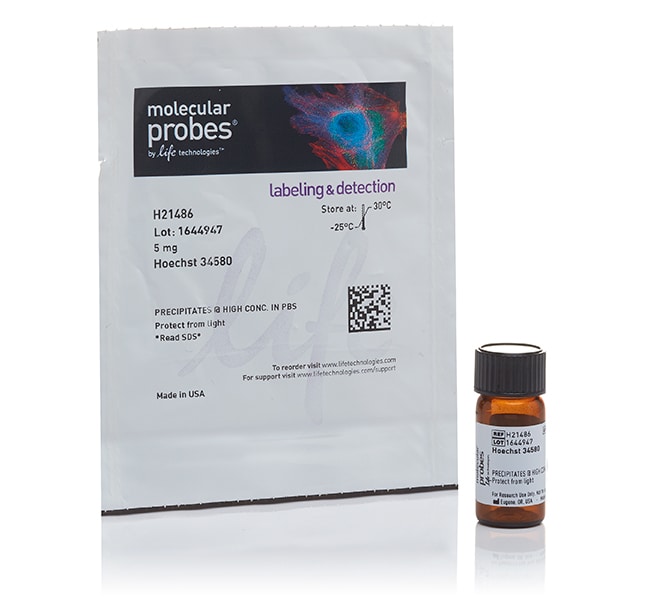
Hoechst 34580
This bisbenzimide dye, Hoechst 34580, is related to the important minor-groove binding, dsDNA-selective dyes Hoechst 33258 and Hoechst 33342. HoechstRead more
| Catalog Number | Quantity |
|---|---|
| H21486 | 5 mg |
Catalog number H21486
Price (CNY)
2,911.00
飞享价
Ends: 31-Dec-2026
3,868.00Save 957.00 (25%)
Each
Quantity:
5 mg
Price (CNY)
2,911.00
飞享价
Ends: 31-Dec-2026
3,868.00Save 957.00 (25%)
Each
This bisbenzimide dye, Hoechst 34580, is related to the important minor-groove binding, dsDNA-selective dyes Hoechst 33258 and Hoechst 33342. Hoechst 34580 has somewhat longer-wavelength spectra than the other Hoechst dyes when bound to nucleic acids [Howard Shapiro, personal communication].
Visualize staining your cell without wasting your reagents, antibodies, or time with our new Stain-iT Cell Staining Simulator.
Visualize staining your cell without wasting your reagents, antibodies, or time with our new Stain-iT Cell Staining Simulator.
For Research Use Only. Not for use in diagnostic procedures.
Specifications
Detection MethodFluorescence
Dye TypeHoechst 34580
Excitation Wavelength Range392⁄440
For Use With (Equipment)Fluorescence Microscope
FormSolid
FormatTube(s)
Quantity5 mg
Shipping ConditionRoom Temperature
Solubilitywater, DMF or DMSO (Dimethylsulfoxide)
Product TypeNucleic Acid Stain
Sub Cellular LocalizationNucleic Acids, Nucleus
Unit SizeEach
Contents & Storage
Contains 1 vial of Hoechst 34580 (5 mg).
Store in freezer -25°C and protect from light.
Store in freezer -25°C and protect from light.
Frequently asked questions (FAQs)
Is DAPI a good live-cell nuclear label?
I want to label the nuclei of live cells and track them over time. Can I use DAPI for this?
DAPI and Hoechst dyes are quite similar to each other. Why would I choose one over the other?
Citations & References (23)
Citations & References
Abstract
The inflammatory mediator leukotriene D4 induces beta-catenin signaling and its association with antiapoptotic Bcl-2 in intestinal epithelial cells.
Journal:J Biol Chem
PubMed ID:16407243
'Increased levels of the inflammatory mediator leukotriene D4 (LTD4) are present at sites of inflammatory bowel disease, and such areas also exhibit an increased risk for subsequent cancer development. It is known that LTD4 affects the expression of many proteins that influence survival and proliferation of intestinal epithelial cells. We
ATP-dependent interaction of the cytosolic domains of the inwardly rectifying K+ channel Kir6.2 revealed by fluorescence resonance energy transfer.
Journal:Proc Natl Acad Sci U S A
PubMed ID:14681552
'ATP-sensitive K(+) (K(ATP)) channels play important roles in the regulation of membrane excitability in many cell types. ATP inhibits channel activity by binding to a specific site formed by the N and C termini of the pore-forming subunit, Kir6.2, but the structural changes associated with this interaction remain unclear. Here,
Nucleic acid binding agents exert local toxic effects on neurites via a non-nuclear mechanism.
Journal:J Neurochem
PubMed ID:16441515
'The mechanism by which drugs that target nucleic acids cause neurotoxicity is not well described. We characterized the neurotoxicity of Hoechst 33342 (bis-benzimide), a common cell permeable nuclear dye, in primary neuronal cultures. The mechanism of cell death was not apoptotic, as death is rapid, not accompanied by typical nuclear
Real-time multiple particle tracking of gene nanocarriers in complex biological environments.
Journal:Methods Mol Biol
PubMed ID:18470640
'Complex biological fluids, such as the vast and molecularly crowded cell cytoplasm and the highly viscoelastic mucus that protects many entry ways to the body, pose significant barriers to efficient gene delivery. Understanding the dynamics of gene carriers in such environments allows insight that leads to rational improvements in gene
Isolation, structure elucidation and cytotoxic evaluation of endiandrin B from the Australian rainforest plant Endiandra anthropophagorum.
Journal:Bioorg Med Chem
PubMed ID:19138858
Chemical investigations of the DCM extract from the roots of Endiandra anthropophagorum resulted in the isolation of a new cyclobutane lignan endiandrin B (1), together with the known natural products, endiandrin A (2), and (-)-dihydroguaiaretic acid (3). The structure of 1 was determined by extensive spectroscopic analyses, and confirmed by