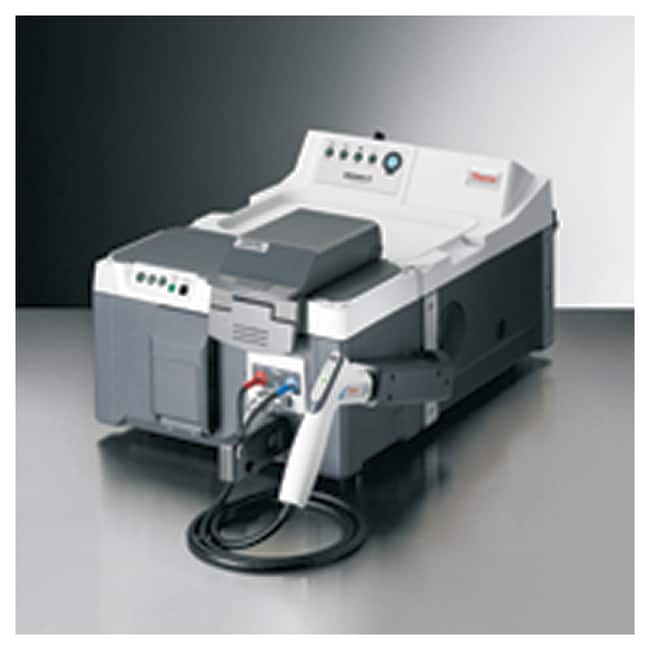
Antaris™ II FT-NIR Analyzer
Thermo Scientific™

Antaris™ II FT-NIR Analyzer

Easily implement laboratory-based FT-NIR performance in a ready-for-plant package using the Thermo Scientific™ Antaris™ II FT-NIR Analyzer.

Have Questions?
Catalog NumberSource TypeSpectral Range
IQLAADGABCFADUMAAVLong-life, high intensity halogen NIR source; spare source included with system, guaranteed filament image alignment12,000 to 3800 cmto1 (833 to 2630 nm)
Catalog number IQLAADGABCFADUMAAV
Price (CNY)
-
Request A Quote
Source Type:
Long-life, high intensity halogen NIR source; spare source included with system, guaranteed filament image alignment
Spectral Range:
12,000 to 3800 cmto1 (833 to 2630 nm)

Easily implement laboratory-based FT-NIR performance in a ready-for-plant package using the Thermo Scientific™ Antaris™ II FT-NIR Analyzer. With industry-leading method transfer performance, the Antaris II FT-NIR Analyzer provides robust and reliable data collection for at-line, online and in-line analysis. You can customize an Antaris II FT-NIR Analyzer for specific applications or choose the Antaris II MDS Method Development Sampling System, which includes transmission, fiber-optic and integrating sphere diffuse reflection analysis all in one turnkey system.

The Antaris II FT-NIR Analyzer Allows You To:

  • Analyze any sample type rapidly and accurately
  • Make regulatory compliance (DQ, IQ, OQ and PQ) easy with the Thermo Scientific™ ValPro™ Instrument Qualification Package
  • Reproduce results regardless of configuration, maintenance, user or environment
  • Achieve fast, precise and accurate measurements in the lab or in the plant

Ordering Information:
The Antaris II FT-NIR Analyzer is sold as a configured system designed to meet your specific needs. For more information, contact your Thermo Scientific Sales Representative.

Recommended for:

  • Solids
  • Powders
  • Grains
  • Tablets
  • Paste
  • Gel
  • Syrup
  • Films
  • Liquids
Specifications
Analyzer TypeFourier Transform Near-Infrared
DescriptionThermo Scientific™ Antaris™ II FT-NIR Analyzer sets an industry standard, providing laboratory-based FT-NIR performance in a ready-for-plant package.
DetectionHigh sensitivity, high stability matched InGaAs
Height (Metric)33 cm
InterfaceDirect PC to Ethernet allows file system and OPC communications
InterferometerProven, frictionless, stable, long-life Michelson
Length (Metric)68.5 cm
Operating Temperature Range15°C to 35°C (59° to 95°F)
Photometric LinearitySlope 1.0 ±0.05 and an intercept of 0.0 ±0.05
Product TypeAntaris II FT-NIR Analyzer
Resolution4 cm-1 across spectral range (0.6 nm at 1250 nm), 2 cm-1 option across spectral range (0.3 nm at 1250 nm)
Sampling ModeConfigurable with reflection, transmission, fiber optics, or tablet transmission.
Sealed and DesiccatedYes
Source TypeLong-life, high intensity halogen NIR source; spare source included with system, guaranteed filament image alignment
Spectral Range12,000 to 3800 cmto1 (833 to 2630 nm)
System Status IndicatorsYes
Voltage90/264 V
Wavenumber Accuracy±0.03 cm-1 (0.005 nm at 1250 nm)
Wavenumber RepeatabilitySingle System: 10 measurement standard deviation <0.006 cm-1
Wavenumber ReproducibilitySystem to System: Better than 0.05 cm-1 (0.008 nm at 1250 nm)
Weight (Metric)47.7 kg
Width (Metric)40.6 cm
Unit SizeEach

Frequently asked questions (FAQs)

How are probes used for in-line NIR analysis?

Fiber optic probes can be used for analyzing liquid samples in transmission or solid samples in reflection. For samples that have bubbles or solids or change state between liquid and solid, a transflectance probe works the best. A fitting attached to the probe mates it with a port on a tank, pipe, reactor, hopper, or above a conveyor. The common fittings used with probes are Swagelok, sanitary tri-clamp or bolt-on.

How can I use an Antaris FT-NIR analyzer for in-line process analysis?

If the process environment has water hose down, CIP, dust, high temperature, corrosive or explosive chemicals, the Antaris FT-NIR analyzer needs to be placed in a safe area or enclosed in an environmentally stabilized enclosure. Fiber optics run from the NIR analyzer to probes or flow cells installed in production process pipes, tanks, hoppers, conveyors, reactors, etc. The fiber optics carry the NIR source light to the probe sampling window and then carry the light after it has interacted with the sample back to the NIR analyzer detector. The end of the probe will have a window or an air gap for reflection or transmission analysis. The product being analyzed must be self-cleaning or the probe engineered to automatically clean itself by high pressure air. The computer that controls the NIR analyzer is also located in the safe area with Thermo Scientific RESULT Software exporting NIR results to text or Microsoft Excel files, LIMS, OPC or by 4-20 mA.

Can current calibrations from a different manufacturer be transferred to the Antaris FT-NIR analyzer?

Yes, using the Thermo Scientific Standards converter utility program, spectra from other NIR manufacturers can be converted to a format directly compatible with the Antaris FT-NIR analyzer. The utility program converts spectra from wavelength to wave number as well as converts to a standard absorbance format. Then it automatically transfers the converted spectra and all associated wet chemistry data into Thermo Scientific TQ Analyst calibration development software. The method developer then sets the spectral processing and regions in TQ Analyst and calibrates the method into Antaris format.

What is Raman spectroscopy?

In Raman spectroscopy, an unknown sample of material is illuminated with monochromatic (single wavelength or single frequency) laser light, which can be absorbed, transmitted, reflected, or scattered by the sample. Light scattered from the sample is due to either elastic collisions of the light with the sample's molecules (Rayleigh scatter) or inelastic collisions (Raman scatter). Whereas Rayleigh scattered light has the same frequency (wavelength) of the incident laser light, Raman scattered light returns from the sample at different frequencies corresponding to the vibrational frequencies of the bonds of the molecules in the sample.

If you wish to learn more about Raman spectroscopy, visit our online Raman Spectroscopy Academy (https://www.thermofisher.com/us/en/home/industrial/spectroscopy-elemental-isotope-analysis/spectroscopy-elemental-isotope-analysis-learning-center/molecular-spectroscopy-information/raman-technology.html), where you will find basic Raman tutorials, advanced Raman webinars on sample applications, and a helpful instrument guide.