Search
 Element Search
 Structure Search
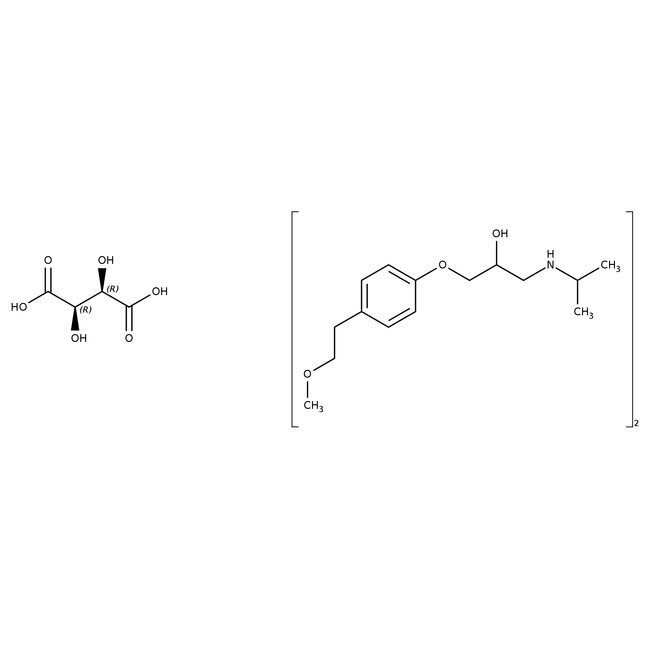

Thermo Scientific Chemicals
Metoprolol tartrate, 98+%
A beta-adrenergic blocker | CAS: 56392-17-7 | C34H56N2O12 | 684.824 g/mol
Have Questions?
Change view


Chemical Identifiers
CAS56392-17-7
IUPAC Name(2R,3R)-2,3-dihydroxybutanedioic acid; bis(1-[4-(2-methoxyethyl)phenoxy]-3-[(propan-2-yl)amino]propan-2-ol)
Molecular FormulaC34H56N2O12
InChI KeyYGULWPYYGQCFMP-CEAXSRTFSA-N
SMILESO[C@H]([C@@H](O)C(O)=O)C(O)=O.COCCC1=CC=C(OCC(O)CNC(C)C)C=C1.COCCC1=CC=C(OCC(O)CNC(C)C)C=C1
View more
Specifications Specification Sheet
Specification SheetLoss on Drying≤0.5%
Appearance (Color)White to pale cream
Assay from Supplier's CofA≥98.0%
Proton NMRConforms to structure
FormPowder or crystals or crystalline powder
Metoprolol tartrate is an antagonist of the β1-AR (β1-adrenoceptor). It inhibits spontaneous endothelin-1 production in vitro.
This Thermo Scientific Chemicals brand product was originally part of the Alfa Aesar product portfolio. Some documentation and label information may refer to the legacy brand. The original Alfa Aesar product / item code or SKU reference has not changed as a part of the brand transition to Thermo Scientific Chemicals.
Applications
Metoprolol tartrate is an antagonist of the β1-AR (β1-adrenoceptor). It inhibits spontaneous endothelin-1 production in vitro and displays antihypertensive.
Solubility
Soluble in water (>1000 mg/ml), methanol (>500 mg/ml), chloroform (496 mg/ml), ethanol (31 mg/ml at 25°C), and DMSO (100 mg/ml at 25°C).
Notes
Store in cool place. Keep container tightly closed in a dry and well-ventilated place. Store away from oxidizing agents.
Metoprolol tartrate is an antagonist of the β1-AR (β1-adrenoceptor). It inhibits spontaneous endothelin-1 production in vitro and displays antihypertensive.
Solubility
Soluble in water (>1000 mg/ml), methanol (>500 mg/ml), chloroform (496 mg/ml), ethanol (31 mg/ml at 25°C), and DMSO (100 mg/ml at 25°C).
Notes
Store in cool place. Keep container tightly closed in a dry and well-ventilated place. Store away from oxidizing agents.
RUO – Research Use Only
General References:
- Jef Stappaerts; Benjamin Wuyts; Jan Tack; Pieter Annaert; Patrick Augustijns. Human and simulated intestinal fluids as solvent systems to explore food effects on intestinal solubility and permeability. European Journal of Pharmaceutical Sciences. 2012, 63,
- Moran Zur; Allison S. Hanson; Arik Dahan. The complexity of intestinal permeability: Assigning the correct BCS classification through careful data interpretation. European Journal of Pharmaceutical Sciences. 2014, 61, 11-17.