Search
 Element Search
 Structure Search

Thermo Scientific™
Lidocaine hydrochloride monohydrate, 98%
CAS: 6108-05-0 | C14H25ClN2O2 | 288.82 g/mol
Have Questions?
Change view



Chemical Identifiers
CAS6108-05-0
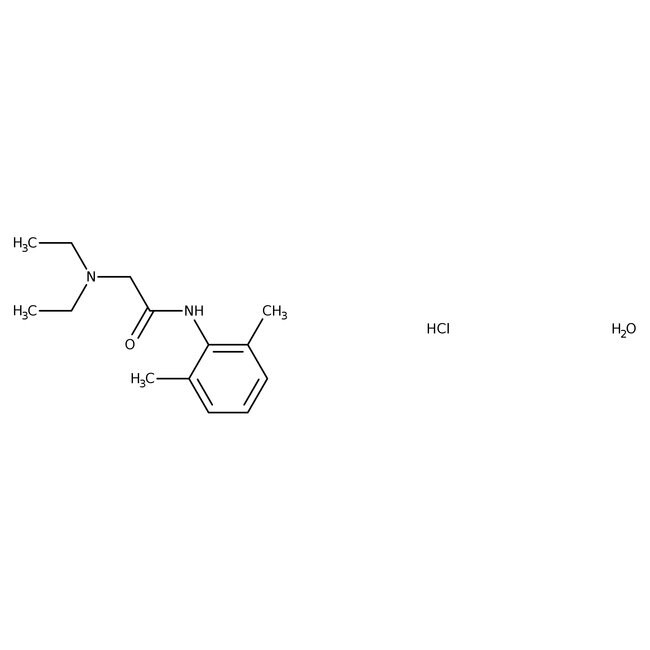
IUPAC Name{[(2,6-dimethylphenyl)carbamoyl]methyl}diethylazanium hydrate chloride
Molecular FormulaC14H25ClN2O2
InChI KeyYECIFGHRMFEPJK-UHFFFAOYSA-N
SMILESO.[Cl-].CC[NH+](CC)CC(=O)NC1=C(C)C=CC=C1C
View more
Specifications Specification Sheet
Specification SheetFormSolid
Appearance (Color)White
Thin Layer Chromatography97.5% min.
It is also used as a fast voltage-gated sodium channel blocker.
This Thermo Scientific Chemicals brand product was originally part of the Alfa Aesar product portfolio. Some documentation and label information may refer to the legacy brand. The original Alfa Aesar product / item code or SKU reference has not changed as a part of the brand transition to Thermo Scientific Chemicals.
Applications
It is also used as a fast voltage-gated sodium channel blocker.
Solubility
Soluble in water (50 mg/ml), chloroform, ethanol, and benzene. Insoluble in diethyl ether.
Notes
Store in cool place. Keep container tightly closed in a dry and well-ventilated place. Keep away from strong oxidizing agents. Do not store above 40 degree C (104 0 F). (preferably store at temperature between 15degree C and 30 degree C).
It is also used as a fast voltage-gated sodium channel blocker.
Solubility
Soluble in water (50 mg/ml), chloroform, ethanol, and benzene. Insoluble in diethyl ether.
Notes
Store in cool place. Keep container tightly closed in a dry and well-ventilated place. Keep away from strong oxidizing agents. Do not store above 40 degree C (104 0 F). (preferably store at temperature between 15degree C and 30 degree C).
RUO – Research Use Only
General References:
- Thomson, P.D., et al. Lidocaine pharmacokinetics in advanced heart failure, liver disease, and renal failure in humans. Ann. Intern. Med. 1973, 78, (4), 499-508.
- Hakim, A.J., et al. Local anaesthetic failure in joint hypermobility syndrome. J R Soc Med. 2005, 98, (2), 84-5.