Search
 Element Search
 Structure Search

Thermo Scientific Chemicals
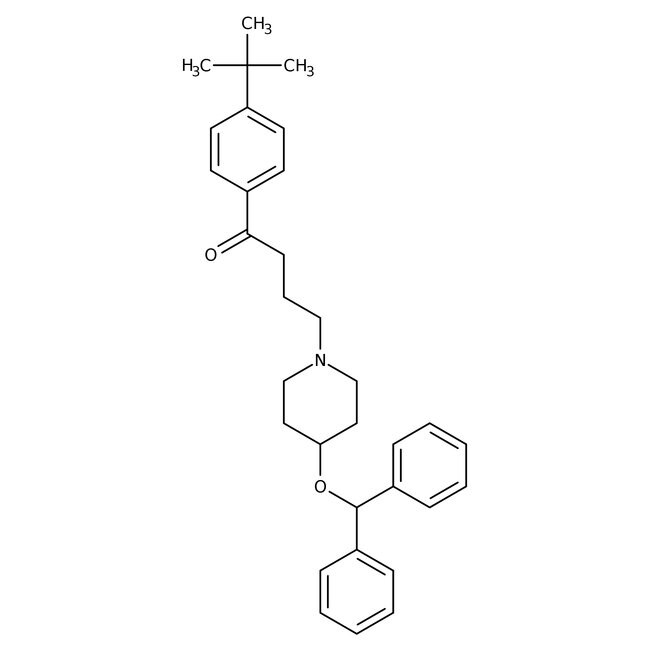
Ebastine
A histamine H1 receptor antagonist | CAS: 90729-43-4 | C32H39NO2 | 469.669 g/mol
| Catalog Number | Quantity |
|---|---|
| J63088.03 also known as J63088-03 | 1 g |

Specifications
CAS90729-43-4
Chemical Name or MaterialEbastine
ColorWhite
Formula Weight469.66
IUPAC Name4-(4-benzhydryloxypiperidin-1-yl)-1-(4-tert-butylphenyl)butan-1-one
View more
Ebastine is a second-generation H1 receptor antagonist that is indicated mainly for allergic rhinitis and chronic idiopathic urticaria. It is available in 10 and 20 mg tablets and as fast-dissolving tablets, as well as in pediatric syrup. It has a recommended flexible daily dose of 10 or 20 mg, depending on disease severity.
This Thermo Scientific Chemicals brand product was originally part of the Alfa Aesar product portfolio. Some documentation and label information may refer to the legacy brand. The original Alfa Aesar product / item code or SKU reference has not changed as a part of the brand transition to Thermo Scientific Chemicals.
Solubility
Slightly soluble in chloroform, methanol.
Notes
Store in cool place. Keep container tightly closed in a dry and well-ventilated place. Keep away from strong oxidizing agents.
Slightly soluble in chloroform, methanol.
Notes
Store in cool place. Keep container tightly closed in a dry and well-ventilated place. Keep away from strong oxidizing agents.
RUO – Research Use Only
General References:
- Tagawa, M; Kano, M; Okamura, N (2001). Neuroimaging of histamine H1-receptor occupancy in human brain by positron emission tomography (PET): a comparative study of ebastine, a second-generation antihistamine, and (+)-clorphrniramine, a classical antihistamine. Br J Clin Pharmacol. 197752 (5), 501-509.
- Bousquet, J; Gaudaño, EM; Palama Carlos, AG. A 12-week, placebo-controlled study of the efficacy and safety of ebastine, 10 and 20 mg once daily, in the treatment of perennial allergic rhinitis. Allergy. 199954 (6), 562-568.