Search

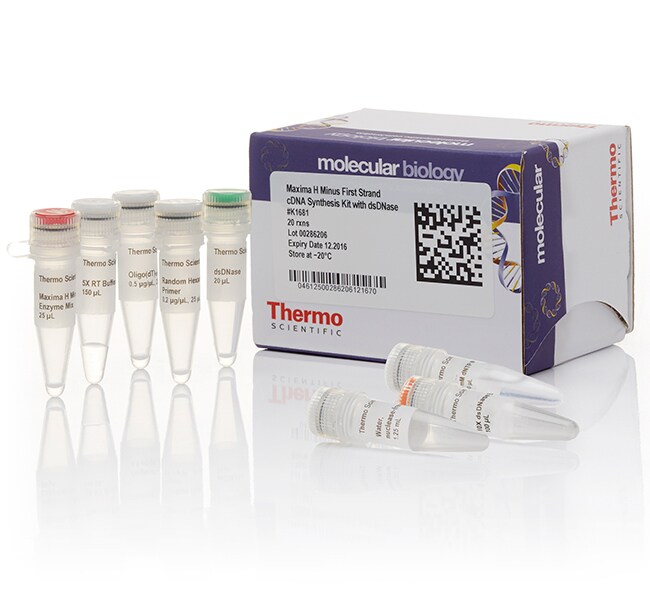
Thermo Scientific™
Maxima H Minus First Strand cDNA Synthesis Kit
Thermo Scientific Maxima H Minus First Strand cDNA Synthesis Kit, available with or without dsDNase, is a complete system for highly efficient synthesis of first strand cDNA.
Have Questions?
Change view

| Catalog Number | Includes | No. of Reactions |
|---|---|---|
| K1681 | Kit with dsDNase | 20 Reactions |
| K1651 | Kit only | 20 Reactions |
| K1652 | Kit only | 100 Reactions |
| K1682 | Kit with dsDNase | 100 Reactions |
Catalog number K1681
Price (CNY)
1,112.00
飞享价
Ends: 31-Dec-2026
1,588.00Save 476.00 (30%)
Each
Includes:
Kit with dsDNase
No. of Reactions:
20 Reactions
Price (CNY)
1,112.00
飞享价
Ends: 31-Dec-2026
1,588.00Save 476.00 (30%)
Each
Thermo Scientific Maxima H Minus First Strand cDNA Synthesis Kit, available with or without dsDNase, is a complete system for highly efficient synthesis of first strand cDNA. The kit uses the Maxima H Minus Reverse Transcriptase (RT), which is an advanced enzyme derived by in vitro evolution of MMLV RT. The enzyme features the highest thermostability among the derivatives of MMLV RT and lacks RNase H activity.
This kit allows synthesis of long cDNAs up to 20 kb at elevated temperatures (up to 65°C), superseding other systems' abilities to produce full-length cDNA. Due to increased synthesis rates the reaction can be completed in 30 minutes.
For reverse transcription the kit uses Maxima H Minus Reverse Transcriptase (RT), which is an advanced enzyme derived by in vitro evolution of MMLV RT.
The Maxima H Minus First Strand cDNA Synthesis Kit with dsDNase provides a dramatically simplified workflow that combines genomic DNA elimination and cDNA synthesis into one-tube procedure. The kit contains a novel double-strand-specific DNase (dsDNase) engineered to remove contaminating genomic DNA from RNA preps in two minutes without damage to quality or quantity of RNA. Highly specific dsDNase activity towards double-stranded DNA ensures that single-stranded DNA (such as cDNA and primers) is not cleaved, and dsDNase treated RNA can be directly added to reverse transcription.
Features of the Maxima H Minus First Strand cDNA Synthesis Kit include:
- Increased reaction temperatures—the first strand of cDNA can be synthesized within the 42–65°C temperature range
- High yields of full-length first strand cDNA—with RNA templates up to 20 kb
- Flexible priming—oligo(dT)18, random hexamer or gene-specific primers
- Integrated genomic DNA removal step with dsDNase kit
Applications
- Full-length cDNA synthesis for long transcripts and ORFs
- Reverse transcription at elevated temperatures to reduce effects of secondary structure
- cDNA cloning and construct generation
- RNA-seq & single cell RNA-seq library prep
- Isoform and transcript characterization
- Template-switching-based full-length RNA-seq
Additional information about reaction components
- Maxima H Minus Enzyme Mix contains Maxima H Minus Reverse Transcriptase and RiboLock RNase Inhibitor. RiboLock RNase Inhibitor effectively protects RNA templates from degradation by RNases A, B, and C at temperatures up to 55°C.
- Oligo(dT)18 and random hexamer primers are supplied with the kit. Random hexamer primers bind non-specifically and are used to synthesize cDNA from all RNAs in a total RNA population. The oligo(dT)18 primer selectively anneals to the 3'-end of poly(A) RNA, synthesizing cDNA only from poly(A) tailed mRNA. Gene-specific primers may also be used with the kit to prime synthesis from a specified sequence.
- 10 mM dNTP Mix is a premixed aqueous solution of dATP, dTTP, dCTP, and dGTP.
- Nuclease-free water is provided for reaction set-up and dilution of sample DNA. The absence of endo-, exodeoxyribonucleases, ribonucleases, and phosphatases has been confirmed by appropriate quality tests.
For Research Use Only. Not for use in diagnostic procedures.
Specifications
Final Product TypeFirst-Strand cDNA
FormatKit
IncludesKit with dsDNase
No. of Reactions20 Reactions
Optimal Reaction Temperature50°C to 55°C
QuantityEach
Reaction FormatSeparate components
Reagent TypeReverse Transcription
Reverse TranscriptaseMaxima H Minus
Ribonuclease H ActivityReduced
Shipping ConditionDry Ice
Size (Final Product)Up to 20 kb
Starting MaterialRNA
TechniqueReverse Transcription
For Use With (Application)RT-PCR
GC-Rich PCR PerformanceHigh
Reaction Speed30 min.
Unit SizeEach
Contents & Storage
• Maxima H Minus Enzyme Mix
• dsDNase
• 10X dsDNase Buffer
• Oligo(dT)18 and Random hexamer primers
• 5X RT Buffer
• dNTP Mix
• Nuclease-free water
Store at –20°C.