Search


Citations & References (42)
Invitrogen™
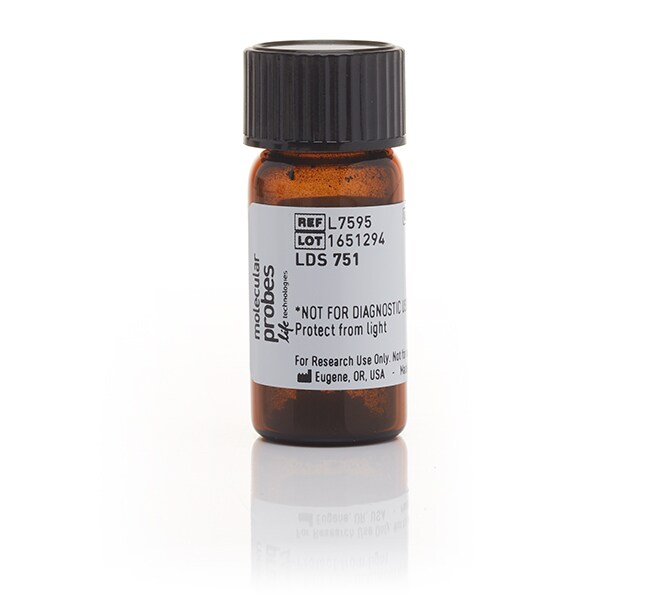
LDS 751
LDS 751
| Catalog Number | Quantity |
|---|---|
| L7595 | 10 mg |
Catalog number L7595
Price (CNY)
2,593.00
飞享价
Ends: 31-Dec-2026
3,446.00Save 853.00 (25%)
Each
Quantity:
10 mg
Price (CNY)
2,593.00
飞享价
Ends: 31-Dec-2026
3,446.00Save 853.00 (25%)
Each
LDS 751 is a cell-permeant nucleic acid stain that has a peak excitation at ∼543 nm on dsDNA and is particular useful in multicolor analyses due to its long wavelength emission maximum (∼712 nm). Binding of LDS 751 to dsDNA results in a ∼20-fold fluorescence enhancement.
For Research Use Only. Not for use in diagnostic procedures.
Specifications
Detection MethodFluorescence
Dye TypeLDS 751
Excitation Wavelength Range543⁄712
For Use With (Equipment)Flow Cytometer
FormSolid
Quantity10 mg
Shipping ConditionRoom Temperature
Product TypeNucleic Acid Stain
Sub Cellular LocalizationNucleic Acids, Nucleus
Unit SizeEach
Contents & Storage
Contains 1 vial of LDS 751 (10 mg). Store at room temperature and protect from light.
Citations & References (42)
Citations & References
Abstract
Dyes providing increased sensitivity in flow-cytometric dye-efflux assays for multidrug resistance.
Journal:Cytometry
PubMed ID:7587707
In an effort to improve detection of P-glycoprotein-mediated multidrug resistance (mdr), several dyes were compared to rhodamine 123 (R123) in efflux assays. Two dyes (SY-38 and SY-3150) were found that provided better sensitivity. These dyes were effluxed by a cell line known to be mdr-positive (P388/R84) but not by an
Modulation of platelet-neutrophil interaction with pharmacological inhibition of fibrinogen binding to platelet GPIIb/IIIa receptor.
Journal:Thromb Haemost
PubMed ID:10064007
'The study investigated how drug inhibition of the GPIIb/IIIa receptor influences the interactions between platelets and leukocytes. These interactions are believed to play an important role in the etiology of the acute coronary syndromes. Thirty patients with unstable angina or non-Q-wave myocardial infarction were studied before the administration of tirofiban
Discriminating between damaged and intact cells in fixed flow cytometric samples.
Journal:Cytometry
PubMed ID:2460298
'A vital, nucleic acid stain (LDS-751) was used to discriminate intact from damaged cells in a flow cytometer even after the samples had been fixed with paraformaldehyde. Three major cell populations with different fluorescence properties with LDS-751 were found in the fixed samples. Cells not staining or only dimly staining
The Q-Prep system: effects on the apparent expression of leucocyte cell surface antigens.
Journal:Cytometry
PubMed ID:9149913
'To facilitate the analysis of immunolabelled peripheral blood or bone marrow leucocytes by flow cytometry, a number of reagents are available commercially that lyse erythrocytes and fix leucocytes. This study has investigated the effect on antibody-labelled whole blood of the Q-Prep procedure, in which erythrocytes are lysed with formic acid,
Interaction of LDS-751 and rhodamine 123 with P-glycoprotein: evidence for simultaneous binding of both drugs.
Journal:Biochemistry
PubMed ID:16229491
'The P-glycoprotein efflux pump, an ABC superfamily member, can export a wide variety of hydrophobic drugs, natural products, and peptides from cells, powered by the energy of ATP hydrolysis. Transport substrates appear to first partition into the membrane and then interact with the protein within the cytoplasmic leaflet. Two drug