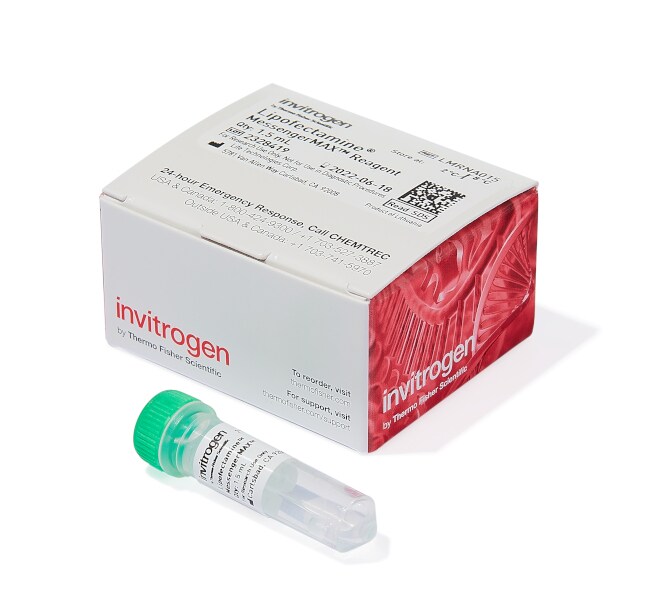
Lipofectamine™ MessengerMAX™ Transfection Reagent
Invitrogen17万+抗体限时买二赠一,靶点广,灵活用!
Lipofectamine™ MessengerMAX™ Transfection Reagent
Invitrogen™

Lipofectamine™ MessengerMAX™ Transfection Reagent

Green features
Maximize mRNA transfection with Lipofectamine MessengerMAX Transfection Reagent. This optimized lipid-based mRNA transfection reagent enables efficient mRNA delivery with a simple and scalable protocol for a wide variety of cell lines.
Have Questions?
Change viewbuttonViewtableView
Catalog NumberQuantity
LMRNA0151.5 mL
LMRNA0010.1 mL
LMRNA0030.3 mL
LMRNA0080.75 mL
LMRNA15015 mL
Catalog number LMRNA015
Price (CNY)
14,458.00
Each
Add to cart
Quantity:
1.5 mL
Price (CNY)
14,458.00
Each
Add to cart

Lipofectamine MessengerMAX mRNA Transfection Reagent delivers amazing mRNA transfection efficiency, enabling improved application outcomes and more biologically relevant research. That's because our novel lipid-based technology is optimized for efficient mRNA transfection without the nuclear entry step that is required with DNA. When combined with our mMESSAGE mMACHINE T7 mRNA Kit with CleanCap Reagent AG, superior mRNA expression is achievable in a wide range of cell types.

Successfully transfect more predictive cell models with a reagent that provides:

  • Rapid protein expression—enables quick translation of mRNA into protein, with no risk of genomic integration, accelerating experimental timelines
  • Broad cell type applicability—versatile use in a wide range of cell lines, including neurons and primary cell types
  • Minimal cytotoxicity—maintains cell viability and health, ideal for sensitive cells and long-term studies
  • High-throughput compatibility—suitable for high-throughput screening, facilitating large-scale mRNA transfection studies
  • Higher genome editing—up to 10X higher cleavage using CRISPR-Cas9 mRNA

Enable high transfection efficiency in novel genome editing applications

Lipofectamine MessengerMAX reagent helps increase the likelihood of successful cleavage and recombination through highly efficient Cas9 mRNA transfection, ultimately maximizing the efficiency of genetic modifications and simplifying the downstream processes.

Efficiently transfect difficult-to-transfect cells

Lipofectamine MessengerMAX reagent is designed for efficient mRNA transfection into neurons and a broad spectrum of difficult-to-transfect primary cells. This eliminates the need for electroporation and provides a >2-fold improvement in transfection efficiency compared to other lipid-based reagents.

Leverage advantages of mRNA transfection

mRNA transfection does not require nuclear uptake, leading to faster protein expression than DNA transfection, since mRNA translation occurs in the cytoplasm. Additionally, mRNA poses no risk of genomic integration and maintains high transfection efficiency regardless of the cell cycle stage.

Working in vivo? Try our lipid nanoparticle products Vivofectamine™ VF232 Liver LNP Composition in Ethanol (Cat. No. VF232LVCE) and Vivofectamine™ VF233 IM LNP Composition in Ethanol (Cat. No. VF233IMCE) for mRNA transfection in vivo.

For Research Use Only. Not for use in diagnostic procedures.
Specifications
For Use With (Application)Transfection
Green FeaturesSustainable packaging
Product LineLipofectamine™
Product TypeTransfection Reagent
Quantity1.5 mL
Serum CompatibleYes
Shipping ConditionRoom Temperature
Cell TypeEstablished Cell Lines, Neuronal Cells, Stem Cells, Primary Cells, Hard-to-Transfect Cells
Format6-well Plate, 12-well Plate, 24-well Plate, 48-well Plate, 96-well Plate, Flasks
Sample TypemRNA
Transfection TechniqueLipid-based Transfection
Unit SizeEach
Contents & Storage
Store in refrigerator (2–8°C).

Frequently asked questions (FAQs)

I am trying to troubleshoot our mRNA transfection process using Lipofectamine MessengerMAX Transfection Reagent. Could you tell me some reasons why we may not be seeing expression after transfection? We are using primary cells, so I am not sure if it is due to the difficulty in transfecting these cells or another cause.

There are reasons that can influence expression after transfection, but before troubleshooting all the possibilities, a transfection experiment with a positive GFP mRNA control (Tri-Link CleanCap EGFP mRNA, Cat. No. L-7201) and the Lipofectamine MessengerMAX mRNA Transfection Reagent could be the solution. If this does not yield good results, it might be best to try an alternative delivery solution or different cells. However, if this gives acceptable results, the next step would be to try the mRNA of interest with the MessengerMAX reagent. If there are expression level concerns at this point, it might be the mRNA that is being used, and troubleshooting from this perspective might be needed. For example, some questions to ask would be: Is there a 5' cap? Is there a poly(A) tail? Is the mRNA pure? Do I get a single band on a gel? Was the DNA template clean?

Find additional tips, troubleshooting help, and resources within our Transfection Support Center.

We have seen quite a bit of variation in our mRNA transfection efficiency with Lipofectamine MessengerMAX Transfection Reagent, based on the number of passages prior to transfection. Do you have advice on the best passage number?

It is normal to observe some transfection efficiency differences between cell passages.To minimized this variability, we recommend using cells between 5-20 passages. Including a positive GFP mRNA control (Tri-Link CleanCap EGFP mRNA, Cat. No. L-7201) with every transfection experiment is helpful to quantitatively determine and follow any changes in transfection efficiencies from week to week.

Find additional tips, troubleshooting help, and resources within our Transfection Support Center.

I have been getting some toxicity in my mRNA transfections using Lipofectamine MessengerMAX Transfection Reagent. What would you recommend for minimizing toxicity?

Consider including appropriate 5' UTR and 3' UTR sequences into the template design to promote mRNA stability and acceptance by the cell. Use high purity in vitro transcribed mRNA purified with the MegaClear Transcription Cleanup Kit. Ensure A260/280 ratios are between 1.8 and 2.1. Check for mRNA quality and size by agarose gel electrophoresis. In some cases, consider incorporating chemically modified nucleotides in the transcription reaction. Cell number, mRNA, and lipid quantities may need to be adjusted. Ideal viable cell density on the day of transfection is between 70 and 90% confluence. For transfection optimization tips, please visit: thermofisher.com/transfectionsupport.

Find additional tips, troubleshooting help, and resources within our Transfection Support Center.

I accidentally left my lipid reagent at room temperature. Can I still use it?

Yes, all of our lipid transfection reagents are stable at room temperature for months.

Find additional tips, troubleshooting help, and resources within our Lipid-Based Transfection Support Center.

When transfecting mRNA, does the packaging of the foreign RNA into vesicles reduce the accessibility of the mRNA for protein translation or is the mRNA all released in the cytoplasm? If packaged away, what percent is packaged vs. what percent is left to be available for translation? Is this observed with DNA plasmids?

We have not observed differences between how a cell packages an mRNA payload versus a DNA payload for the purpose of delivery. Transfection involves complex formation between a liposome and mRNA, which create lipoplexes that are taken up by the cell via endocytosis. The liposome protects the mRNA during this process and also assists in endosomal escape, which releases the mRNA into the cytoplasm of the cell. The mRNA is immediately available for translation with the ribosome. In vitro transcribed mRNA may be prepared using the mMESSAGE mMACHINE T7 Ultra Transcription Kit, which incorporates a 5' ARCA cap and a 3' poly(A) tail to mimic endogenously transcribed mRNA.

Find additional tips, troubleshooting help, and resources within our Transfection Support Center.