Search


Citations & References (4)
Invitrogen™
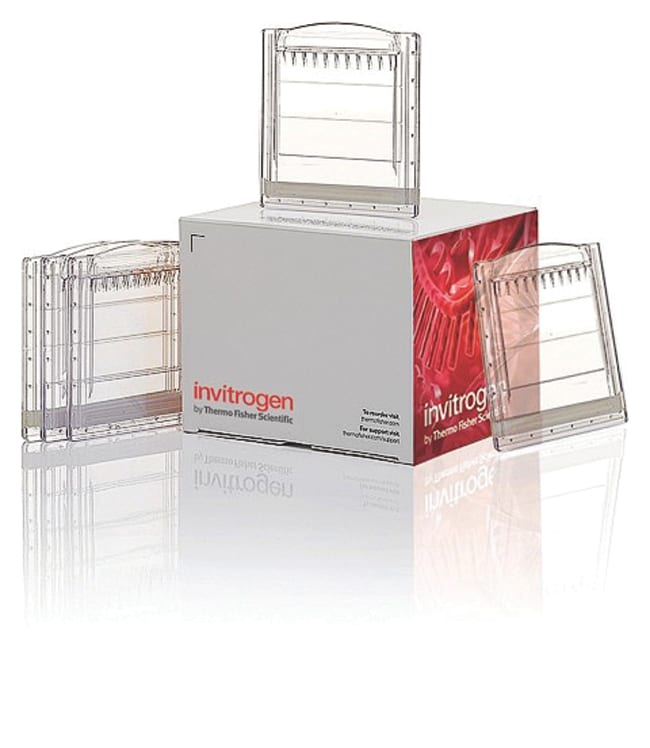
NuPAGE™ Bis-Tris Mini Protein Gels, 4–12%, 1.0–1.5 mm
Invitrogen NuPAGE Bis-Tris protein gels are precast polyacrylamide gels that provide broad molecular weight protein separation with high resolution and sample integrity.
Have Questions?
Change view

| Catalog Number | Wells | Gel Thickness | Quantity |
|---|---|---|---|
| NP0330BOX | IPG-well | 1.0 mm | 10 gels (1 box) |
| NP0321BOX | 10-well | 1.0 mm | 10 gels (1 box) |
| NP0321PK2 | 10-well | 1.0 mm | 2 gels (1 box) |
| NP0322BOX | 12-well | 1.0 mm | 10 gels (1 box) |
| NP0322PK2 | 12-well | 1.0 mm | 2 gels (1 box) |
| NP0323BOX | 15-well | 1.0 mm | 10 gels (1 box) |
| NP0323PK2 | 15-well | 1.0 mm | 2 gels (1 box) |
| NP0324BOX | 1-well | 1.0 mm | 10 gels (1 box) |
| NP0326BOX | 2D-well | 1.0 mm | 10 gels (1 box) |
| NP0327BOX | 9-well | 1.0 mm | 10 gels (1 box) |
| NP0329BOX | 17-well | 1.0 mm | 10 gels (1 box) |
| NP0329PK2 | 17-well | 1.0 mm | 2 gels (1 box) |
| NP0335BOX | 10-well | 1.5 mm | 10 gels (1 box) |
| NP0335PK2 | 10-well | 1.5 mm | 2 gels (1 box) |
| NP0336BOX | 15-well | 1.5 mm | 10 gels (1 box) |
| NP0336PK2 | 15-well | 1.5 mm | 2 gels (1 box) |
Catalog number NP0330BOX
Price (CNY)
997.00
Each
Wells:
IPG-well
Gel Thickness:
1.0 mm
Quantity:
10 gels (1 box)
Price (CNY)
997.00
Each
Invitrogen NuPAGE Bis-Tris protein gels are precast polyacrylamide gels that provide broad molecular weight protein separation with high resolution and sample integrity. These precast gels are ideal for applications where protein integrity is crucial. Unlike traditional Tris-glycine gels, NuPAGE Bis-Tris gels have a neutral pH environment that minimizes protein modifications. Use NuPAGE Bis-Tris gels for preparing proteins for sequencing, mass spectrometry, and any other techniques where protein integrity is important.
Features of NuPAGE Bis-Tris gels:
• Better protein integrity—optimized sample preparation process preserves your proteins
• Wide ranges of molecular weight separation—select the right gel and running buffer to get the optimal separation of your proteins
• Faster run times—get separation of your proteins in as little as 35 minutes
• Longer shelf life—NuPAGE Bis-Tris gels can be stored for at least 12 months at room temperature
Choose the right NuPAGE Bis-Tris gel for your protein separation
Obtain optimal separation of your proteins by choosing the right combination of gel and running buffer. NuPAGE Bis-Tris protein gels come in four polyacrylamide concentrations: 8%, 10%, 12%, and a 4–12% gradient. Gels come in two sizes: mini (8 cm x 8 cm) or midi (8.7 cm x 13.3 cm) and either 1.0 mm (mini and midi gels) or 1.5 mm (mini gel format only) in thickness. NuPAGE Bis-Tris gels also come in multiple well formats.
NuPAGE Bis-Tris gels are formulated for denaturing gel electrophoresis applications. For optimal sample preparation, use the NuPAGE LDS Sample Buffer (NP0007) and NuPAGE Sample Reducing Agent (NP0004). Use NuPAGE Antioxidant (NP0005) in the running buffer to maintain the reduced state of the proteins during the run and to allow maximum band sharpness. The gels can be run using NuPAGE MES SDS Running Buffer (NP0002) to better resolve small proteins or NuPAGE MOPS SDS Running Buffer (NP000102) to resolve medium- to large-size proteins.
For transfer of proteins to a membrane, we recommend using NuPAGE Transfer Buffer (NP00061) for traditional wet transfer using the Mini Blot Module (B1000) or XCell II Blot Module (EI9051). Alternatively, rapid semi-dry transfer can be done using the Invitrogen Power Blotter or rapid dry transfer using the iBlot 2 Gel Transfer Device (IB21001).
For Research Use Only. Not for use in diagnostic procedures.
Specifications
For Use With (Equipment)Mini Gel Tank
Gel Thickness1.0 mm
Length (Metric)8 cm
Mode of SeparationMolecular Weight
Quantity10 gels (1 box)
Sample Loading Volume7 cm strips
Shelf Life12 Months
Shipping ConditionRoom Temperature
Storage RequirementsStore at 4–25°C. Do not freeze.
Width (Metric)8 cm
Gel Percentage4 to 12%
Gel SizeMini
Gel TypeBis-Tris
Product LineNuPAGE, ZOOM
Separation Range3.5 to 260 kDa
Separation TypeDenaturing
WellsIPG-well
Unit SizeEach
Frequently asked questions (FAQs)
Can I prepare my protein sample with the reducing agent and store it for future use?
My LDS or SDS sample buffer precipitates when stored at 4 degrees C. Can I warm it up? Can I store it at room temperature?
How are Bolt gels different than NuPAGE gels?
What is the advantage of NuPAGE Gels over regular Tris-Glycine gels?
What may cause streaking on the 2nd dimension gel after IEF?
Citations & References (4)
Citations & References
Abstract
Sero-epidemiology as a tool to screen populations for exposure to Mycobacterium ulcerans.
Journal:PLoS Negl Trop Dis
PubMed ID:22253937
'Previous analyses of sera from a limited number of Ghanaian Buruli ulcer (BU) patients, their household contacts, individuals living in BU non-endemic regions as well as European controls have indicated that antibody responses to the M. ulcerans 18 kDa small heat shock protein (shsp) reflect exposure to this pathogen. Here,
Apolipoprotein A-I is a selective target for myeloperoxidase-catalyzed oxidation and functional impairment in subjects with cardiovascular disease.
Journal:J Clin Invest
PubMed ID:15314690
In recent studies we demonstrated that systemic levels of protein-bound nitrotyrosine (NO(2)Tyr) and myeloperoxidase (MPO), a protein that catalyzes generation of nitrating oxidants, serve as independent predictors of atherosclerotic risk, burden, and incident cardiac events. We now show both that apolipoprotein A-I (apoA-I), the primary protein constituent of HDL, is
Akt-mediated valosin-containing protein 97 phosphorylation regulates its association with ubiquitinated proteins.
Journal:J Biol Chem
PubMed ID:16027165
Hypoxia is a common environmental stress that influences signaling pathways and cell function. Previous studies from our laboratory have identified significant differences in cellular responses to sustained or intermittent hypoxia with the latter proving more cytotoxic. We hypothesized that differences in susceptibility of neurons to intermittent (IH) and sustained hypoxia
Epstein-Barr virus protein kinase BGLF4 is a virion tegument protein that dissociates from virions in a phosphorylation-dependent process and phosphorylates the viral immediate-early protein BZLF1.
Journal:J Virol
PubMed ID:16698993
Epstein-Barr virus (EBV) BGLF4 is a viral protein kinase that is expressed in the lytic phase of infection and is packaged in virions. We report here that BGLF4 is a tegument protein that dissociates from the virion in a phosphorylation-dependent process. We also present evidence that BGLF4 interacts with and