Search


Citations & References (23)
Invitrogen™
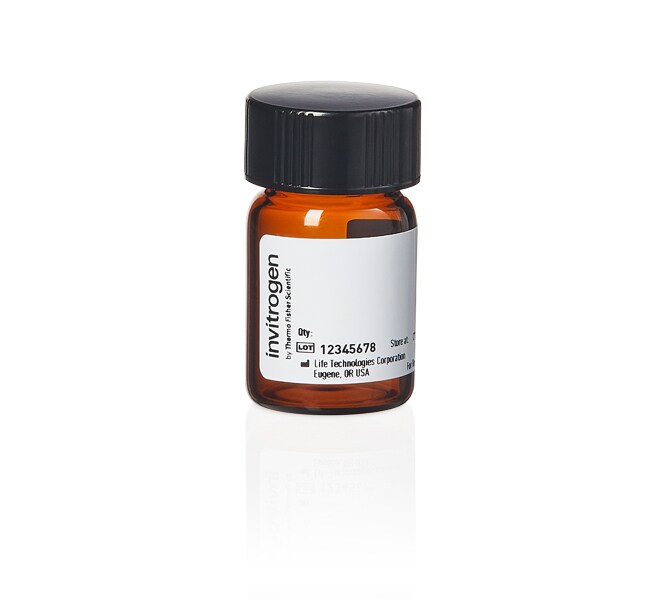
PDAM (1-Pyrenyldiazomethane)
The fluorescent diazomethyl derivative PDAM (1-pyrenylyldiazomethane) has been commonly used to derivatize biomolecules. Diazoalkane react with the addition of catalysisRead more
| Catalog Number | Quantity |
|---|---|
| P1405 | 25 mg |
Catalog number P1405
Price (CNY)
4,466.00
Each
Quantity:
25 mg
Price (CNY)
4,466.00
Each
The fluorescent diazomethyl derivative PDAM (1-pyrenylyldiazomethane) has been commonly used to derivatize biomolecules. Diazoalkane react with the addition of catalysis and may be used for direct carboxylic acid modification of proteins and synthetic polymers. Fluorescent diazoalkanes also react with phosphates. PDAM is recommended as an alternative to ADAM because it has much better chemical stability. Moreover, the detection limit for PDAM for conjugates is reported to be about 20-30 femtomoles, which is five times better than reported for ADAM conjugates.
For Research Use Only. Not for use in diagnostic procedures.
Specifications
Chemical ReactivityCarboxylic Acid
Label or DyePyrene
Product TypePDAM
Quantity25 mg
Reactive MoietyDiazoalkane
Shipping ConditionWet Ice
Label TypeClassic Dyes
Unit SizeEach
Contents & Storage
Store in freezer (-5 to -30°C) and protect from light.
Citations & References (23)
Citations & References
Abstract
Omega oxidation of 3-hydroxy fatty acids by the human CYP4F gene subfamily enzyme CYP4F11.
Journal:J Lipid Res
PubMed ID:18065749
'Long-chain 3-hydroxydicarboxylic acids (3-OHDCAs) are thought to arise via beta-oxidation of the corresponding dicarboxylic acids (DCAs), although long-chain DCAs are neither readily transported into nor beta-oxidized in mitochondria. We thus examined whether omega-hydroxylation of 3-hydroxy fatty acids (3-OHFAs), formed via incomplete mitochondrial oxidation, is a more likely pathway for 3-OHDCA
Headspace solid-phase microextraction with 1-pyrenyldiazomethane in-fibre derivatisation for analysis of faecal short-chain fatty acids.
Journal:J Chromatogr B Biomed Sci Appl
PubMed ID:10437678
'Short chain fatty acids (SFCAs) are nutritionally important products of colonic bacteria. Their analysis in faeces is problematic. We report a headspace solid-phase microextraction procedure in which faecal SCFAs are derivatised on the fibre in-situ with 1-pyrenyldiazomethane. With this method sharp, well-resolved chromatographic peaks were obtained with no interferences. Inclusion
[Highly effective separation and highly sensitive detection for clinical chemistry and biochemistry]
Journal:Yakugaku Zasshi
PubMed ID:9513578
'Highly effective separation and highly sensitive detection reagents for clinical chemistry and biochemistry were developed and their applications were investigated. The sensitive detection of carboxylic acids was accomplished using 9-anthryldiazomethane (ADAM) which gave intensely fluorescent derivatives from carboxylic acids without catalysts or heating. 1-Pyrenyldiazomethane was then synthesized and proved to
Application of capillary electrophoresis with laser-induced fluorescence detection for routine determination of methylmalonic acid in human serum.
Journal:Anal Chem
PubMed ID:7762817
'Methylmalonic acid (MMA) in serum is an established marker of cobalamin deficiency. MMA and other short-chain dicarboxylic acids react with 1-pyrenyldiazomethane to form stable, highly fluorescent 1-pyrenylmethyl monoesters. We have analyzed these esters in human blood by capillary electrophoresis (CE) combined with laser-induced fluorescence detection, and here we describe our
Enhancement of hydrolytic activity of sphingolipid ceramide N-deacylase in the aqueous-organic biphasic system.
Journal:J Lipid Res
PubMed ID:10787446
'Lysoglycosphingolipids were produced from glycosphingolipids by using sphingolipid ceramide N-deacylase, which cleaves the N-acyl linkage between fatty acids and sphingosine bases in various glycosphingolipids. The enzyme reaction was done in a biphasic media prepared with water;-immiscible organic solvent and aqueous buffer solution containing the enzyme. We investigated the effects of