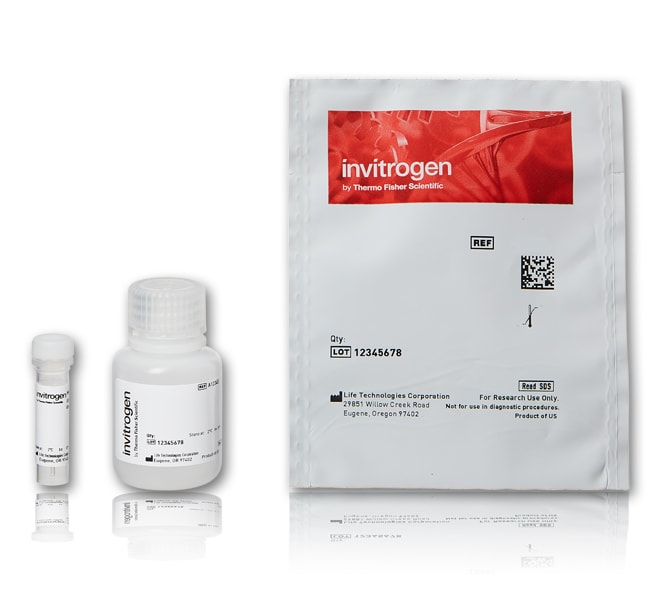
Qdot™ 525 ITK™ Streptavidin Conjugate Kit
Invitrogen™

Qdot™ 525 ITK™ Streptavidin Conjugate Kit

The Qdot™ 525 ITK™ Streptavidin Conjugate Kit provides the Qdot™ streptavidin conjugate as 250 μL of a 2 μM solution.Read more
Have Questions?
Catalog NumberQuantity
Q10041MP1 kit
Catalog number Q10041MP
Price (CNY)
11,360.00
Each
Add to cart
Quantity:
1 kit
Price (CNY)
11,360.00
Each
Add to cart
The Qdot™ 525 ITK™ Streptavidin Conjugate Kit provides the Qdot™ streptavidin conjugate as 250 μL of a 2 μM solution. Unlike the Qdot™ streptavidin conjugates, the Qdot™ ITK™ streptavidin conjugates have the streptavidin covalently attached to the inner amphiphilic coating without a PEG linker. These Qdo™ conjugates can be used for binding biotinylated probes. The kit also includes 30 mL of Qdot™ incubation buffer.
For Research Use Only. Not for use in diagnostic procedures.
Specifications
Concentration2 μM
Product TypeStreptavidin Conjugate (fluorescent)
Quantity1 kit
Shipping ConditionRoom Temperature
ConjugateQdot 525
Product LineITK, Qdot
Unit SizeEach
Contents & Storage
Store in refrigerator (2–8°C).

Frequently asked questions (FAQs)

I am getting very high background with my Qdot streptavidin conjugate. Do you have any suggestions?

Here are some suggestions: Use the Qdot Incubation Buffer (Cat. No. Q20001MP). The included buffer is formulated specifically for improved signal-to-background ratios in most immunolabeling applications using the Qdot streptavidin conjugates. Alternate buffers may result in more variable staining and, in particular, may increase background staining. However, some specific applications may require other buffer conditions. Please see the protocol "Double-labeling Using Qdot Streptavidin conjugates."
Determine if the sample has a high level of endogenous biotin. Block the sample using an avidin-biotin pre-blocking step.
If you have used the Qdot Incubation Buffer and still get high nonspecific background, then it may be necessary to check other steps of your procedure. Blocking the sample with BSA or normal animal serum will generally decrease nonspecific binding of both antibodies and Qdot streptavidin conjugates. It is a good practice to dilute your primary and secondary antibodies in the blocking buffer. Some tissues such as spleen and kidney sections may contain endogenous biotin, which may contribute to non-specific signal. Endogenous biotin can be blocked with an avidin/biotin blocking kit (Cat. No. E21390).
Grainy staining or clumps of fluorescent material appear in the background.
Occasionally the BSA within the Qdot Incubation Buffer shows slight aggregation over time. It is necessary to remove this aggregate prior to labeling the sample with the Qdot streptavidin conjugate. Spin down the incubation mixture before addition to the sample. This can be accomplished by spinning the samples in a benchtop centrifuge (Eppendorf 5415) at 5,000 x g for 2 minutes. The material can also be passed over a 0.2 µm spin filter unit before you add it to the sample for staining to remove microscopic precipitates. If you are using a buffer that is different than the Qdot Incubation Buffer, this behavior can often be attributed to higher levels of NaCl or other salts in the incubation buffer, and may not be easily fixed with filtration. In this case, reduce the overall salt concentration.
Optimize concentration of biotinylated secondary antibodies.
Optimizing specific signal can often be achieved by adjusting the level of biotinylated antibody used instaining. High levels of biotinylated antibody are necessary to obtain specific labeling, but overly high levels will contribute to nonspecific binding of the antibody to the sample. Nonspecifically bound biotinylated antibody will bind to the Qdot streptavidin conjugate, resulting in higher staining of the background.
Optimize concentration of Qdot streptavidin conjugate.
Just as titration of primary and secondary antibodies is necessary to achieve optimal specific signal in immunolabeling applications, the level of the final probe should be optimized for each conjugate. In general, concentrations at or slightly below saturation should have the optimal signal-to-background ratio, while concentrations substantially higher than saturation will compromise the assay with higher background levels.

Find additional tips, troubleshooting help, and resources within our Cell Analysis Support Center.

I am getting no signal with my Qdot streptavidin conjugate. What should I do?

Here are some suggestions:

Confirm imaging/detection setup suitability.
Make sure that you are using an appropriate filter set to detect the signal. Please consult Table 1 in the Qdot Biotin User Manual for a list of appropriate and optimal filters.
Check to see that Qdot conjugate is fluorescing using an alternative light source.
Qdot conjugates will normally fluoresce brightly under a hand-held ultraviolet lamp (long wave, such as the type used to visualize ethidium bromide on agarose gels). Although we have not seen pronounced loss of fluorescence of these materials under any storage conditions that we have investigated, we have not been able to examine all storage conditions. If the Qdot product does not appear to fluoresce under the long wave UV excitation, please contact Technical Support at techsupport@qdots.com. For a microscope, perform a spot test: place a small droplet (2 to 5 µL) of the quantum dot solution onto a clean slide (no coverslip) and examine under the appropriate filter set at low magnification.
Confirm the specificity and titer of primary antibody.
Make sure the antibody will recognize the intended targets. Make sure there is sufficient primary antibody bound to the targets. This verification can be performed by ELISA-based capture of the antigen of interest, or by other techniques that can be found in lab manuals such as the Current Protocols in Immunology.
For Qdot streptavidin conjugates, confirm biotinylation of antibody.
Make sure your antibodies are effectively biotinylated. It may be necessary to independently adjust the concentration of both the primary and secondary antibodies used in the assay to obtain optimal signal and minimal background.
PAP pen ink may quench signal.
Use an alternate method for isolating target areas on the slide. If your protocol requires the use of a PAP pen, we recommend the ImmEdge Hydrophobic Barrier Pen (Cat. No. H-4000) from Vector Labs.

Find additional tips, troubleshooting help, and resources within our Cell Analysis Support Center.

What is the best way to remove white precipitate from my ITK Qdot nanocrystals?

Spinning your ITK Qdot nanocrystals at approximately 3,000 rpm for 3-5 minutes should remove the white precipitate from the supernatant. Use the supernatant immediately.

Find additional tips, troubleshooting help, and resources within our Cell Analysis Support Center.

I see a white precipitate in my ITK Qdot nanocrystals; should I be concerned?

The precipitate in the organic ITK Qdot nanocrystals occurs with some frequency. The ITK Qdot nanocrystals sometimes include impurities that show as a white precipitate.

Find additional tips, troubleshooting help, and resources within our Cell Analysis Support Center.

Why do my Qdot nanocrystals appear to be blinking?

Blinking is an inherent property of quantum dots; in fact, all single-luminescent molecules blink, including organic dyes. The brightness and photostability of Qdot nanocrystals makes the blinking more visibly apparent. Under higher energy excitation, Qdot nanocrystals blink even faster.

Find additional tips, troubleshooting help, and resources within our Cell Analysis Support Center.

Citations & References (8)

Citations & References
Abstract
Simultaneous atomic force microscope and fluorescence measurements of protein unfolding using a calibrated evanescent wave.
Authors:Sarkar A, Robertson RB, Fernandez JM
Journal:Proc Natl Acad Sci U S A
PubMed ID:15326308
Fluorescence techniques for monitoring single-molecule dynamics in the vertical dimension currently do not exist. Here we use an atomic force microscope to calibrate the distance-dependent intensity decay of an evanescent wave. The measured evanescent wave transfer function was then used to convert the vertical motions of a fluorescent particle into ... More
Correlated light and electron microscopic imaging of multiple endogenous proteins using Quantum dots.
Authors:Giepmans BN, Deerinck TJ, Smarr BL, Jones YZ, Ellisman MH
Journal:Nat Methods
PubMed ID:16179920
'The importance of locating proteins in their context within cells has been heightened recently by the accomplishments in molecular structure and systems biology. Although light microscopy (LM) has been extensively used for mapping protein localization, many studies require the additional resolution of the electron microscope. Here we report the application ... More
Quantum-dot aptamer beacons for the detection of proteins.
Authors:Levy M, Cater SF, Ellington AD
Journal:Chembiochem
PubMed ID:16254932
Combined tyramide signal amplification and quantum dots for sensitive and photostable immunofluorescence detection.
Authors:Ness JM, Akhtar RS, Latham CB, Roth KA
Journal:J Histochem Cytochem
PubMed ID:12871979
Conventional immunofluorescence detection of biologically relevant proteins and antigens in tissue sections is often limited by relatively weak signals that fade rapidly on illumination. We have developed an immunohistochemical protocol that combines the sensitivity of tyramide signal amplification with the photostability of quantum dots to overcome these limitations. This simple ... More
Ensemble and single particle photophysical properties (two-photon excitation, anisotropy, FRET, lifetime, spectral conversion) of commercial quantum dots in solution and in live cells.
Authors:Grecco HE, Lidke KA, Heintzmann R, Lidke DS, Spagnuolo C, Martinez OE, Jares-Erijman EA, Jovin TM
Journal:Microsc Res Tech
PubMed ID:15630694
In this work, we characterized streptavidin-conjugated quantum dots (QDs) manufactured by Quantum Dot Corporation. We present data on: (1) two-photon excitation; (2) fluorescence lifetimes; (3) ensemble and single QD emission anisotropy; (4) QDs as donors for Forster resonance energy transfer (FRET); and (5) spectral conversion of QDs exposed to high-intensity ... More