Search

Thermo Scientific™
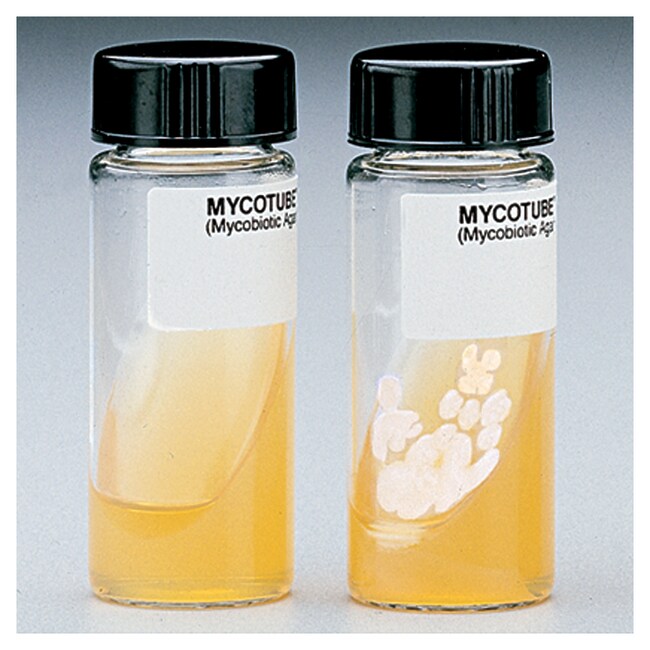
Mycobiotic Agar (MycoTube) with Chloramphenicol, Cycloheximide
Selectively isolate and cultivate the growth of pathogenic fungi from clinical specimens using Mycobiotic Agar with chloramphenicol, cycloheximide.
| Catalog Number | Format |
|---|---|
| R241055 | H |
Catalog number R241055
Price (CNY)
-
Format:
H
Selectively isolate and cultivate pathogenic fungi from clinical specimens which may be contaminated with bacteria and saprophytic fungi using Thermo Scientific™ Remel™ Mycobiotic Agar (MycoTube) with chloramphenicol, cycloheximide. The use of cycloheximide as a selective agent for inhibition of saprophytic fungi was first described by Leach, Ford, and Whitten1. In 1958, Huppert and Walker added cycloheximide and chloramphenicol to mycological agar for isolation of Coccidioides immitis2. The agar came to be known as Mycobiotic Agar3.
Mycobiotic Agar is a solid medium used for selective cultivation of fungal pathogens from diverse clinical samples and other materials contaminated with a mixed associated flora. It is recommended for recovery of dimorphic fungi and dermatophytes from clinical specimens potentially contaminated with bacteria and saprophytic fungi4,5.
- Ready to use: Convenience of prepared media.
- Selective: Cycloheximide and chloramphenicol are selective agents that inhibit saprophytic fungi and bacteria.
This medium contains soy peptone which provides nitrogen, amino acids, and peptides necessary for the growth of fungi and dextrose as a source of energy which supports the growth of fungi. Cylcoheximide inhibits rapidly growing saprophytic fungi that may overgrow slower-growing pathogens. Chloramphenicol is a broad-spectrum antibiotic which inhibits gram-positive and gram-negtaive bacteria, as well as Nocardia spp.
Not all products are available for sale in all territories. Please inquire.
Remel™ and Oxoid™ products are now part of the Thermo Scientific brand.
General References:
- Leach, B.E., J. H. Ford, and A. J. Whiffen. 1947. J. AM. Chem. Soc. 69:474.
- Huppert, M. and L.J. Walker. 1958. Am. J. Clin. Pathol. 29:291-295.
- MacFaddin, J.F. 1985. Media-for-isolation-cultivation-identification-maintainence of Medical Bacteria. Vol. 1. Williams and Wilkins, Baltimore, M.D.
- Isenberg, H.D. 2004. Clinical Microbiology Procedures Handbook, 2nd Vol. 2. ASM Press, Washington, D.C.
- Forbes, B.A., D.F. Sahm, and A.S. Weissfeld. 2007. Bailey and Scott's Diagnostic Microbiology. 12th Mosby Elsevier, St. Louis, MO.
Specifications
DescriptionMycoTube™ (Mycobiotic)
FormatH
Quantity10/Pk.
Product TypeAgar Tube
Unit SizeEach