Search


Citations & References (12)
Invitrogen™
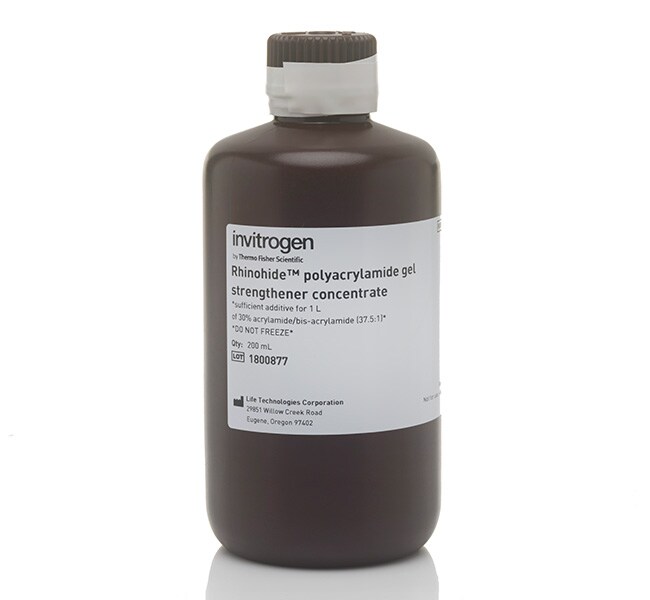
Rhinohide™ Polyacrylamide Gel Strengthener Concentrate
Rhinohide polyacrylamide gel strengthener improves upon classic polyacrylamide gel technology by making gels much stronger, providing easier handling and resistanceRead more
| Catalog Number | Quantity |
|---|---|
| R33400 | 200 mL |
Catalog number R33400
Price (CNY)
1,693.00
飞享价
Ends: 31-Dec-2026
2,375.00Save 682.00 (29%)
Each
Quantity:
200 mL
Price (CNY)
1,693.00
飞享价
Ends: 31-Dec-2026
2,375.00Save 682.00 (29%)
Each
Rhinohide polyacrylamide gel strengthener improves upon classic polyacrylamide gel technology by making gels much stronger, providing easier handling and resistance to tearing, without adverse side effects. Rhinohide polyacrylamide gel strengthener is highly recommended for low-percentage gels, large-format gels and gels subject to multiple staining and handling steps. Rhinohide polyacrylamide gel strengthener is also available in a kit (R-33410), which includes an acrylamide/bis-acrylamide mixture (37.5:1 ratio).
For Research Use Only. Not for use in diagnostic procedures.
Specifications
Quantity200 mL
Shipping ConditionRoom Temperature
Product LineRhinohide
Product TypePolyacrylamide Gel Strengthener Concentrate
Unit SizeEach
Contents & Storage
Store at room temperature.
Frequently asked questions (FAQs)
I am staining my protein gel with multiple stains over several days. How do I prevent excessive gel tearing?
Citations & References (12)
Citations & References
Abstract
Cytoskeleton/endoplasmic reticulum collapse induced by prostaglandin J2 parallels centrosomal deposition of ubiquitinated protein aggregates.
Journal:J Biol Chem
PubMed ID:16774923
'Many neurodegenerative disorders, such as Parkinson disease, exhibit inclusion bodies containing ubiquitinated proteins. The mechanisms implicated in this aberrant protein deposition remain elusive. In these disorders signs of inflammation are also apparent in the affected central nervous system areas. We show that prostaglandin J2 (PGJ2), an endogenous product of inflammation,
Regulation of class II beta-tubulin expression by tumor suppressor p53 protein in mouse melanoma cells in response to Vinca alkaloid.
Journal:Mol Cancer Res
PubMed ID:16603638
'The continuous exposure of antimicrotubule drugs to tumors often results in the emergence of drug-resistant tumor cells with altered expression of several beta-tubulin isotypes. We found that Vinca alkaloid enhanced expression of class II beta-tubulin isotype (mTUBB2) in mouse B16F10 melanoma cells via alteration of the tumor suppressor p53 protein.
Prostaglandin J2 alters pro-survival and pro-death gene expression patterns and 26 S proteasome assembly in human neuroblastoma cells.
Journal:J Biol Chem
PubMed ID:16737963
'Many neurodegenerative disorders are characterized by two pathological hallmarks: progressive loss of neurons and occurrence of inclusion bodies containing ubiquitinated proteins. Inflammation may be critical to neurodegeneration associated with ubiquitin-protein aggregates. We previously showed that prostaglandin J2 (PGJ2), one of the endogenous products of inflammation, induces neuronal death and the
Aging perturbs 26S proteasome assembly in Drosophila melanogaster.
Journal:FASEB J
PubMed ID:17413001
'Aging is associated with loss of quality control in protein turnover. The ubiquitin-proteasome pathway is critical to this quality control process as it degrades mutated and damaged proteins. We identified a unique aging-dependent mechanism that contributes to proteasome dysfunction in Drosophila melanogaster. Our studies are the first to show that
Proteomic analysis of a penicillin-tolerant rgg mutant strain of Streptococcus pyogenes.
Journal:J Antimicrob Chemother
PubMed ID:16891633
'To determine whether the transcriptional regulator Rgg contributes to penicillin-induced killing of Streptococcus pyogenes by altering a regulatory response to penicillin. Penicillin-induced killing of a wild-type and isogenic rgg mutant strain was assessed in broth and solid media and in the presence of cerulenin, which inhibits fatty acid biosynthesis (FAB).