Search


Citations & References (1)
Invitrogen™
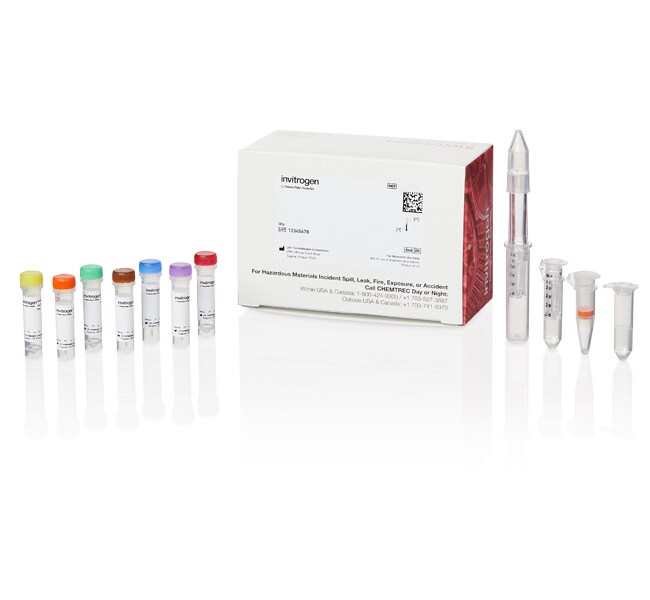
SiteClick™ Qdot™ Antibody Labeling Kits
Achieve precise and reproducible antibody labeling with SiteClick R-PE Antibody Labeling Kit.
Have Questions?
Change view

| Catalog Number | Label or Dye |
|---|---|
| S10453 | Qdot 655 |
| S10449 | Qdot 525 |
| S10454 | Qdot 705 |
| S10451 | Qdot 585 |
| S10452 | Qdot 625 |
| S10455 | Qdot 800 |
| S10469 | Qdot 605 |
Catalog number S10453
Price (CNY)
8,038.00
Each
Label or Dye:
Qdot 655
Price (CNY)
8,038.00
Each
Achieve precise and reproducible antibody labeling with SiteClick R-PE Antibody Labeling Kit. This kit targets carbohydrate domains present on all IgG antibodies, regardless of isotype or host species, ensuring site-selective labeling. The labeled antibodies are suitable for flow cytometry, fluorescence imaging, and western blot detection.
Features of the SiteClick R-PE Antibody Labeling Kit include:
- Complete kit—includes everything needed to label 100 μg of IgG antibody using a straightforward, step-by-step protocol
- Site-specific labeling—SiteClick technology attaches labels to the heavy chains of IgG antibodies under mild conditions, preserving antigen-binding domains
- Consistent results—the gentle, site-selective attachment to heavy-chain N-linked glycans ensures reproducibility across sequential labelings and different antibodies, without harsh reduction steps
- Efficient protocol—easy-to-follow steps requiring minimal hands-on time
- High-quality conjugates—produces highly efficient, site-specific, and reproducible antibody conjugates
Unlike traditional amine or thiol labeling, which can affect antigen binding domains or antibody structure, SiteClick labeling technology maintains the integrity of the antibody. This ensures that antigen binding sites remain available for target binding, providing consistent and reproducible labeling. The workflow utilizes copper-free click chemistry to covalently link the DIBO moiety with the azide-modified antibody, ensuring uniform labeling without the need for reaction optimization.
With the SiteClick R-PE Antibody Labeling Kit, you can confidently achieve consistent, high-quality labeling every time.
For Research Use Only. Not for use in diagnostic procedures.
Specifications
ColorFar-Red
Excitation/Emission405/655
Filter TypeQdot 525-800
Flow Cytometer Laser LinesUV, Violet, Blue, Green, Yellow
Kit ContentsContains everything needed to azido modify and label 100 μg of antibody.
Labeling MethodSiteClick Labeling System
Labeling Scale100 μg
Product LineQdot, SiteClick
Product TypeLabeling Kit
Quantity1 kit
Shipping ConditionWet Ice
Labeling TargetIgG
Label or DyeQdot 655
Unit SizeEach
Contents & Storage
Store the entire kit at 2 to 6°C upon receipt
Frequently asked questions (FAQs)
I need to label my tissue section with two mouse primary antibodies. Do I have to make direct conjugates of the antibodies to use them?
What is the best way to remove white precipitate from my ITK Qdot nanocrystals?
I see a white precipitate in my ITK Qdot nanocrystals; should I be concerned?
Why do my Qdot nanocrystals appear to be blinking?
My Qdot nanocrystals were brightly fluorescent before I mounted my samples; now I'm seeing a loss of fluorescence. Why is this happening?
Citations & References (1)
Citations & References
Abstract
Enzyme-mediated methodology for the site-specific radiolabeling of antibodies based on catalyst-free click chemistry.
Journal:
PubMed ID:23688208
'An enzyme- and click chemistry-mediated methodology for the site-selective radiolabeling of antibodies on the heavy chain glycans has been developed and validated. To this end, a model system based on the prostate specific membrane antigen-targeting antibody J591, the positron-emitting radiometal (89)Zr, and the chelator desferrioxamine has been employed. The methodology