Search


Citations & References (4)
Invitrogen™
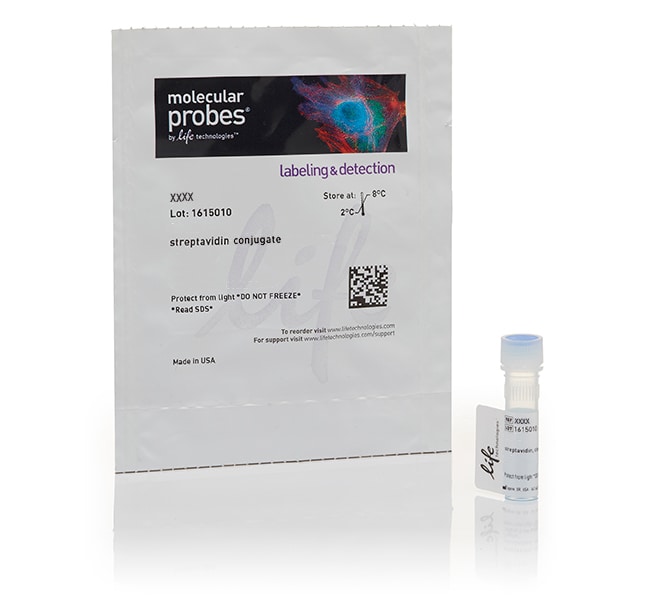
Streptavidin, Alexa Fluor™ 405 conjugate
Our streptavidin, Alexa Fluor 405 conjugate is a bright, photostable probe with excitation/emission maxima of 402 and 421 nm. StreptavidinRead more
| Catalog Number | Quantity |
|---|---|
| S32351 | 1 mg |
Catalog number S32351
Price (CNY)
4,770.00
Each
Quantity:
1 mg
Price (CNY)
4,770.00
Each
Our streptavidin, Alexa Fluor 405 conjugate is a bright, photostable probe with excitation/emission maxima of 402 and 421 nm. Streptavidin is a nonglycosylated biotin-binding protein that is isolated from bacteria and has a near-neutral isoelectric point. It is widely used to detect biotinylated probes, because it reportedly exhibits less nonspecific binding than does the glycosylated, biotin-binding protein, avidin.
View a selection guide for all Alexa Fluor™ streptavidin and avidin conjugates.
View a selection guide for all Alexa Fluor™ streptavidin and avidin conjugates.
For Research Use Only. Not for use in diagnostic procedures.
Specifications
Detection MethodFluorescence
Excitation/Emission402/421
Flow Cytometer Laser Lines405
For Use With (Equipment)Flow Cytometry, Immunoassays, Histochemical Applications, Blot Analysis
Label or DyeAlexa Fluor 405
Product TypeStreptavidin Conjugate (Fluorescent)
Quantity1 mg
Shipping ConditionRoom Temperature
ConjugateAlexa Fluor 405
FormSolid
Product LineAlexa Fluor
Unit SizeEach
Contents & Storage
Contains 1 vial of streptavidin Alexa Fluor™ 405 conjugate.
Store in freezer (-5 to -30°C) and protect from light.
Store in freezer (-5 to -30°C) and protect from light.
Frequently asked questions (FAQs)
I am planning to use a fluorescent streptavidin labeled conjugate. What are the storage conditions and shelf life for the lyophilized powder and reconstituted solution?
I am planning to use a fluorescent streptavidin labeled conjugate. How should I prepare the working solution of the conjugate?
Citations & References (4)
Citations & References
Abstract
Violet laser diodes in flow cytometry: an update.
Journal:Cytometry A
PubMed ID:17051581
INTRODUCTION: In previous studies we and others have demonstrated the usefulness of violet laser diodes (VLDs) as replacement laser sources for krypton-ion lasers on stream-in-air cytometers. Previously available VLDs had a maximum available power of less than 25 mW; this was sufficient for excitation of densely labeled cell surface antigens
Novel strategy to selectively label excitatory and inhibitory neurons in the cerebral cortex of mice.
Journal:J Neurosci Methods
PubMed ID:18321591
Revealing the connections of neuronal systems is critical for understanding how they function. The vast majority of neurons in all cortical areas consist of excitatory cells whose activity is controlled by inhibitory cells. Distribution and projection patterns of inhibitory and excitatory cells are key information to understand the organization of
Endosomal trafficking of the ligated FcvarepsilonRI receptor.
Journal:Mol Immunol
PubMed ID:18945491
In addition to initiating signaling cascades leading to mast cell mediator release, aggregation of the high affinity IgE receptor (FcvarepsilonRI) leads to rapid internalization of the cross-linked receptor. However, little is known about the trafficking of the internalized FcvarepsilonRI. Here we demonstrate that in RBL-2H3 cells, aggregated FcvarepsilonRI appears in
Inducible gene targeting in the neonatal vasculature and analysis of retinal angiogenesis in mice.
Journal:Nat Protoc
PubMed ID:20725067
The retina is a powerful experimental system for the analysis of angiogenic blood vessel growth in the postnatal organisms. The three-dimensional architecture of the vessel network and processes as diverse as endothelial cell (EC) proliferation, sprouting, perivascular cell recruitment, vessel remodeling or maturation can be investigated at high resolution. The